

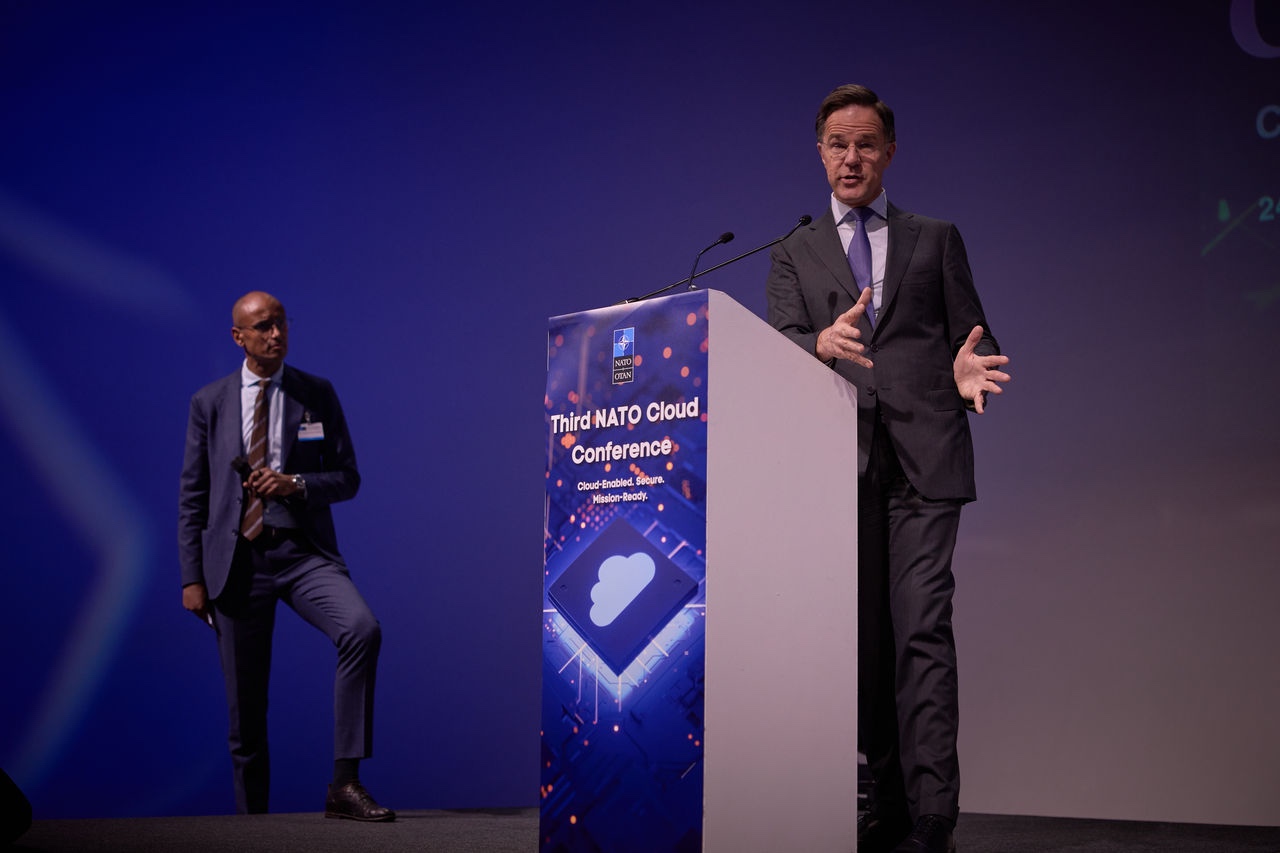
Speaking to some 500 delegates from governments, industry and academia, Rutte emphasised a simple yet powerful principle: “There simply is no strong defence without a strong and also an innovative industry.” His message was clear — NATO must modernise swiftly to keep pace in an age defined not just by tanks and aircraft, but by algorithms and data.
Rutte’s remarks came amid rising geopolitical tension, with NATO citing growing threats from Russia, China, North Korea and Iran. According to the secretary-general, adversaries are making rapid advances in artificial intelligence and quantum computing — two technologies that could reshape warfare in the decades ahead. “We must accelerate cloud adoption — or we will fall behind,” he insisted.
To that end, NATO is pushing hard on its Cloud and Edge Computing Policy as well as on Project ACE (Allied Software for Cloud and Edge Services), which seeks to make data-sharing among member states faster, more secure and more resilient. Rutte urged decisive implementation, arguing that seamless data flow is now vital for quick, coordinated decision-making.
One of the more compelling arguments in his address was drawn from recent history. Rutte cited Ukraine’s cloud migration, which helped Kyiv mitigate the impact of Russian cyber-attacks by decentralising its data infrastructure. This, he said, offers a model — and a warning — for NATO: rapid, secure cloud adoption is not just a technological luxury, but a strategic necessity.
The NATO chief also pointed to previous Alliance decisions made at the summit in The Hague, including the commitment by member states to spend 5 per cent of GDP on defence by 2035, as a crucial enabler for funding digital innovation. The implication is unmistakable: digital capability is no longer optional, but central to future deterrence.
Rutte addressed a perennial concern: sovereignty over data. As NATO grooms its next-generation cloud, he argued, it must strike a delicate balance between national control and collective power. Cloud scalability and edge computing, he maintained, can deliver both — offering the speed needed in wartime alongside the resilience that comes from distributed infrastructure.
He praised NATO’s move toward a “zero-trust” model of security — where every data connection is verified — and urged the adoption of standardised frameworks for data governance. This, he said, will underpin not only operational interoperability but also trust among allies.
For all the ambition, Rutte insisted that NATO must ensure that its digital promises translate into real-world capability. He called on industry to work more closely with NATO’s commands, not just to produce new technologies, but to embed them rapidly into operational processes.
That means edge computing, but also a radical re-think of development cycles — breaking down the silos between software and hardware, speeding up experimentation, and accepting that innovation must be delivered incrementally.
NATO’s Allied Command Transformation (ACT) has echoed the same message in recent forums: the Alliance must “train as you fight,” and use exercises to test and validate new cloud-based capabilities across domains. This is more than modern defence; it is digital deterrence.
The NATO Cloud Conference has also shone a spotlight on the vital role that private sector partners will play in this digital transformation. Rutte urged firms to see themselves not just as contractors, but as strategic drivers — and to move fast.
Indeed, NATO’s Communications and Information Agency (NCIA) is already stepping up. Recent industry partnerships aim to replace legacy infrastructure with highly secure, modern private-cloud networks. These networks, NATO argues, are critical to ensuring resilience in the face of sophisticated cyber and hybrid threats.
Meanwhile, cloud engineering is rapidly becoming a key part of NATO’s future force posture. The alliance’s Digital Policy Committee continues to hammer out standards and governance frameworks that will shape how data flows and decisions are made across the entire NATO architecture.
Mark Rutte’s speech in Brussels was not mere rhetoric: it was a clarion call for NATO to treat digital infrastructure as frontline defence. The scale of his ambition reflects a recognition that future conflict will not be won by firepower alone, but by speed, data and collaboration.
If NATO is to succeed in this digital era, it must keep its foot on the accelerator — pushing edge computing, cloud adoption and software interoperability in tandem with defence investment. Industry must continue to step forward, not as a supplier, but as a partner. Member states must deliver on funding and resist fragmentation.
This is a transformation not just of technology, but of mindset. The cloud conference made it clear that NATO’s future battlefield may very well be virtual — but the stakes could scarcely be more real. As Rutte reminded his audience, in a world defined by accelerating innovation, the Alliance that dares to lead in the cloud may very well define what it means to be secure tomorrow.
Main Image: NATO



Britain’s Consistent Message on Ukraine Carries Growing Weight at the OSCE