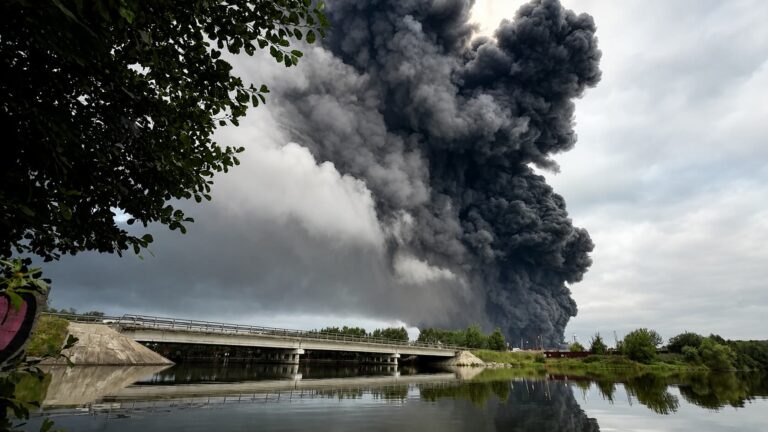
Open-source imagery and Russian regional reporting indicate that a large aircraft caught fire on the apron, with extensive secondary explosions and a prolonged blaze visible from the city.censor.net+1 Ukrainian and independent defence analysts say the burning aircraft is almost certainly the Beriev A-60 – a highly unusual airborne laser laboratory of which only two were ever built.
The A-60 is a Soviet-era experimental platform based on the Il-76 transport airframe, rebuilt to house a megawatt-class laser and associated power generation equipment. It was designed to research the propagation of laser beams in the upper atmosphere and to test concepts for anti-satellite and missile-defence applications. According to technical histories, the second and last A-60 testbed, designated 1A2, was reactivated in the 2000s and has been observed regularly at Taganrog in recent years.
Militarnyi, a Ukrainian defence outlet, reported that the aircraft was struck during a drone attack on the Beriev plant, describing it as a flying laboratory used to test the 1LK222 “Sokol Eshelon” airborne laser system. The A-60 entry on several open sources was updated on Tuesday to list its status as “destroyed in a Ukrainian drone strike on Taganrog”. Russian authorities have not formally confirmed the loss, but video from residents shows a large four-engined aircraft engulfed in flames at the airfield.
At the same time, a major fire broke out in at least one large hangar within the Beriev complex, which serves as Russia’s principal centre for developing and overhauling special-mission aircraft such as the A-50 and A-100 airborne early-warning fleets. Ukrainian and Western defence sources suggest the affected facility is also involved in the modernisation of Tu-95MS strategic bombers to the Tu-95MSM standard, including work on aircraft that carry Kh-101 cruise missiles used in repeated strikes against Ukraine.
Some Ukrainian commentators, citing leaked Russian procurement documents, argue that a Tu-95MS may have been inside the damaged hangar at the time of the attack, but this point remains unconfirmed. Satellite imagery and further battle-damage assessment are likely to clarify the extent of the loss in the coming days.
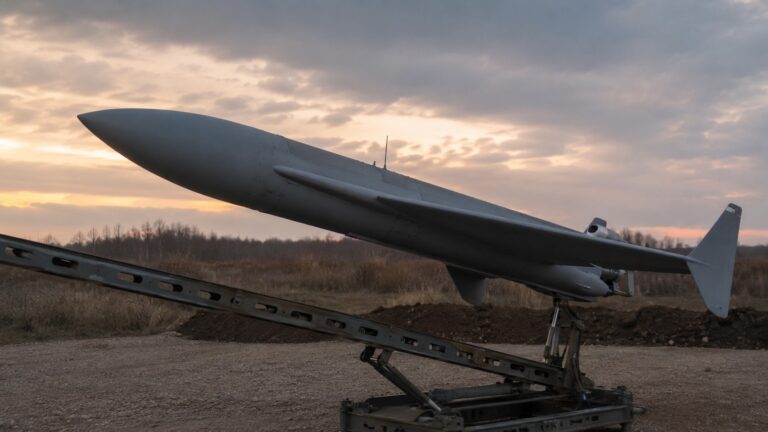
Ukraine’s General Staff stated that domestically produced “Bars” long-range drones and Neptune missiles were used in a series of overnight strikes against Russian military-industrial and fuel infrastructure, including targets in Rostov and Krasnodar regions, oil facilities and drone-production sites. Russian officials reported what they described as a “massive” Ukrainian UAV attack across several southern regions.
Rostov governor Yury Slyusar said three people were killed in Taganrog – one at the scene and two later in hospital – and several others were injured. Local authorities reported damage to educational and residential buildings in the city.
The Beriev complex at Taganrog has long been a core element of Russia’s high-end aviation capability. It designs and supports amphibious aircraft and special-mission platforms; its workshops have handled A-50 airborne early-warning aircraft, the next-generation A-100, and modernised Tu-95MSM bombers. The plant has previously been reported as damaged in earlier Ukrainian drone operations, but the latest strike appears to have hit both infrastructure and high-value airframes at once.
If confirmed, the destruction of the A-60 would remove Russia’s only active airborne laser testbed. Defence analysts note that the programme was intended to explore methods for blinding or disrupting adversary reconnaissance satellites and ballistic targets, complementing ground-based laser efforts. The loss therefore affects not only Russia’s current fleet but also its long-term research and development in directed-energy systems.
The reported hit on a Tu-95 modernisation hangar, together with the damage to the Beriev plant, would also complicate efforts to sustain Russia’s already limited inventory of airborne early-warning aircraft and ageing turboprop bombers. Russia has only a small number of operational A-50s, several of which have been destroyed or damaged in separate incidents since 2023.
The overnight exchange did not occur in isolation. While Ukraine struck Taganrog and other targets in southern Russia, Moscow launched another wave of missile and drone attacks against Kyiv and other Ukrainian cities. In the capital, at least six people were reported killed and many more injured after residential buildings and infrastructure were hit, with fires breaking out in several high-rise blocks.
Ukrainian officials and military commentators link the intensification of deep-strike drone operations with uncertainty over future Western weapons supplies. In 2025 the Trump administration has repeatedly paused deliveries of key air-defence interceptors and GMLRS guided rockets to Ukraine, citing concerns about US stockpiles, before partially resuming them. Kyiv has responded by accelerating domestic production of long-range attack drones and missiles and by expanding its target set inside Russia to include defence-industrial facilities.
For Russia, the Taganrog incident underscores the vulnerability of high-value assets well beyond the immediate front line, despite extensive deployments of S-300 and S-400 air-defence systems in the region. For Ukraine, it represents a further attempt to degrade Russia’s capacity to conduct long-range strikes and to develop advanced sensing and space-denial capabilities.