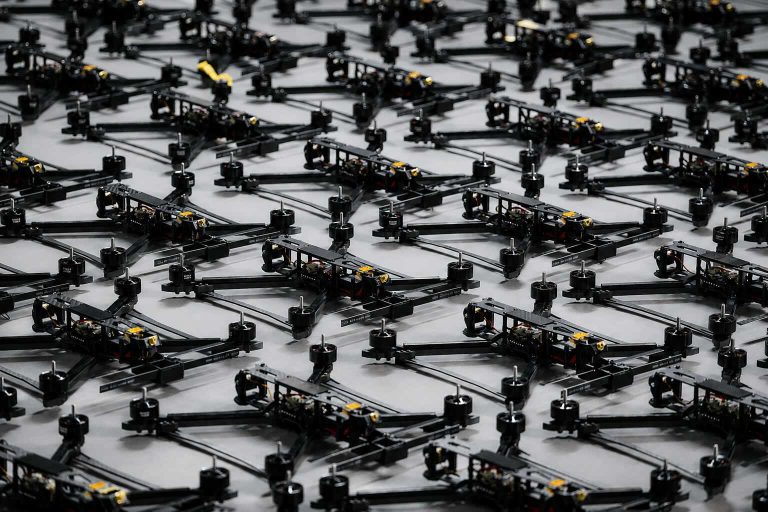
At its heart, Project NYX is emblematic of the UK’s Strategic Defence Review’s vision: a deliberate pivot towards uncrewed systems that augment existing capabilities and better prepare the British Army for the complexities of 21st-century conflict. These advanced systems are intended to behave as “loyal wingmen”, carrying out tasks ranging from reconnaissance and surveillance to strike roles and electronic warfare — all while remaining flexible and resilient in contested environments.
On 24th January 2026, the Ministry of Defence announced the first major milestone: seven British and UK-based defence partners have been invited to submit designs for prototype drones. The cohort of industry heavyweights includes Anduril, BAE Systems, Leonardo, Lockheed Martin UK, Syos, Tekever and Thales. This selection follows a rigorous pre-qualification phase completed at the end of 2025.
The importance of this initiative is not simply technological, but strategic. In an era where military forces worldwide are racing to harness autonomy, Britain’s defence establishment views Project NYX as crucial to maintaining and extending its operational edge — particularly as threats evolve and adversaries field increasingly sophisticated unmanned systems. By the government’s own account, the programme is designed to enhance lethality, survivability and mission effectiveness while reducing risk for human operators on the battlefield.
Yet the significance of this development resonates far beyond the battlefield. Defence Secretary Luke Pollard, who has championed Project NYX, has underscored its industrial and economic dividends as much as its military utility. In public remarks, he framed the programme as part of a wider strategy to support British industry and ensure the UK remains at the forefront of autonomous military technology — a strategic imperative that also serves jobs and the national industrial base.
March 2026 is a key date on the project’s roadmap. That month, the original shortlist of seven will be trimmed to four companies, each to be offered contracts that will fund research and development toward full concept demonstrators. The goal, according to defence planners, is to achieve initial operational capability by around 2030.
This timeline underscores the ambitious nature of the programme. Developing systems capable of autonomous decision-making — within mission parameters — and robust enough to operate in contested airspace is no small undertaking. The drones are envisioned to follow a “command rather than control” philosophy, wherein their onboard artificial intelligence enables them to adapt to dynamic battlefield conditions without constant human input.
Project NYX does not exist in isolation. It sits alongside other elements of a broader revitalisation of British drone strategy. For example, the UK Defence Innovation (UKDI), established under the Strategic Defence Review, has committed hundreds of millions of pounds into drone and counter-drone technologies, from autonomous submarine hunters to air-launched systems and directed-energy weapons.
At the Royal Navy’s Predannack airfield in Cornwall, another symbol of this technological leap has already taken to the skies. The Proteus autonomous helicopter, developed by Leonardo, achieved its maiden autonomous flight in January 2026, representing one of the first full-size uncrewed helicopters ever to fly. It is intended to operate as part of a future “hybrid air wing”, and plays a central role in the UK’s Atlantic Bastion strategy, which seeks to secure the North Atlantic against evolving maritime threats.
This convergence of innovation highlights a broader shift in defence doctrine. Uncrewed systems are no longer adjuncts but integral parts of military planning; they are being woven into air, land and sea domains to complement traditional capabilities. The emphasis is on networked, intelligent platforms that can operate alongside human crews while taking on high-risk tasks that would otherwise place personnel in harm’s way.
Critically, these programmes also underscore the UK’s desire for industrial sovereignty. By backing British firms and nurturing home-grown technological expertise, the government aims to ensure that it can design, build and sustain leading-edge military systems without undue reliance on foreign supply chains. This drive dovetails with recent announcements about new drone manufacturing hubs and partnerships that underscore the defence sector’s role as an engine of British economic growth.
The path to fully realised autonomous combat wingmen is nonetheless fraught with technical and ethical challenges. Balancing autonomy with command oversight, integrating new systems into existing force structures, and ensuring compliance with international law and norms are ongoing concerns. Yet for now, Project NYX stands as a clear marker of British ambition — a venture that not only reimagines how future wars might be fought but also how Britain positions itself in the ever-accelerating race for technological supremacy.
In the crucible of modern geopolitics, where the importance of unmanned systems has been underscored by recent conflicts and technological breakthroughs alike, London’s commitment to this project signals a confident embrace of the future — one where skies are shared by men and machines operating in concert under a unified strategic vision.
Royal Navy’s crewless helicopter could not have come at a more urgent moment