Ukraine says two Kalibr-armed frigates, a Buyan-M missile ship and a Project 22160 patrol vessel were damaged at Novorossiysk. Satellite analysis indicates that the combined missile, aerial-drone and maritime attack may have reached additional ships and submarine-support infrastructure inside the heavily defended base.
Ukraine’s 12 August strike on Novorossiysk damaged four Russian warships, according to a subsequent assessment by the Ukrainian General Staff, giving a clearer picture of the scale of an operation that combined missiles, aerial drones and unmanned maritime systems against Russia’s principal Black Sea naval base.
The General Staff identified the Project 11356R frigates Admiral Makarov and Admiral Essen, a Project 21631 Buyan-M small missile ship and the Project 22160 patrol vessel Vasily Bykov as having suffered varying degrees of damage. Kyiv said the assessment remained preliminary.
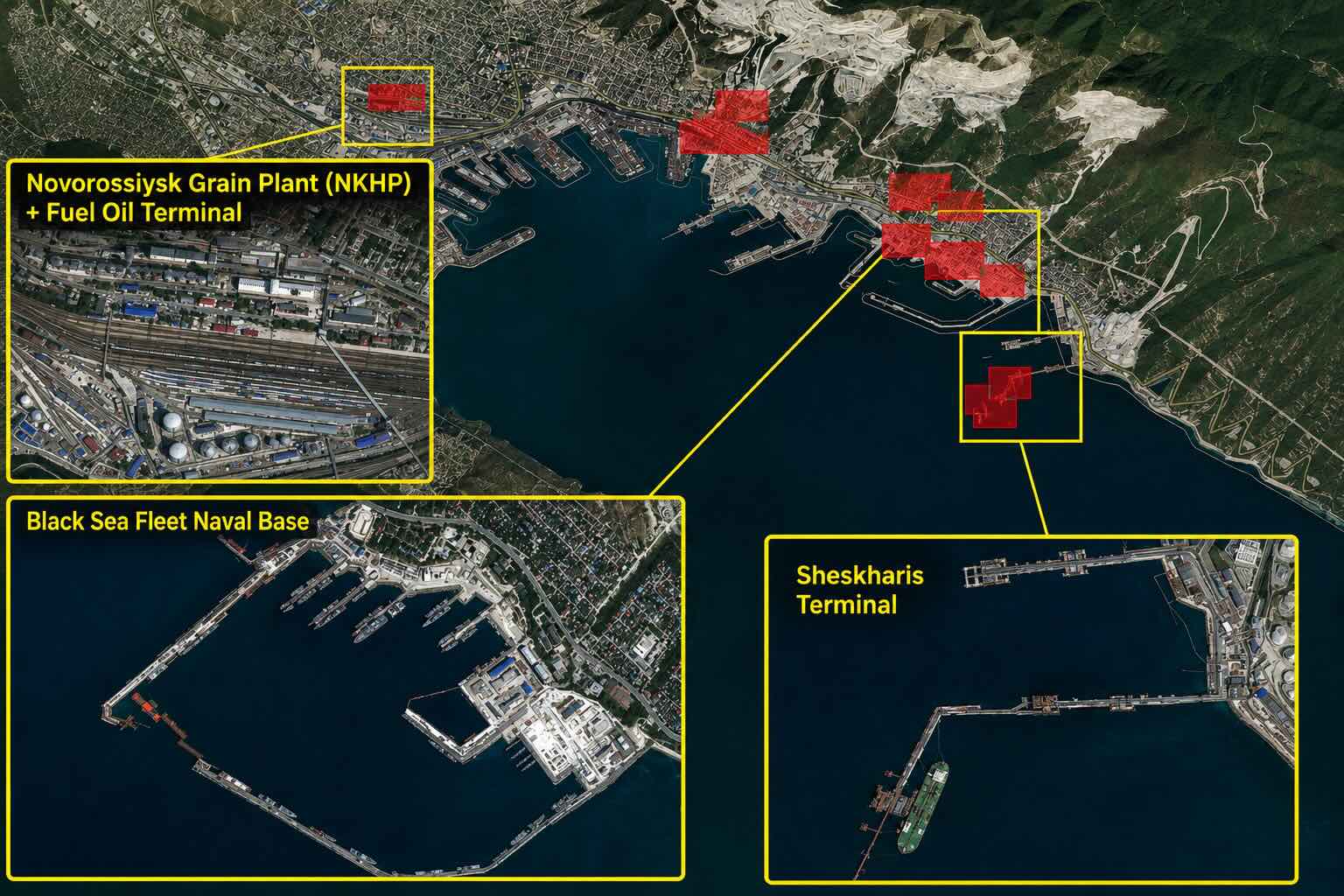
The SBU subsequently confirmed damage to both frigates and Vasily Bykov, while also reporting strikes against the base’s defensive and logistical infrastructure. The targets included a 30N6E radar forming part of an S-300 air-defence system, a mobile firing group on Pier No 2, infrastructure at Piers 3, 6 and 7 and the tunnel portal linking the Grushovaya oil depot with the Sheskharis terminal.
The combination matters as much as the individual targets. President Volodymyr Zelenskyy said the operation involved Palianytsia jet-powered drones, Neptune missiles and unmanned maritime systems. Attacking air-defence components, ships and port infrastructure within the same operation presented the defenders with threats arriving through different domains rather than a single class of weapon.
The two Project 11356R frigates are among the most capable surface combatants remaining available to Russia in the Black Sea. Both carry eight universal vertical-launch cells capable of employing Kalibr cruise missiles.
An assessment of post-strike satellite imagery by Exilenova+ and CyberBoroshno identified apparent damage to Admiral Makarov around the Kalibr launcher area and the aft superstructure, where radar systems are installed. Admiral Essenshowed apparent damage around its own missile-launch section.
Satellite imagery cannot by itself establish whether either frigate has lost its ability to launch missiles. Damage near the vertical-launch complex, sensors or associated electronics could nevertheless remove a ship from operational service even without catastrophic hull damage. The distinction between a vessel being hit and being rendered combat-ineffective will therefore depend on later imagery, movements from its berth and repair activity.
Both ships had already been reported damaged in previous Ukrainian attacks on Novorossiysk earlier in 2026. Ukraine’s General Staff confirmed damage to the two frigates following a March strike, while Admiral Essen was subsequently reported hit again in April.
The latest satellite assessment identifies possible damage beyond the four vessels named by the General Staff. Exilenova+ and CyberBoroshno reported apparent hits on a Project 266M minesweeper, the Project 20360 OS trials vessel Viktor Cherokov and the Project 864 intelligence ship Priazovye. The analysts also identified an unidentified cargo vessel and several impacts on shore infrastructure belonging to the 4th Submarine Brigade.
Those additional vessel assessments remain unconfirmed. They should therefore be separated from the four ships that Ukraine’s General Staff says were damaged and the three specifically confirmed by the SBU.
That distinction does not reduce the operational importance of the attack. Novorossiysk became increasingly important to the Black Sea Fleet after Ukrainian missile and unmanned-system attacks made Sevastopol considerably more difficult for Russia to use as a secure base for major surface ships. Previous Ukrainian operations have already demonstrated that relocation eastwards did not place the fleet beyond the range of Ukrainian strike systems.
The reported strike on the S-300 radar is particularly relevant when considered alongside damage inside the harbour. A naval base is protected not merely by shipboard systems but by shore-based air defence, electronic warfare, observation, physical barriers and local firing positions. Ukraine says both the defensive layer and the vessels it was intended to protect were hit during the same operation.
Russia can strengthen individual elements of the defence around Novorossiysk, disperse ships or increase the frequency with which vessels change berths. Each measure, however, imposes additional demands on personnel, air-defence systems and port operations.
The immediate question is therefore not how many vessels show visible marks on satellite photographs, but how many remain capable of performing their assigned missions. Confirmation that either Project 11356R frigate or the Buyan-M has been removed from operational service would directly affect the pool of Black Sea Fleet vessels capable of carrying Kalibr missiles.
Even if the damage proves repairable, the 12 August operation demonstrates that concentrating surviving Black Sea Fleet assets at Novorossiysk has created a new problem for Moscow: the harbour that absorbed ships withdrawn from Crimea is itself now repeatedly within reach of Ukraine’s expanding combination of long-range and maritime strike systems.