Ukraine says its forces have regained more than 745 square kilometres of territory and 26 settlements during an offensive operation conducted since January along the Oleksandrivka sector of the south-eastern front.
President Volodymyr Zelenskyy announced the results on Wednesday after receiving a report from Commander-in-Chief of the Armed Forces Mykhailo Drapatyi, Chief of the General Staff Ihor Skybiuk and Air Assault Forces commander Oleh Apostol.
According to the official account of the commanders’ report to Zelenskyy, the operation ran from January to August and was intended to halt further Russian advances and push Russian forces back beyond the administrative boundary of the Dnipropetrovsk region.
The Ukrainian military subsequently provided a more detailed account. The Air Assault Forces said the operation began on 29 January and remains under way, adding that Ukrainian units had restored control over more than 745 sq km while conducting operations against Russian troops that had infiltrated rear areas covering a further 300 sq km.
The 26 settlements identified by Kyiv are spread across three regions: 12 in Dnipropetrovsk, ten in Donetsk and four in Zaporizhzhia.
The official Ukrainian list includes Tovste, Novokhatske, Hrushivske, Zirka, Zelenyi Hai, Piddubne, Myrne, Tsehelne, Pryvillia, Zlahoda, Krasnohirske, Pryvilne, Novohryhorivka, Stepove, Kalynivske, Berezove, Novomykolaivka, Voskresenka, Oleksandrohrad, Yalta, Rybne, Maliivka, Sichneve, Ternove, Novoheorhiivka and Zaporizke.
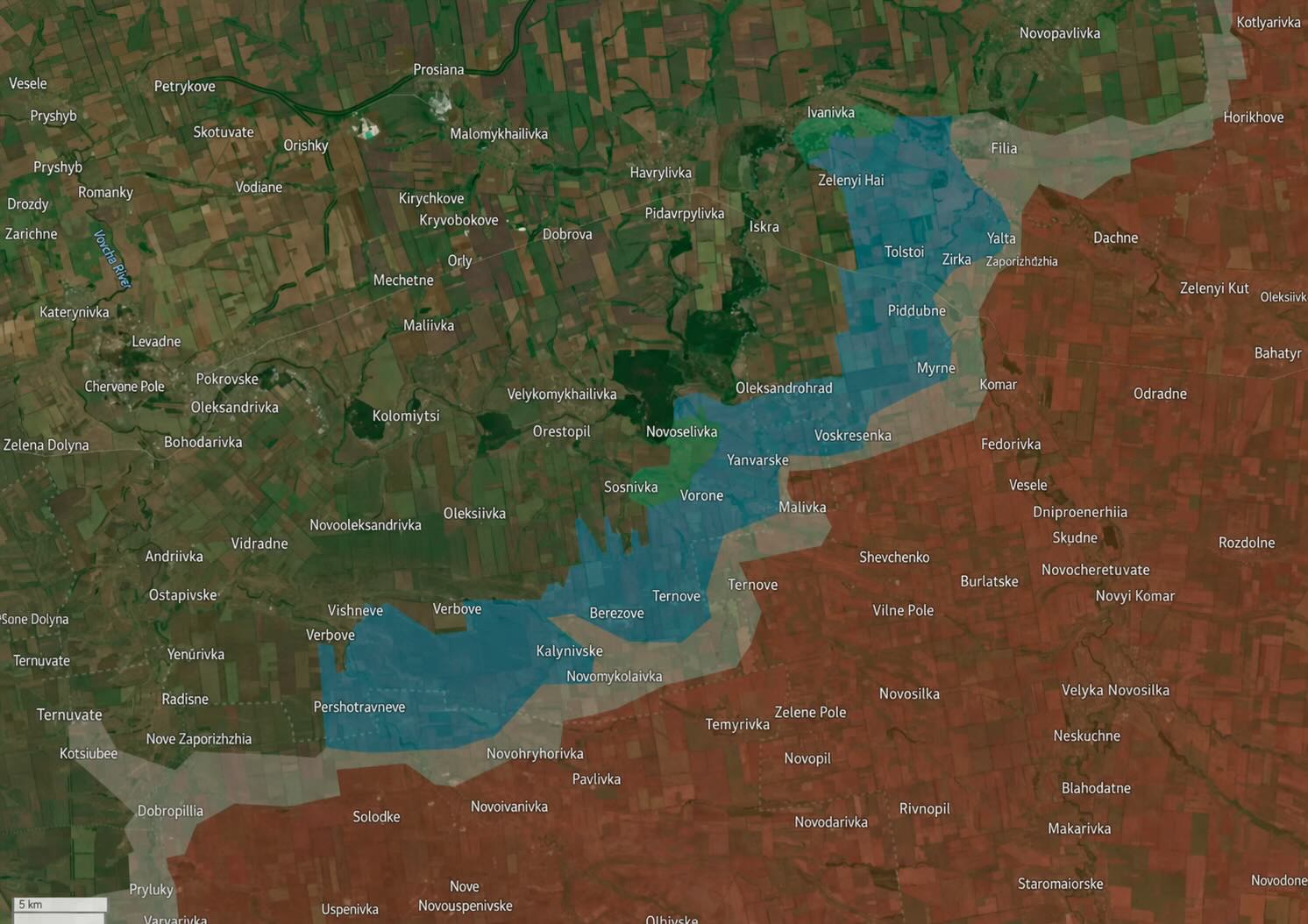
The settlements lie along an approximately 60-kilometre section of the front around the point where Dnipropetrovsk, Donetsk and Zaporizhzhia regions meet. Independent reporting has confirmed that the Ukrainian announcement concerns a prolonged counter-offensive rather than territory captured in a single breakthrough.
The distinction is important. The original Ukrainian account describes an operation conducted over more than six months, with advances taking place at different stages and only now being presented publicly as a single operational result. The source material provided for this article likewise describes the gains as accumulated between January and August rather than occurring in one recent attack.
The scale of the Ukrainian advance is broadly visible on the DeepState battlefield map, which tracks changes in territorial control using open-source information and information supplied from the front.
Its assessment, however, is more cautious than Kyiv’s announcement. DeepState’s latest mapping indicates that Ukrainian forces have restored control over 19 settlements and pushed Russian troops back in another six. Some territory covered by the Ukrainian announcement remains classified as a grey zone where neither side has established firm control, while other areas are still marked as Russian-held.
That discrepancy does not necessarily mean that the Ukrainian military and DeepState are describing different events. Battlefield maps often lag behind military announcements while territorial control is being verified, particularly during active operations.
The Air Assault Forces themselves acknowledged the need for caution when interpreting footage from the operation. In their detailed account of the offensive, they said that some Ukrainian flags shown in accompanying video had been raised at safe distances from the actual positions of Ukrainian troops for security reasons.
Ukraine also reported substantial Russian casualties during the operation.
The presidential statement put Russian losses at at least 9,550 personnel killed and more than 6,600 wounded. Zelenskyy’s office also said Russian servicemen had been captured, adding to the number of prisoners available for future exchanges.
Those figures are Ukrainian military estimates and cannot be independently verified. Moscow has not provided corresponding figures for losses in the Oleksandrivka operation.
The territorial development is nevertheless relevant to the wider course of the war. Russian forces remain on the offensive in several parts of eastern Ukraine, but their rate of territorial advance has slowed across much of the front during 2026. They continue to press towards important positions in Donetsk region while Moscow maintains its demand that Kyiv relinquish the remaining Ukrainian-controlled part of Donetsk — a demand Ukraine rejects.
For Ukraine, the Oleksandrivka operation shows that movement along the roughly 1,200-kilometre front is not exclusively in Russia’s favour. It has also forced Russian units back in an area where Moscow had been attempting to extend its positions westwards from occupied parts of Donetsk and Zaporizhzhia towards Dnipropetrovsk.
The military importance of the operation will now depend on whether Ukrainian forces can consolidate the recovered territory and maintain their positions as fighting continues along the sector.