

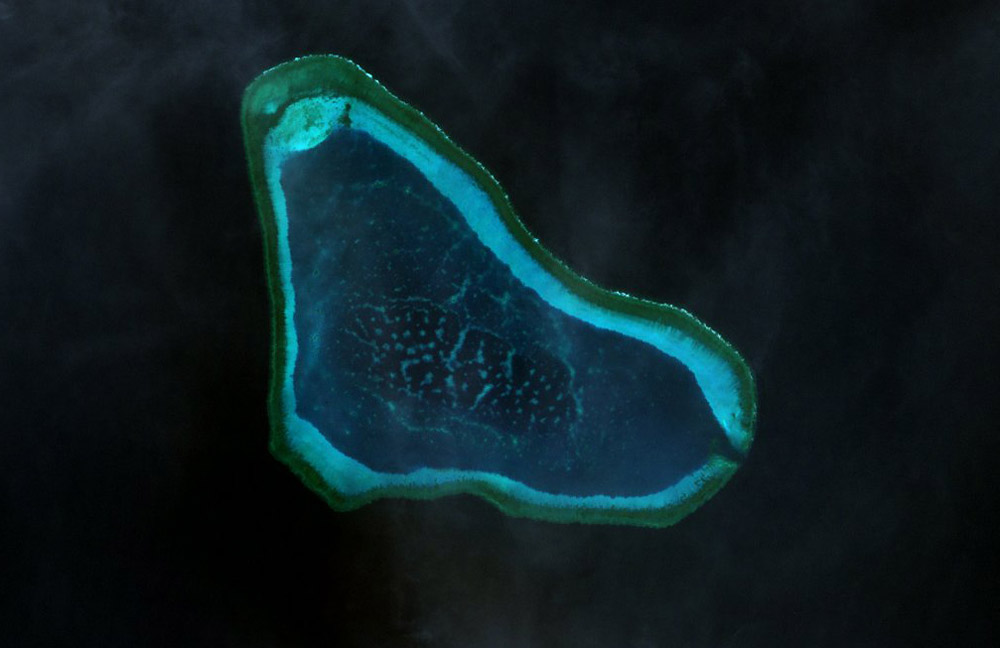
The declaration, terse but loaded with strategic subtext, was dispatched into the global news stream by China’s official channels and subsequently picked up by international agencies.
Scarborough Shoal (referred to by Beijing as Huangyan Dao) lies well within what Manila considers its exclusive economic zone — roughly 120 nautical miles from the Philippine mainland — yet it sits at the heart of an ever tightening web of overlapping territorial claims in the South China Sea. Beijing’s decision to renew naval and aerial patrols around the feature is more than an operational exercise: it is a calculated reaffirmation of sovereignty, an imprint of power in waters where legal claims and strategic imperatives collide.
To the casual observer the announcement might read like a routine update from a military command. Yet, the broader context belies a subtler narrative — one of shifting balances, diplomatic ruptures, and the enduring struggle for maritime supremacy in Asia’s busiest shipping corridor.
In recent months, data from independent monitors has pointed to an “unprecedented” Chinese presence near the shoal. Analysis by the Asia Maritime Transparency Initiative (AMTI) — a think tank affiliated with the Centre for Strategic and International Studies — found that Chinese coast guard vessels maintained patrols for nearly the entirety of 2025, with at least one Chinese vessel present on 352 days of the year. These figures underscore a calculated effort to normalise presence, to make Beijing’s footprint an immutable fact of life in a contested expanse of ocean.
For Manila, such manoeuvres are hardly theoretical. Since 2012, following a standoff that effectively handed control of the shoal to China, Philippine officials have protested Beijing’s actions, arguing that they contravene a landmark 2016 ruling by a United Nations tribunal, which invalidated China’s expansive “nine-dash line” claims. Intervention by external powers, most notably the United States, has been a recurrent theme: joint maritime exercises between Filipino and US forces have occurred in the vicinity, marking at least the 11th such collaboration since late 2023, according to Manila’s armed forces.
From Beijing’s vantage point, these exercises represent an externalisation of the dispute, a forging of coalitions that, in its view, ‘provocatively’ encroach upon Chinese sovereignty and regional stability. Chinese state media and military communiqués frequently characterise their patrols as necessary countermeasures to intrusion and destabilisation by “individual countries.”
The diplomatic rhetoric is matched, on the ground, by strategic heft. In previous patrols — captured in rare official footage and corroborated by independent reporting — a constellation of PLA Navy warships, China Coast Guard vessels, and air assets, including bombers and fighters, have been seen manoeuvring in close proximity to the shoal, projecting a clear message of control and readiness.
Absent from most dispatches, however, is the collateral strain these operations place on regional relationships. Manila itself has oscillated between diplomatic restraint and public alarm. In mid-2025, a collision between a Chinese coast guard cutter and a PLA destroyer during a high-speed pursuit of a Philippine patrol boat underscored the risks inherent in this new normal of near-constant confrontation. That incident, while not resulting in escalation to open conflict, hinted at the dangerous edges of this maritime choreography.
For policymakers in Washington, Tokyo and Canberra, China’s intensifying presence is both a challenge and a clarion call. The United States, which has reiterated its commitment to uphold freedom of navigation and to stand by treaty obligations with Manila, views the South China Sea not merely as a geographical theatre, but as a symbol of the broader strategic contest with Beijing. Similarly, regional partners such as Japan and Australia have quietly bolstered their diplomatic and military engagement, not least because the implications of Chinese dominance extend beyond the immediate vicinity of Scarborough Shoal to the wider Indo-Pacific security architecture.
In Manila, alarm is tempered by pragmatic realism. Philippine officials have protested Beijing’s actions and repeatedly underscored their nation’s sovereign rights under international law. Yet, there is also a cognizance of power asymmetry — a recognition that the shoal, despite its modest size, has become a potent symbol of a larger struggle for influence in Southeast Asia.
What transpires around Scarborough Shoal in the coming months may well set the tone for the next phase of the South China Sea dispute. Will Beijing’s assertiveness ultimately deter — or energise — the network of regional partnerships aligned against unilateral maritime claims? And will the United States and its allies follow through with concrete strategies that balance deterrence with diplomatic engagement? These are questions that reach far beyond the rustling of radar screens and the rumble of aircraft engines.
In a corner of the ocean fringed by limestone reefs and brimming with geopolitical significance, the answer to those questions could reshape the contours of Asia’s maritime order for years to come.
Main Image: By NASA – http://www.oceandots.com/pacific/scarborough/scarborough2.php, Public Domain,
Reclaiming Port of Darwin From China: Australia Sends a Signal of Resolve



If Russia Wins: A Scenario and the Logic of the West’s Managed Defeat