A powerful explosion at an ammunition factory near Rome has become the latest security incident affecting Europe’s defence industry, three days after fire and explosions struck a facility belonging to Bulgarian arms manufacturer EMCO.
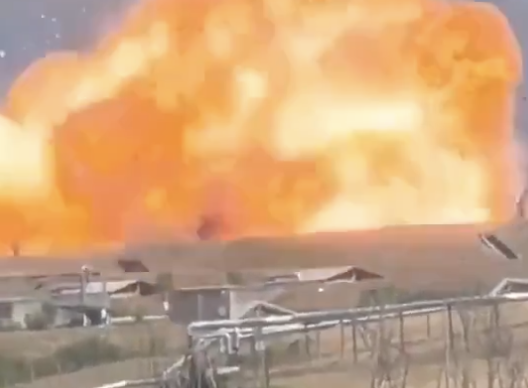
The Italian blast occurred on 13 August at the KNDS Ammo Italy plant in Colleferro, south-east of Rome. A fire was followed by a major explosion at the facility, which produces medium- and large-calibre ammunition for land and naval forces as well as solid propellants.
Emergency services deployed firefighters, police and helicopters to the site. All employees believed to have been inside the facility were accounted for and no injuries were reported. Investigators are examining how the fire began and how it developed into the explosion.
For Europe’s defence sector, however, the importance of the incident extends beyond the immediate damage.
KNDS is deeply integrated into the expansion of European ammunition production and the support network sustaining Ukraine’s armed forces. In October 2024 the group established KNDS Ukraine in Kyiv, creating a local structure for the maintenance and repair of Leopard tanks, CAESAR artillery systems, PzH 2000 self-propelled howitzers, Gepard anti-aircraft vehicles and other systems.
The company said at the time that around 800 KNDS systems were either already deployed in Ukraine or under contract. It also announced plans to work with Ukrainian industry on local production of 155mm artillery ammunition.
That makes security around KNDS facilities a matter not simply of industrial safety, but of European military resilience.
The Italian explosion followed another incident on 10 August at an ammunition storage facility operated by EMCO near Belitsa in Bulgaria.
A fire spread through the site and triggered explosions that destroyed a warehouse and scattered explosive material in the surrounding area. Workers were evacuated and no casualties were reported.
Bulgarian authorities initially said there was no evidence of foreign interference, while EMCO said it believed human error could be excluded.
The company’s history makes any serious incident involving its facilities particularly sensitive.
EMCO owner Emilian Gebrev was poisoned in Sofia in 2015 together with his son and another company executive. Bulgarian prosecutors later charged three Russian citizens with attempted premeditated murder.
Gebrev’s company had been involved in arms exports to Ukraine during the earlier phase of the Russo-Ukrainian war, and Bulgarian investigators examined whether that activity could have been connected to the poisoning.
The most important precedent remains the 2014 explosions at ammunition depots in Vrbětice in the Czech Republic.
Czech investigators concluded that members of Russia’s GRU military intelligence service were responsible for the blasts, which killed two people. Police said the operation was intended to prevent weapons and ammunition reaching areas where Russian forces were conducting military operations.
That case demonstrated a central vulnerability in European defence logistics: destroying ammunition before it reaches the battlefield can be cheaper, less visible and potentially less escalatory than attacking it after delivery.
For military planners, warehouses, propellant plants, railway terminals, maintenance centres and the executives who run defence companies therefore form part of the wider operational environment.
The concern is reinforced by events in Poland.
Prime Minister Donald Tusk said this week that Polish security services had arrested a Russian citizen who had allegedly been recruited by Russian intelligence to assassinate a man with Ukrainian and American citizenship in Warsaw.
The suspect was detained on 7 August before the planned attack could be carried out. The intended target has not been publicly identified.
Unlike the factory explosions, the Polish case contains an explicit allegation of Russian intelligence involvement. It nevertheless contributes to the broader picture confronting European counter-intelligence services.
The EU has repeatedly accused Moscow of conducting hybrid operations involving sabotage, attacks on infrastructure, cyber activity and covert interference across Europe.
Europe is attempting to increase ammunition output, rebuild depleted stockpiles and sustain Ukrainian forces while simultaneously preparing for the possibility of a longer confrontation with Russia.
That expansion creates new targets.
Ammunition factories and depots contain materials that can turn relatively small incidents into major losses. Production is often concentrated in a limited number of specialised plants, meaning that damage to a single facility can affect deliveries far beyond the country in which it is located.
Security therefore has to extend beyond perimeter fences. Counter-intelligence screening, cyber protection, supply-chain monitoring, surveillance of transport routes and protection of key personnel are increasingly part of defence-industrial planning.
Whether the explosions in Colleferro and Belitsa ultimately prove to be accidents or something more deliberate remains for investigators to establish.
Their timing nevertheless highlights a problem European governments can no longer treat as peripheral: as ammunition production becomes central to NATO readiness and Ukraine’s ability to continue fighting, the factories producing it are themselves becoming part of the security battle.