The intervention comes as United States envoys shuttle between Kyiv and Moscow to explore a possible ceasefire and as Washington debates formulas that would see Ukraine pull back from parts of occupied territory.
Until recently, the Kremlin’s stated precondition for ending the war was narrower. Putin had been insisting on the withdrawal of Ukrainian forces from the remaining Kyiv-controlled areas of Donetsk region, presenting this as the central requirement for a halt to hostilities. That demand has appeared in various drafts of US-backed “land-for-peace” ideas, which would see Ukraine cede parts of Donbas to Russia under some form of security arrangement.
President Donald Trump has repeatedly suggested that Ukraine should surrender territory because Russia is “winning” the war and would in any case take control of Donbas. Kyiv has publicly rejected such proposals, with President Volodymyr Zelenskyy stating that any formal loss of territory would violate Ukrainian law and invite further aggression.
Against this background, the reintroduction of “Novorossiya” looks less like a rhetorical flourish and more like an attempt to widen the menu of Russian claims. In Kremlin logic, any sign that the United States is ready to press Kyiv over Donbas is interpreted as weakness – and therefore as an opportunity to demand more.
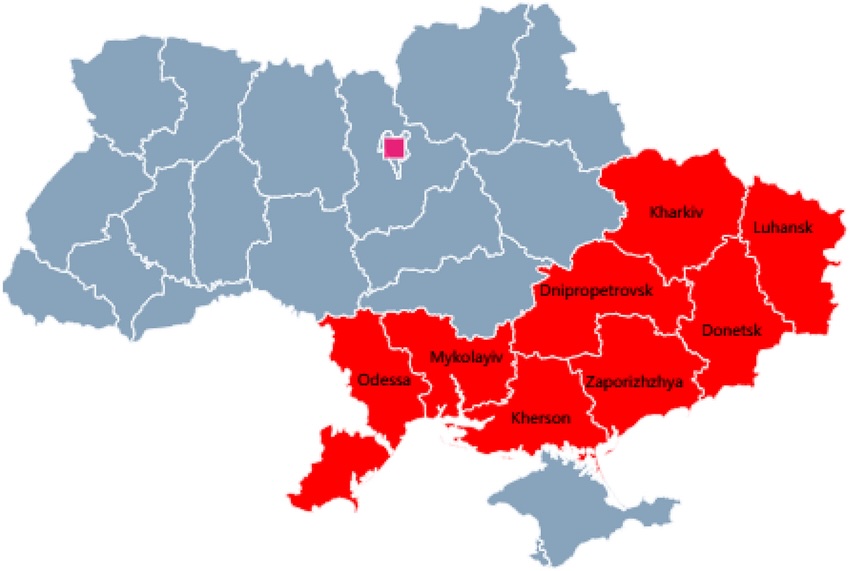
The strength of the “Novorossiya” label, from Moscow’s perspective, lies in its ambiguity. Historically it referred to a broad swathe of territory north of the Black Sea incorporated into the Russian Empire in the 18th and 19th centuries. In modern usage, Putin has cited cities such as Kharkiv, Luhansk, Donetsk, Kherson, Mykolaiv and Odesa as belonging to “what was called Novorossiya in tsarist times”, and has questioned why they “ended up” in Ukraine.
Politically, that flexibility creates room for incremental escalation. At its most limited, “Novorossiya” can be presented as covering the occupied and illegally annexed parts of Kherson and Zaporizhzhia regions, allowing Russia to add these formally to any list of negotiating conditions. In such a scenario, Moscow could demand not only Ukrainian withdrawal from Donbas but also from these southern territories, or at minimum insist on a “frozen conflict” while reiterating that they will eventually be “returned” to Russia.
At a broader level, the concept can be stretched to cover much of south-eastern Ukraine. Putin has long argued that modern Ukraine sits on “historically Russian lands” created by Soviet-era administrative decisions and described it as an “anti-Russia project”. In his 2014 Crimea speech he referred to Soviet “gifts” to Ukraine, casting doubt on the legitimacy of its post-1991 borders.
On the eve of the full-scale invasion in February 2022, Putin again framed the conflict in terms of the “self-determination” of various “peoples” within Ukraine. That language maps directly onto the Kremlin’s practice of promoting constructed entities such as the “people of Donbas”, proclaiming “republics”, staging referendums and then incorporating the territories into the Russian Federation.
This was the core of the original blitzkrieg design in 2014 and again in 2022: remove or sideline the legitimate authorities in Kyiv and rely on loyal figures such as Viktor Yanukovych or Viktor Medvedchuk to front a chain of regional “self-determination” votes across an imagined “Novorossiya”. The project faltered in 2014 when annexation remained largely confined to Crimea and parts of Donbas, and the 2022 attempt to topple the Ukrainian government failed in the face of resistance.
The abandonment of a rapid takeover has not meant the abandonment of the underlying territorial objective. Russian military operations since 2022 have shifted towards a campaign of attrition, while domestic messaging has continued to emphasise historic claims, alleged discrimination against Russian speakers and the unity of the “Russian world”. In that framing, a long war becomes the instrument for revisiting borders step by step.
The New Delhi remarks suggest that Moscow believes the current diplomatic phase offers scope to revive that strategy. If Western negotiators appear focused on Donbas, “Novorossiya” offers a ready-made framework for additional demands later – from Kherson and Zaporizhzhia to, in the maximal variant, other parts of southern and eastern Ukraine. Each can be presented as part of a pre-existing historical entity whose “liberation” is postponed rather than renounced.
This has direct implications for the much-discussed “peace process”. For the Kremlin, talks appear to serve several functions at once: gaining time to replenish forces, testing Western unity, and inserting Russian territorial narratives into international discussion. Recent statements indicate that Putin does not see negotiations as a route to a stable compromise, but as a way to entrench existing gains while keeping options open for further advances.
For Kyiv, any settlement that leaves large occupied areas in a grey zone, subject to open-ended claims under the “Novorossiya” banner, looks less like peace and more like a pause between rounds of conflict. That assessment helps explain Ukraine’s refusal to accept proposals involving formal territorial concessions in exchange for promises of future security.
The reappearance of “Novorossiya” therefore serves as a reminder that the dispute is not confined to Donbas and that, in Russian official discourse, questions over Ukraine’s borders remain open.