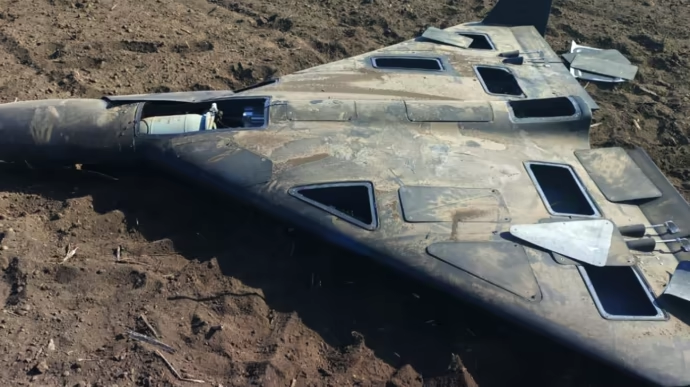
According to Estonian reporting, the incident occurred at 03:43 on 25 March. The Internal Security Service said the drone crossed into Estonia from Russian airspace before hitting the chimney of the Auvere plant, one of the country’s major energy facilities in the north-east near Narva. Rescue Department sappers were sent to the scene, while the State Prosecutor’s Office took charge of the proceedings and the Security Police launched the investigation.
Astrid Asi, Estonia’s Prosecutor General, said the information available at this stage suggested the drone had not been deliberately aimed at Estonia, though she stressed that the investigation was only at a preliminary stage. Her remarks point to the uncertainty still surrounding the drone’s route, purpose and intended target. Officials have not yet publicly identified the model of the aircraft or released technical details on whether it was armed when it crossed the border.
The operator of the plant, Enefit Power, said its preliminary assessment was that the station itself had not suffered direct damage and that the incident would not have any significant impact on Estonia’s power system. That statement appears to have calmed immediate concerns over energy supply, but the fact that a drone was able to reach a critical industrial installation inside Nato territory is likely to intensify discussion in Estonia and across the Baltic region about airspace monitoring and the vulnerability of infrastructure close to Russia’s border.
The Auvere power station lies in Estonia’s industrial east, an area of obvious strategic importance because of its proximity to Russia and its role in the country’s energy network. Even without major physical damage, the symbolism of a Russian-origin drone striking part of an Estonian power facility is considerable. It underlines how the wider war environment created by Russia’s invasion of Ukraine continues to generate risks beyond the battlefield itself.
Margot Palloson, Director General of the Internal Security Service, said the episode should be understood as one of the consequences of Russia’s full-scale war and warned that similar incidents could recur. That assessment reflects a broader Baltic concern that the air war around Russia’s north-western military and industrial assets may increasingly produce spillover incidents affecting neighbouring states. Estonia, Latvia and Lithuania have all heightened attention to border security and critical infrastructure protection since Russia launched its full-scale invasion of Ukraine in February 2022.
The timing of the incident is notable. On Tuesday evening and during the night into Wednesday, Ukraine was reported to be carrying out drone strikes against targets linked to the Russian Baltic port of Ust-Luga and other sites in Leningrad region. ERR reported that the Estonian incident coincided with Ukrainian attacks on Ust-Luga, while oil facilities at Primorsk, also on the Gulf of Finland, had been burning for more than two days. Estonian authorities have not publicly drawn a direct operational link between those events and the drone that hit Auvere, but the overlap in time is likely to form part of the investigation.
The incident also comes amid reports from neighbouring Latvia of a drone falling on Latvian territory, adding to regional unease over the possibility of unmanned aircraft straying into Nato airspace as fighting and long-range strikes continue in and around Russia. While officials in Tallinn have emphasised that there is no evidence so far that Estonia itself was the intended target, the breach is likely to renew questions about early warning, interception capacity and coordination among Baltic states facing a deteriorating security environment on the alliance’s eastern flank.
For now, the practical consequences appear limited: no casualties, no immediate disruption to power generation, and no indication of a broader attack on Estonia. Politically and strategically, however, the event is more significant. A drone crossing from Russian airspace and striking infrastructure inside an EU and Nato member state is not easily dismissed as an isolated technical mishap. Even if it proves unintended, it illustrates how the geography of Russia’s war against Ukraine can produce direct security incidents for neighbouring countries that are not themselves combatants. Estonia’s investigation will now be watched closely for answers on the drone’s origin, trajectory and mission — and for what those findings may reveal about the risks facing the Baltic region.