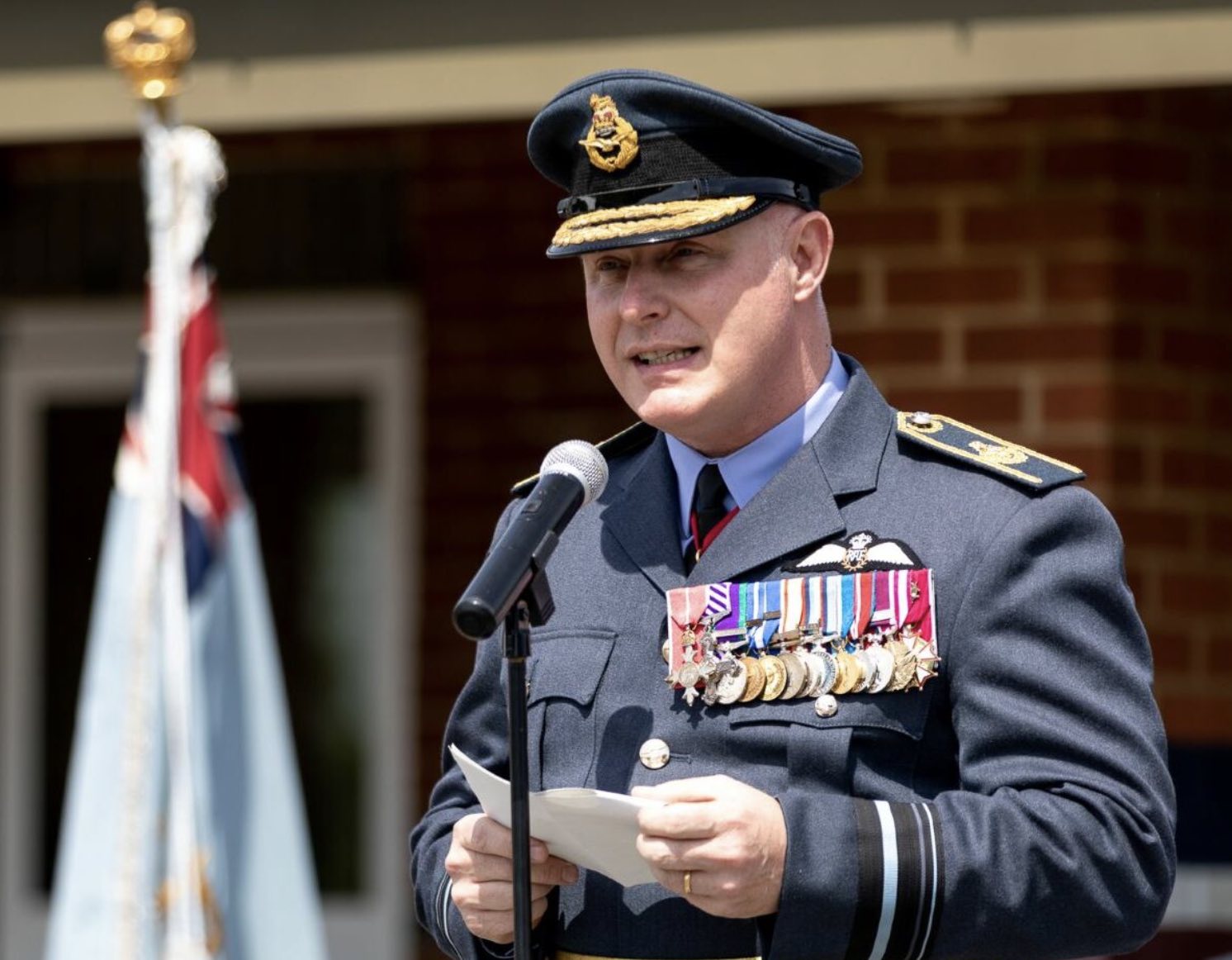
His central motif — putting more “AIR” into Air: Agile, Integrated, Ready — offered a confident slogan, yet behind the crisp phrase lay something more sober: an admission that the Royal Air Force is stepping into an era thick with hazards.
This was not a speech designed to win applause for its own sake. It was a speech that called the country to look steadily at the storm gathering over the global order — and to grasp that the RAF’s future relevance hinges not on what it has been, but on how quickly and deftly it can change.
Smyth’s first challenge is simply the world itself. He noted that the “benign operating environment” of the past 30 years has ended. That remark, almost offhand, ought to ring in Whitehall like a warning siren. The last generation saw air power largely uncontested, precision strikes delivered with impunity, and space treated as a neutral commons. That era is over.
Russia’s war in Ukraine has revived state-on-state conflict in Europe. China is pressing its military reach across the Indo-Pacific. Iran and North Korea are proliferating drones, missiles and disruptive cyber tools. The democracies that once shaped global rules are on the defensive, and the technological edge on which Western forces relied is being eroded by cheap, fast-iterating commercial systems.
For the RAF, accustomed to uncontested skies and stable alliances, this means operating in a world where freedom of action can no longer be assumed — and where adversaries will seek to blind, disrupt or overwhelm from the outset.
The first plank of Smyth’s plan — agility — is an understandable response. He wants an RAF able to adapt at pace, to anticipate threats and shift posture quickly. But here lies a risk: agility can be a euphemism for over-stretch.
British air power is thinly spread. Combat airframes are ageing. Training pipelines are tight. Maintenance crews are already running at the red line to keep fast jets and transport fleets serviceable. Pivoting quickly in such conditions carries the danger of cracking what remains of resilience.
Moreover, agility demands information. In conflicts where data networks are the first targets, keeping those networks alive long enough to enable rapid decision-making is no small feat. Smyth’s optimism is well-placed, but unless the RAF’s digital backbone is hardened, agility may collapse at the first shock.
The second pillar — integration — is equally fraught. The concept is sound: fusing air, space, cyber, uncrewed systems, sensors and strike assets into a seamless whole. The risk is that integration becomes diffusion: an ambition so sprawling it saps focus.
Smyth wants the RAF to be a glue binding Britain’s armed forces together, and to act as a connective node among allies. Yet integration requires more than goodwill. It needs shared digital architectures, compatible data standards, and secure cross-domain networks — all of which are notoriously difficult to achieve even within a single service, let alone across NATO.
The RAF could end up trapped between worlds, expected to master everything from space ISR to hypersonic missile defence while still keeping Typhoons and F-35s combat-ready. The danger is not incompetence but exhaustion: a force doing many things tolerably, but nothing decisively.
The third leg of Smyth’s triad, readiness, is arguably the hardest. The RAF has, by his own admission, lived off “war stocks” accumulated during easier times. Years of efficiency drives and budget parsimony have stripped spare capacity from the system.
Rebuilding readiness means replenishing munitions, revitalising infrastructure, expanding training pipelines, and recruiting and retaining skilled personnel — all in a tight labour market. It means building redundancy into a force structure that has long prided itself on lean efficiency. It means paying now for resilience that may not be needed until later.
This will require sustained political will, not merely ministerial enthusiasm. A change of government, or a fiscal squeeze, could derail progress before it bites. Smyth’s plan demands a long view in a political culture notorious for short horizons.
The three operational priorities he set out each carry their own minefields.
Nuclear burden: Joining NATO’s dual-capable aircraft mission will restore a sub-strategic nuclear role to the RAF, but it also makes Britain a more prominent target in any escalation. It will absorb scarce F-35 capacity, entail complex security protocols, and place extraordinary demands on training and discipline. The capability gap it fills is real — so are the escalatory risks.
Integrated Air and Missile Defence (IAMD): Smyth’s invocation of Air Chief Marshal Dowding’s Battle of Britain system was stirring. Yet the analogy cuts both ways. Dowding’s system worked because Britain concentrated everything on it. Modern IAMD requires a lattice of radars, interceptors, command posts, cyber defences and satellite links. Creating such a lattice in peacetime, amid peacetime budgets, will be Herculean. Failure will be obvious only when it is too late.
Space vulnerability: Space offers vast opportunity for surveillance, communications and precision targeting. It also offers fragility. Satellites are slow to replace and easy to disrupt. Smyth knows this better than anyone — he once ran the MOD’s space directorate. But the UK’s space sector is still small, and its sovereign launch capacity fragile. Betting heavily on space makes sense; it also exposes the RAF to a domain where surprise attacks are cheap and defences immature.
Even if the technology comes good, the human dimension remains critical — and brittle. The RAF’s personnel shortfalls are chronic. Engineers are leaving for the private sector. Pilots spend more time on simulators than in the air. Manning shortfalls make it hard to surge for crises. Smyth is right to stress “people, infrastructure and enablers”, but reversing the trend will take sustained cash and cultural change.
Industrial support is another pressure point. The UK’s defence industry is innovative, but lean. Major projects already run on knife-edge schedules. If the RAF demands simultaneous expansion of combat air, missile defence, space assets and digital networks, industry may simply lack the capacity. Foreign reliance will fill the gap — but that carries geopolitical risk if allies waver.
Where Smyth deserves credit is his clarity. He does not pretend that risk can be avoided. Instead he frames the RAF’s task as mastering risk — imposing order on it. That candour is refreshing. Yet clarity alone will not shield the service if politics falters.
The RAF is embarking on a strategic bet: that Britain can afford to be a tier-one air and space power, that allies will align, and that the public will accept the costs. If any leg of that bet collapses, so too might the edifice. Strategy can fail not only through error, but through abandonment.
For all these perils, Smyth’s speech was not bleak. It was bracing. He did not claim victory; he claimed responsibility. That, in truth, is what makes it worth heeding.
The RAF is being asked to change faster than at any time since the early Cold War, under tighter budgets, with slimmer margins for error, and against more capable adversaries. The risks are sharp, real, and growing. But Smyth’s message was that shrinking from them would be riskier still.
It is a hard message — and a necessary one. If Britain is to remain defended in a world that has shed its illusions of safety, it will require exactly what Smyth called for: agility, integration, and readiness — not as slogans, but as disciplines.
The path ahead is narrow. But at least, for once, it is clear.
It is worth being blunt about what is at stake. If the RAF stumbles — if agility proves hollow, if integration falters, if readiness slips — the result will not be a graceful decline into irrelevance, but something starker.
In a future crisis, a hollowed-out RAF would find itself unable to contest airspace against peer adversaries. Our fighters might be grounded by spare-part shortages, our aircrews too thinly trained to surge, our stockpiles of precision weapons depleted within weeks. Command networks could collapse under cyber attack, blinding the force and leaving Britain dependent on allies who may be distracted or unwilling.
A degraded RAF would also strip Britain of its nuclear credibility and its standing in NATO. It would erode our influence in Washington and embolden hostile powers from Moscow to Tehran to test our resolve. Above all, it would leave our soldiers and sailors exposed, deprived of the protective shield that British air power has long provided.
This is the shadow that hangs behind Smyth’s call to action. The RAF’s transformation is not a luxury. It is a necessity — because the cost of failure would not merely be decline, but danger.
Main Image: RAF
RAF Prepares for Transformation as Air Marshal Harv Smyth Named New Chief of the Air Staff