The biennial exercise, long heralded as a crucible for allied interoperability in extreme conditions, is now unfolding amid heightened geopolitical strains — and serves as a stark reminder of NATO’s renewed emphasis on Arctic readiness.
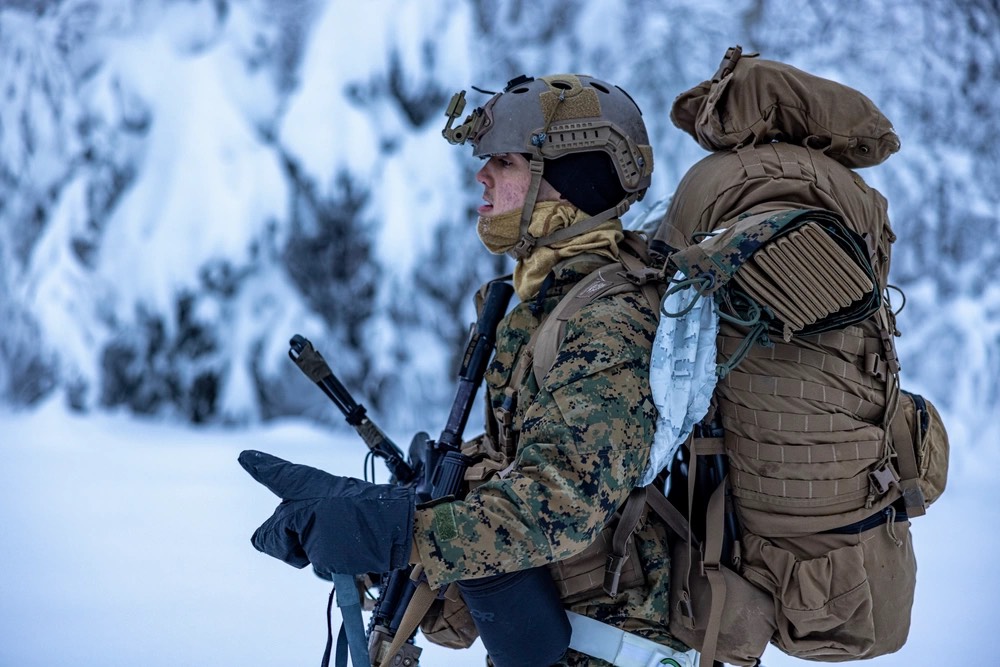
At its core, Cold Response is more than just a show of force against imagined adversaries; it is a practical rehearsal for conducting joint operations across the unforgiving sub‑Arctic environment that potentially could be a theatre of strategic competition. Around 3,000 US Marines from Camp Lejeune, North Carolina, began cold weather preparations in Norway this month, joined by forces from across Europe and North America, including Canada, Denmark, Finland, France, Germany, Italy, the Netherlands, Spain, Sweden and the United Kingdom.
The origins of Cold Response reflect Norway’s unique position on NATO’s northern flank. The exercise, historically held every two years under Norwegian leadership, is designed to test the alliance’s ability to operate cohesively in one of the harshest climates on the planet. The terrain of northern Norway — stretching from the fjords to the Arctic Circle — presents logistical and tactical challenges that few other regions can match, from sub‑zero temperatures to snowbound valleys that choke movement and strain equipment.
These conditions are precisely why all participants view such training as indispensable. For NATO, an alliance grounded in collective defence, interoperability among land, sea and air forces is not an abstraction but a necessity. As one senior Marine planner put it in a recent statement, Cold Response is as much about future deterrence as it is about immediate preparedness: “This exercise isn’t just about preparing for today’s threats … it’s about building the capabilities and strengthening the capacity necessary to deter future aggression and safeguard our shared interests.”
Across the fjords and frozen plains, the exercise takes on added significance as the geopolitical focus intensifies around the Arctic. Climate change is opening new maritime routes, and with them comes heightened strategic competition among major powers. Securing access and readiness in the High North has become a priority not just for Norway but for NATO’s entire northern flank.
Yet this year’s edition of Cold Response unfolds against an unusual backdrop: strained relations between the United States and some of its closest allies over political rhetoric regarding Greenland, a semiautonomous Danish territory. Washington’s incendiary statements about Greenland’s strategic value, including controversial suggestions of possible acquisition, have unsettled capitals from Copenhagen to London. A YouGov poll released this week found that majority opinion in the United Kingdom would support the removal of American forces from British bases should the United States pursue military action in Greenland — a stark indicator of how transatlantic bonds are being tested in public as well as military spheres.
Despite these tensions, the mechanics of Cold Response proceed with apparent normality, suggesting that defence cooperation still retains a robust — if complicated — institutional underpinning. In preparation for the main exercise, allied troops have spent January engaged in unit‑level cold weather training, fine‑tuning skills from logistics and communications to life‑sustaining operations in lethal cold.
The sheer scale of Cold Response speaks volumes about NATO’s commitment to joint readiness. Successfully moving and sustaining heavy equipment — from pre‑positioned armoured vehicles to aviation assets — across snowbound terrain is no trivial task. In the weeks leading up to the exercise, Marines have been engaged in meticulous logistical operations, retrieving gear from hardened storage caves in central Norway and convoys over long distances to staging areas ahead of the March drills.
For a Marine Corps long accustomed to pivoting between global theatres, from the deserts of the Middle East to the jungles of Southeast Asia, the Arctic presents a distinctive challenge. Soldiers and sailors alike must adapt not just their equipment but their very instincts — here, friction comes not only from enemy forces but from nature itself.
Perhaps the most enduring legacy of Cold Response is the message it sends about alliance cohesion. In a world in which NATO faces diverse and evolving threats, from cyber intrusion to conventional force build‑ups on its eastern flank, the ability of 25,000 troops from multiple nations to train and operate as a single force in one of the least forgiving environments on Earth is more than symbolic.
The Arctic drills also reflect an understanding among NATO members that collective defence is a shared responsibility — one that extends beyond treaty halls in Brussels or capitals in Europe and Washington to the actual fields and frozen valleys where troops train and prepare for eventualities that, to most civilians, remain distant abstractions.
As Cold Response 26 approaches, the echoes of boot-heels on ice and the roar of aircraft overhead will not just prepare NATO’s forces for winter warfare; they will reaffirm a strategic posture rooted in cooperation, readiness and a shared understanding that the security of the High North is integral to the security of the alliance itself.
Denmark’s Arctic Command invites US to join Greenland exercises as Nato allies plan larger presence
Main Image: by Sgt. Dylan Chagnon , 2nd Marine Division