You could walk into a Warsaw Pact armoury and find a Kalashnikov; into a NATO one and find some variant of the AR-15 of FN T48 (SLR, in UK parlance) families, firing either 7.62 mm, or 5.56 mm, and the argument between them — reliability versus precision — became almost theological. The debate was never truly resolved, but it was stable.
That stability has now ended.
Across the United States, Europe and Asia, armies are redesigning the basic soldier’s weapon in ways more radical than anything seen since the 1960s. What makes the shift interesting is not simply that rifles are being replaced. It is why they are being replaced. Modern assault rifle design is no longer about the rifle itself. It is about sensors, armour, drones, and the reappearance of long-range combat.
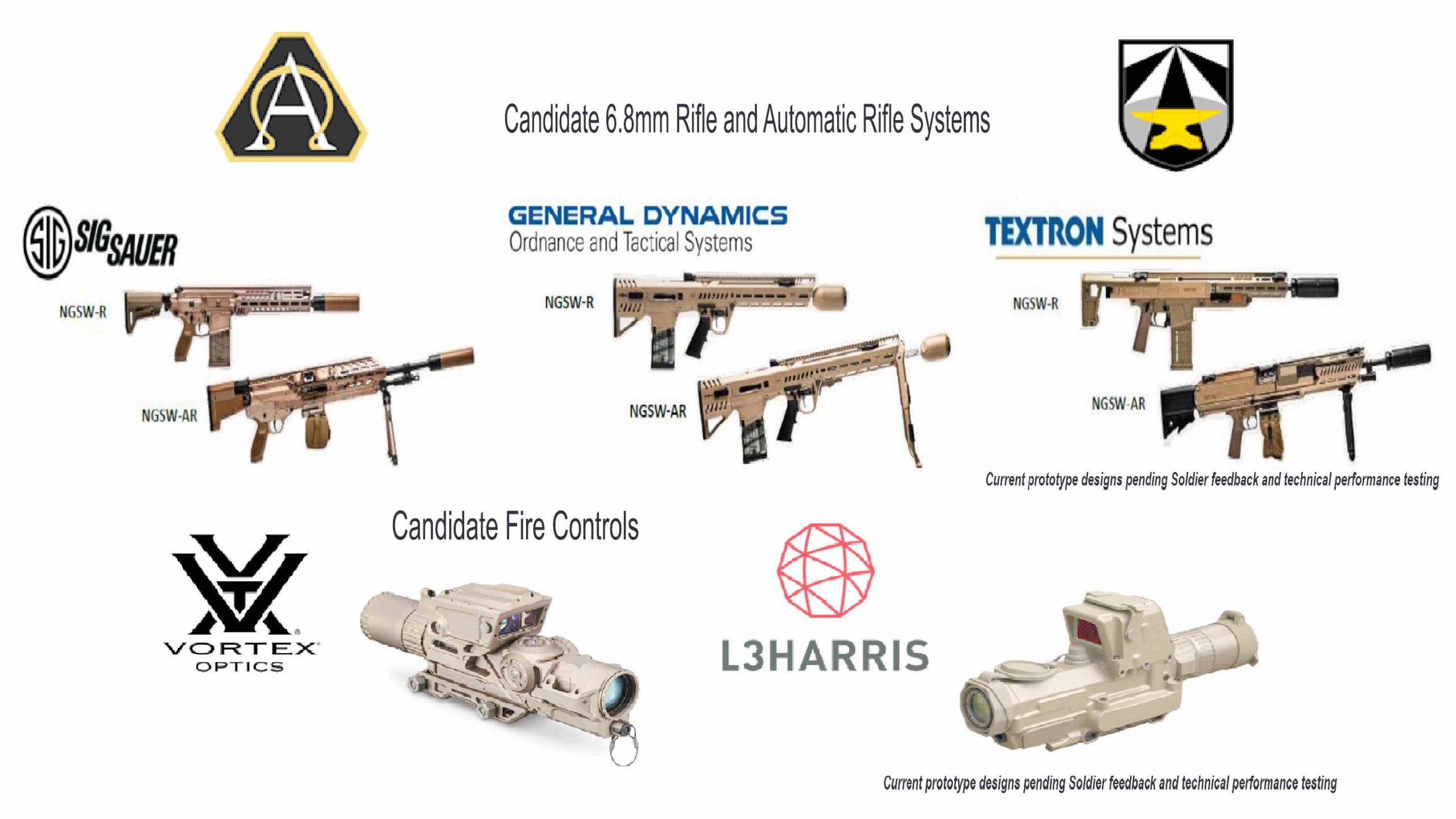
The clearest sign of the change is the US Army’s Next Generation Squad Weapon programme. Its new service rifle — the XM7 — is intended to replace the M4 carbine, a weapon whose lineage traces back to Vietnam.
At first glance the XM7 looks familiar: magazine-fed, shoulder-fired, recognisably part of the AR-style family. But in design philosophy it represents a break.
For half a century Western armies embraced small, lightweight ammunition. The logic was simple: soldiers carry more bullets than they fire, and suppressive fire matters more than individual hits.
That assumption is collapsing.
Modern militaries are increasingly concerned about advanced body armour and longer engagement distances. The XM7 fires a new 6.8mm cartridge designed to provide greater range, velocity and penetration than the long-standard 5.56mm round.
The new ammunition was specifically chosen to defeat protective plates and remain effective at extended ranges, potentially out to several hundred metres.
This is a remarkable reversal of late-20th-century doctrine. For decades, NATO believed firefights would occur primarily at short range — urban combat, jungle, or mechanised warfare where artillery and armour dominated. Afghanistan and Ukraine have quietly disproved that assumption. In mountainous terrain and open countryside, infantry once again fights at distances resembling the Second World War.
The modern rifle, therefore, is rediscovering lethality over volume. One accurate shot is becoming more valuable than a burst of ten.
Perhaps the most important innovation is not the weapon but the sight.
The XM157 optic integrated with the new rifle contains a laser rangefinder, ballistic calculator and digital display overlay.
In practical terms, the soldier points, the optic measures distance, adjusts for bullet drop, and indicates the corrected aiming point.
In other words, marksmanship is being partially automated.
This is a profound doctrinal shift. For most of history, infantry accuracy depended on training and experience. Modern rifle design increasingly assumes the opposite: technology will compensate for human limitations. The rifle is evolving into a networked targeting system rather than a standalone firearm.
The infantryman is slowly becoming less a rifleman and more a sensor operator.
Another quiet revolution concerns sound.
Historically, suppressors were specialist equipment. Today they are moving toward standard issue. The new US rifles are designed to operate with integral suppressors to reduce flash and acoustic signature and improve command and control on the battlefield.
This is not about stealth in the cinematic sense. It is about survivability.
On a drone-watched battlefield, muzzle flash reveals position instantly. Reducing signature delays detection, especially by night-vision devices and sensors. Modern rifle design increasingly treats visibility — not just firepower — as a tactical liability.
Another universal trend is modular architecture.
Modern rifles feature rail systems, ambidextrous controls and adjustable stocks.
The rifle is no longer a fixed object. It is a platform onto which optics, thermal imagers, laser designators, electronic sights and communications devices can be attached.
This reflects a deeper reality: the infantry squad is becoming a network node.
The rifle is now the mount for the soldier’s sensors, and increasingly his communications equipment as well.
In effect, the weapon is becoming an accessory to the electronics.
Yet progress has revived an old problem — weight.
The new infantry rifle models heavier than the weapons they replace, especially once suppressors and optics are attached.
More powerful ammunition also reduces how many rounds a soldier can carry.
This illustrates the central paradox of modern infantry design.
Technology makes soldiers more capable individually, but also more burdened. Batteries, optics, radios and armour accumulate until mobility suffers. Modern armies now confront the same dilemma faced by medieval knights: protection and lethality versus endurance.
Underlying all these changes is a doctrinal transformation.
Twentieth-century infantry tactics emphasised suppressive fire — pinning the enemy while manoeuvre elements advanced. Twenty-first-century weapons emphasise precision and first-round hit probability. The new systems are intended to increase “range, accuracy and probability of hit” while reducing engagement time.
Why? Because the modern battlefield is transparent.
Drones, thermal imaging and satellite reconnaissance mean prolonged firefights are dangerous. A soldier who fires repeatedly reveals his position. Therefore the logic of weapon design shifts toward rapid, accurate engagement rather than sustained automatic fire.
The rifle is adapting to surveillance warfare.
What we are witnessing is not a new rifle but a new theory of infantry combat.
Modern rifles assume:
enemies wearing armour,
longer engagement distances,
persistent aerial surveillance,
digital targeting assistance.
The assault rifle is evolving into a hybrid of carbine, marksman rifle and electronic targeting platform. The infantryman is becoming something closer to a precision shooter integrated into a reconnaissance network.
Ironically, after decades of trying to make the rifle less important, technology has made it more sophisticated than ever. The basic tool of war has not disappeared. It has become smarter.
And that tells us something unsettling: despite drones, missiles and cyberwarfare, control of territory still depends on a soldier carrying a rifle.
Only now, that rifle contains a computer.
Main Image: By U.S. Army Acquisition Support Center – https://asc.army.mil/web/portfolio-item/fws-cs-2/, Public Domain, https://commons.wikimedia.org/w/index.php?curid=117752509
Ukraine Develops 5.56mm Anti-Drone Ammunition to Enhance Infantry Defence