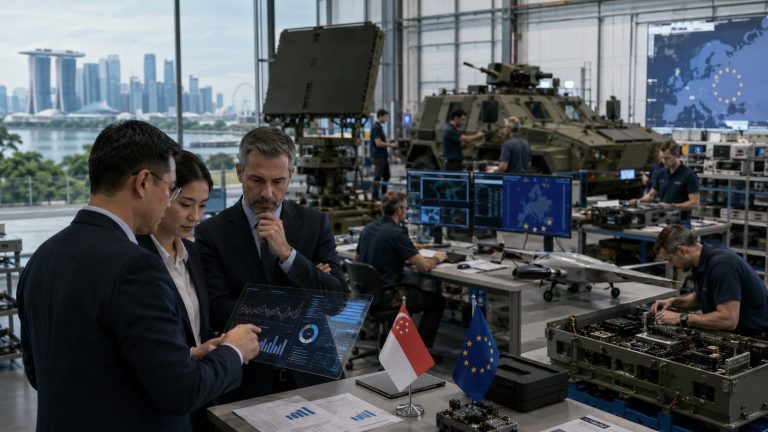
The Chinese Ministry of Commerce notice prohibits direct supply of controlled dual-use goods to the listed entities and subjects possible indirect transfers to tighter scrutiny. Beijing describes the action as a response to the European Union’s latest Russia sanctions.
For defence planners, the important issue is not the political language but the mechanism. China is using end-user controls to raise the cost and uncertainty of production by particular European organisations. The restriction may touch inexpensive inputs whose financial value is modest but whose absence can stop a production line.
Rheinmetall’s inclusion is particularly significant. The German group occupies a central position in Europe’s effort to increase ammunition output, rebuild land-force capacity and supply Ukraine. It has the scale to diversify procurement, but scale does not eliminate qualification lead times or the need to certify replacements.
Defence supply chains are vulnerable when a single foreign source provides an item that cannot quickly be substituted. Electronics, sensors, optical assemblies, specialist magnets, battery cells, machine tools and chemical precursors can all become bottlenecks. A prime contractor may not even buy the relevant product directly; exposure can sit several tiers below it.
This makes the precise effect of the Chinese measure difficult to calculate from public information. Companies do not publish detailed bills of materials for weapons systems, and governments should not demand disclosures that would reveal exploitable weaknesses. They do, however, need confidential mapping of critical dependencies.
Defence Matters previously reported that European drone production remains exposed to Chinese components. The same pattern can appear in larger systems. A domestically assembled vehicle or air-defence launcher may still incorporate foreign microelectronics, motors or manufacturing equipment.
The challenge is magnified by configuration control. Defence products are tested as systems. Replacing one component may require engineering work, environmental testing, software changes and approval from a military customer. A commercially available substitute is therefore not necessarily an operationally available substitute.
The first requirement is a common exposure assessment. National defence ministries, the European Defence Agency, the Commission and contractors should identify controlled Chinese inputs whose interruption would affect contracted delivery. The exercise must reach beyond prime contractors to specialist suppliers.
Second, authorities should distinguish between three responses: reserves for short disruptions, dual sourcing for recurring demand and European production for items that cannot safely remain externally dependent. Each carries a different cost.
Stockpiles are appropriate for standard components with stable specifications. Dual sourcing is useful when a competitive non-Chinese market exists. Domestic capacity is justified where an input is both militarily critical and concentrated in a jurisdiction able to deny supply.
Third, procurement contracts should reward resilience. Governments often select bids largely on acquisition price, encouraging contractors to use the cheapest global input. Requirements for verified second sources, traceability and minimum inventories add cost but reduce the risk of a programme-wide delay.
Fourth, Europe needs faster procedures for approving substitutes during supply emergencies. That does not mean weakening safety standards. It means completing testing in advance, maintaining alternative configurations and allowing shared certification evidence to be used across participating countries.
Total separation from Chinese industry is neither immediate nor economically realistic. China occupies major positions in materials processing, electronics and industrial manufacturing. Attempting to reproduce every input within Europe would consume resources better reserved for genuinely critical bottlenecks.
The correct objective is selective de-risking based on operational consequence. Governments should ask whether denial of an item would interrupt the delivery, maintenance or replenishment of a priority capability. If the answer is yes and substitutes cannot be activated quickly, intervention is warranted.
Europe should also avoid treating all Chinese suppliers as equivalent to the Chinese state. Transparent licensing and reliable end-use controls can preserve lawful trade. But commercial assurances alone are insufficient when Beijing has demonstrated its willingness to name defence businesses in retaliation for EU policy.
The restriction is designed to produce pressure beyond the 14 organisations. It tells European corporate boards that alignment with defence policy may carry a supply-chain penalty. It also invites governments to consider whether sanctions against Chinese entities are worth the industrial response.
If the measure delays production, the signal will be strengthened. If Europe absorbs it through prepared alternatives, the leverage will diminish.
The EU’s answer should therefore be operational rather than theatrical. Counter-sanctions may have a role, but they cannot manufacture a missing component. The priority is to protect delivery schedules, assist smaller suppliers and turn dependency data into procurement decisions.
China has demonstrated that economic interdependence can be weaponised at company level. Europe’s defence-industrial strategy must now show that it can keep factories operating under precisely that kind of pressure.