The Ministry of Defence confirmed yesterday that a £453 million contract has been awarded to British and European defence contractors, including BAE Systems and Leonardo UK, to install the next generation European Common Radar System Mark 2 (ECRS Mk2) on RAF Typhoons. The deal — part of a broader £650 million investment in Typhoon capability announced this week — is designed to secure British air superiority for decades to come and reinforce the country’s defence industrial base.
This move comes amid an intensifying strategic backdrop in which the UK, NATO and their allies face an array of evolving threats, from sophisticated Russian drones over Eastern Europe to expanding Chinese military modernisation. Defence Secretary John Healey, speaking on the sidelines of a visit to Leonardo’s facility in Edinburgh, described the radar upgrade as a “crucial step” in keeping the UK’s air defence ahead of the curve.
“Our Typhoon fleet is the backbone of UK and NATO air defence,” Mr Healey said. “As the threats we face increase, this cutting-edge radar capability will keep Britain secure at home and strong abroad for many years to come.”
The heart of the programme is the ECRS Mk2 radar, an active electronically scanned array (AESA) system capable of simultaneously detecting, identifying and tracking multiple air and ground targets in contested environments. Unlike the legacy radars, which use mechanically steered arrays, the ECRS Mk2’s electronically steered beam offers faster target acquisition, greater reliability and enhanced electronic warfare capabilities — allowing Typhoons to suppress enemy air defences and operate with heightened situational awareness.
Under the terms of the contract, 40 Typhoons will be equipped with the new radars — 38 new production units and modifications to two test systems — phasing the upgrade through to the end of the decade. The programme forms a central part of the UK’s efforts to keep the Typhoon competitive well into the 2040s, a necessity given the uncertainties surrounding the development of future combat air systems such as Team Tempest.
Industry sources highlight that the AESA technology brings Typhoon in line with modern threats and peer-competitor aircraft. It offers key advantages in electronic surveillance, counter-measure resistance and integration with next-generation weapons. Senior figures within the programme have noted that the radar’s enhanced electronic warfare suite could be decisive against advanced integrated air defence systems — a capability increasingly relevant given Russia’s deployment of layered anti-aircraft assets in Ukraine.
Beyond the immediate military advantage, the radar contract underscores the government’s emphasis on defence as an engine of economic growth. With supply chains extending across the UK, the Typhoon programme supports more than 20,000 jobs in some 330 companies — from high-end systems engineering in Scotland and Lancashire to electronics and software integration in centres across England.
Leonardo’s Edinburgh facility, in particular, will see hundreds of highly skilled roles sustained by the programme. The contract secures approximately 300 jobs in Scotland, alongside a further 120 in Lancashire and over 100 in Luton. Staff engaged in hardware engineering, software design and electronic warfare systems will be central to building and integrating the ECRS Mk2 units.
“The award of this contract is a testament to UK defence excellence and the skilled workforce that underpins it,” said Scottish Secretary Douglas Alexander. “This technology not only strengthens Britain’s national security but also reinforces Scotland’s status as a global centre of defence innovation.”
Ministers have pointed to the wider strategic value of such industrial investment, noting its role in underpinning export campaigns. Late last year, the UK secured an £8 billion Typhoon sales deal with Turkey — one of the largest fighter aircraft export deals in a generation — and officials say further agreements with nations such as Qatar and Saudi Arabia are under active discussion.
The radar upgrade comes at a moment of renewed scrutiny for Western defence planning. NATO allies have pledged to increase defence spending in the wake of Russia’s invasion of Ukraine, with the UK aiming to lift its budget to 2.6 per cent of GDP by 2027. That commitment is rooted in a belief that modern wars demand investments not just in numbers of platforms, but in advanced sensor suites and networked systems — areas where the ECRS Mk2 is expected to offer significant payoff.
Yet the programme is not without its critics. Some analysts argue that, as long-range strike systems and hypersonic threats advance, fighter aircraft will need to operate in even more contested spaces — perhaps pushing platforms like Typhoon beyond their intended envelope. Others contend that defence spending should be more evenly spread across domains such as cyber capabilities and space. Nonetheless, the government’s position remains clear: maintaining a qualitative edge in key air platforms is indispensable.
For the Royal Air Force, the Typhoon has been a mainstay of air defence since entering service in the early 2000s. The £453 million radar project signals not only an upgrade but a renewal of purpose — ensuring that the aircraft, which have been deployed across Europe and the Middle East, remain relevant against a backdrop of fast-evolving threats and geopolitical risk.
As the first of the upgraded radars prepare for installation, the message from Whitehall and industry alike is unmistakable: the Typhoon is not a relic of the past but a pillar of future security.
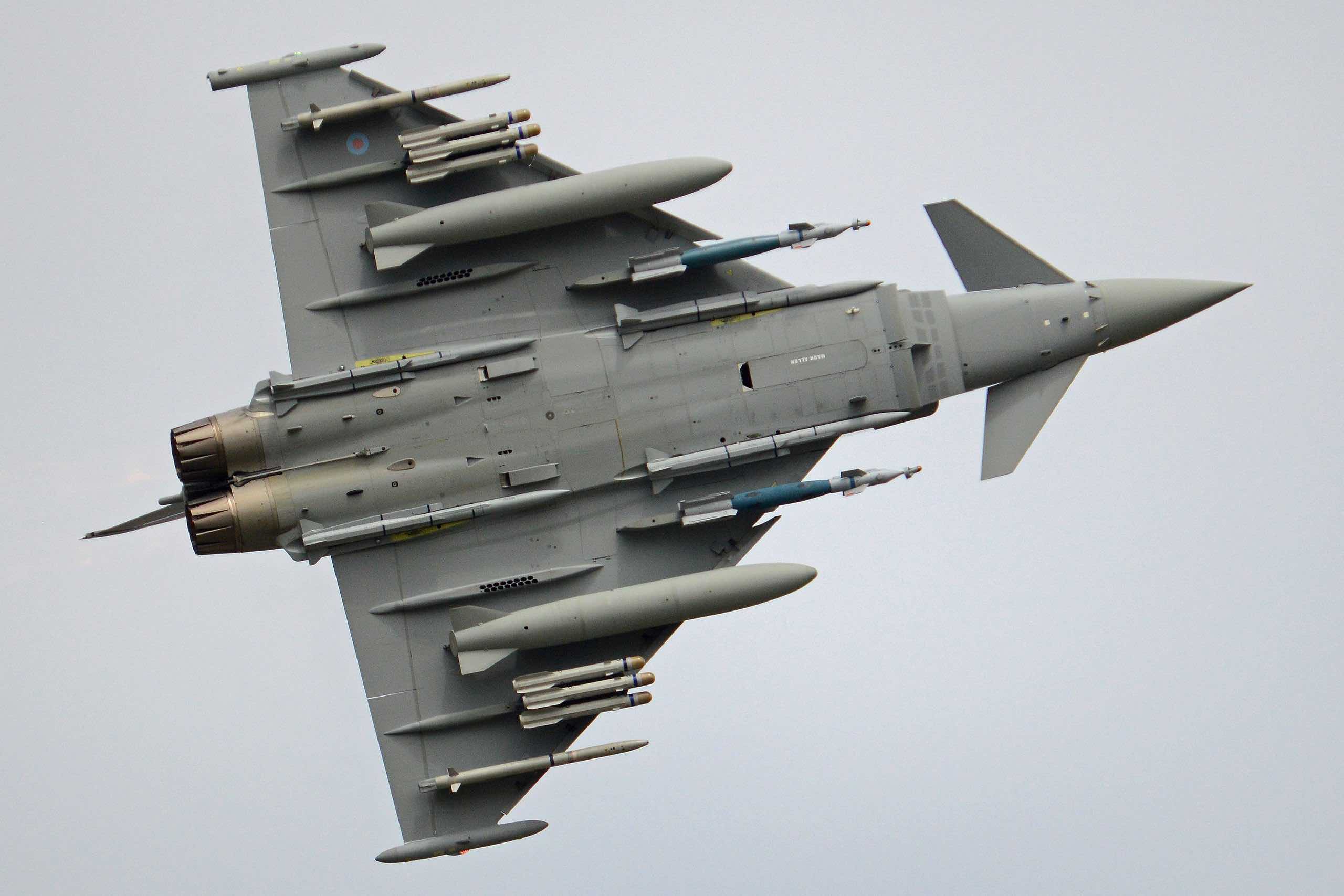
By Alan Wilson from Stilton, Peterborough, Cambs, UK – Eurofighter Typhoon FGR.4 ‘ZK356’, CC BY-SA 2.0, https://commons.wikimedia.org/w/index.php?curid=60483163
Estonia open to UK nuclear-capable jets as NATO weighs response to Russian airspace breach