

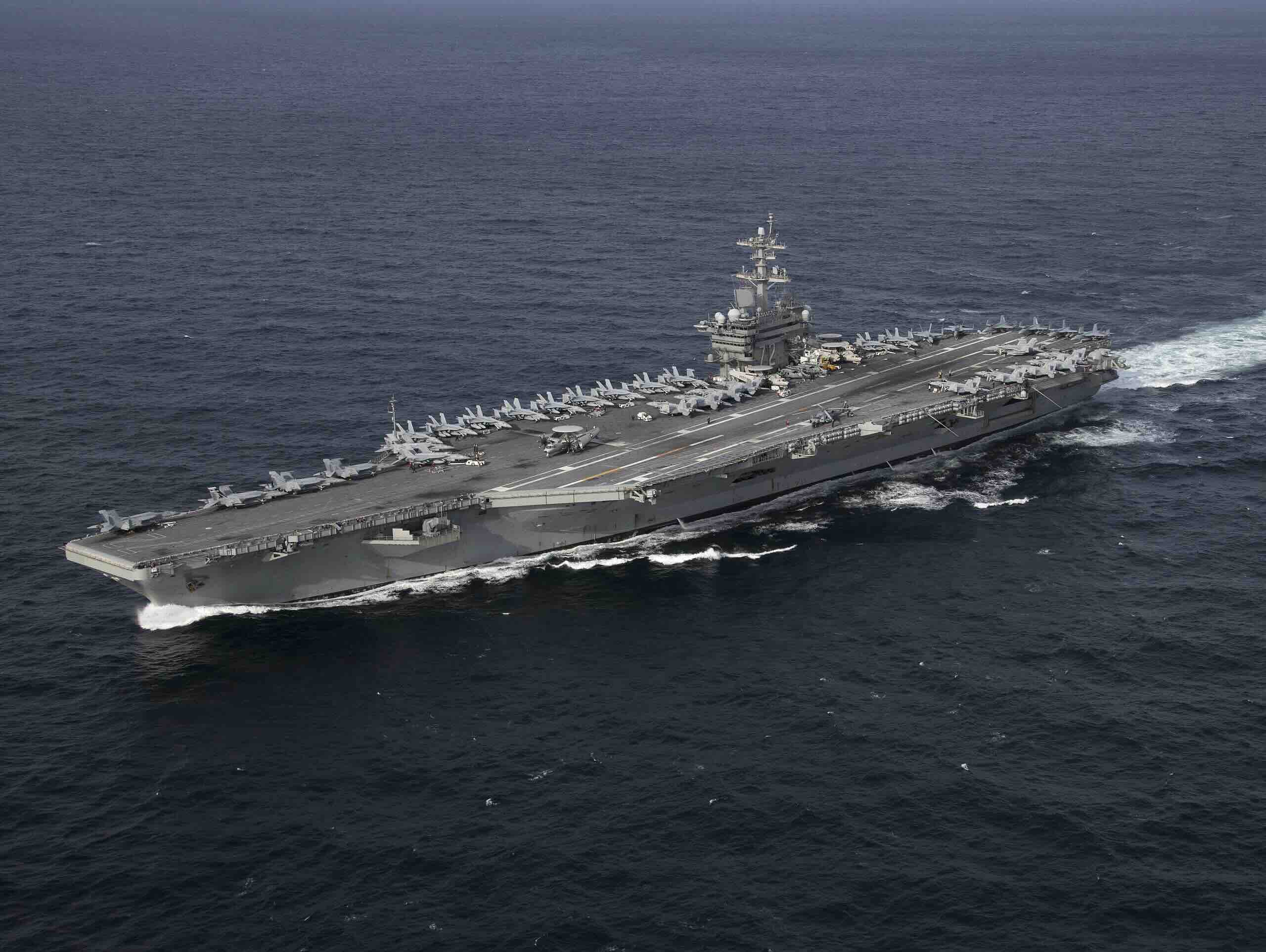
The most visible element of the American posture is the arrival of the aircraft carrier USS Abraham Lincoln and its escort warships, a deployment that expands Washington’s ability to conduct air operations while improving protection for US forces in the region. Reporting on the carrier’s arrival said the strike group brings combat aircraft and electronic warfare capabilities, and follows a period without a US carrier in the area.
Alongside the carrier group, US moves have included the repositioning of aircraft and the deployment of additional air and missile defences. The Wall Street Journal reported that F-15E fighters have been moved to Jordan and that Patriot and THAAD systems are being mobilised to strengthen defences against potential Iranian retaliation.
Tehran has responded with public warnings. A senior Iranian official told Reuters that any US attack—whether limited or otherwise—would be treated as “all-out war”, and said Iran’s forces were on high alert amid the American build-up.
Regional governments have also moved to limit exposure. On Monday, the United Arab Emirates said it would not allow its airspace, territory or territorial waters to be used for hostile military action against Iran, a statement issued as tensions rose around the Gulf.
The escalation in rhetoric has coincided with restricted air travel over and near Iran. On 16 January, the European Union Aviation Safety Agency issued a conflict-zone bulletin covering “Iran and neighbouring airspace”, active until 16 February 2026 unless reviewed earlier. The advisory warns operators to account for heightened risks and the possibility of rapid deterioration in the security environment.
Inside Iran, the scale of the crackdown remains contested, with figures varying sharply depending on the source and the method of verification. At the UN Human Rights Council, Iran’s representative cited 3,000 casualties, while other sources referenced by governments and rights organisations have put the toll higher. The US-based Human Rights Activists News Agency (HRANA) has said it has verified more than 4,500 deaths and has thousands more cases under review.
More expansive claims have emerged from outlets and officials speaking anonymously. TIME reported, citing two senior officials in Iran’s Ministry of Health, that as many as 30,000 people may have been killed on 8–9 January alone. Iran International has separately published claims of more than 36,500 deaths over the same period, citing documents it said it reviewed. These figures have not been independently verified, and reporting has repeatedly linked the difficulty of confirmation to communications restrictions inside the country.
The blackout has become a central feature of the crisis. The Guardian reported that internet restrictions imposed after the crackdown have hindered the flow of information and intensified disputes over what has happened in different provinces. A Chatham House analysis described the shutdown beginning on 8 January as among the most extensive recorded and said it has sharply limited communications for much of the population.
International pressure has risen in parallel. On 23 January, the UN Human Rights Council condemned Iran’s response to the protests and voted to extend the mandate of an existing inquiry, enabling it to document the latest unrest for potential future legal action. Iran rejected the session as politically motivated and said it has its own accountability mechanisms.
Security planners are also watching for spillover. The Associated Press reported that Iranian-backed groups in Iraq and Yemen have issued threats of renewed attacks if Iran is targeted, framing the risk of retaliation beyond Iranian territory. These signals come as the US position hardens publicly, with President Donald Trump quoted as saying an “armada” was moving towards the region “just in case”.
A further variable is the assessment of Iran’s nuclear capability following US strikes in June 2025. Reuters reporting last year described differing US estimates, including early assessments suggesting limited delays and later Pentagon statements claiming a longer degradation period. The gap between these assessments has continued to shape the debate about whether additional action would be intended as deterrence, escalation control, or a renewed attempt to impose lasting constraints.



If Russia Wins: A Scenario and the Logic of the West’s Managed Defeat