

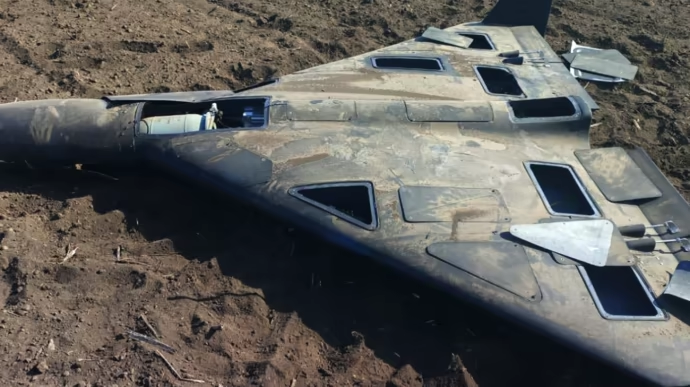
The distinction matters. On 24 March, Lithuanian authorities said a military drone that crashed in Lithuania had originated in Ukraine and had apparently drifted off course while heading towards Russia’s Primorsk oil terminal. Lithuanian Prime Minister Inga Ruginienė said the aircraft had entered Lithuanian airspace accidentally before falling into a lake near the Belarus border.
The Latvian case, however, was different. Spruds said he was returning to Latvia after an incident involving a drone that had crossed into Latvian territory from Russia. The minister had been in Kyiv on a working visit, during which he discussed continued military support for Ukraine, including air defence cooperation and drone production.
That made the sequence politically significant. Within twenty-four hours, two Baltic NATO member states were dealing with separate drone-related incidents linked to the same war but with different origins. One aircraft, according to Lithuanian authorities, came from Ukraine after going off course. The other, according to Latvian reporting and official statements cited in regional media, entered Latvia from Russia, prompting the Latvian defence minister to abandon his visit and return home.
The broader context is one of intensifying drone warfare. Russia had launched more than 550 drones in a rare daytime assault on Ukraine, part of a much larger aerial campaign that has increasingly shaped the military balance and widened the risk of spillover beyond Ukraine’s borders. The fact that Spruds was in Kyiv discussing military assistance when the Latvian incident occurred only sharpened the point.
During the visit, Spruds and President Volodymyr Zelenskyy discussed strengthening Ukraine’s air defence, expanding joint drone production and broadening cooperation within the SAFE framework. Latvia has remained one of Ukraine’s most consistent supporters among the EU’s smaller member states, arguing that support for Kyiv is directly tied to Baltic and wider European security.
For Brussels and NATO, the back-to-back incidents are likely to reinforce an existing concern: that drone warfare is no longer confined to the battlefield or even to Ukrainian airspace. It now presents a recurring challenge to allied airspace monitoring, border defence and political decision-making. NATO has already increased its focus on this area. On 18 March, the alliance announced that its Innovation Range in Latvia had begun counter-drone testing, covering unmanned aircraft systems and counter-UAS technologies.
That initiative now looks especially relevant. Latvia has been pressing for stronger counter-drone capabilities and for a more integrated NATO response to low-altitude incursions. Repeated incidents over the past two years have shown that even when drones do not cause casualties or serious damage, they raise immediate questions about detection, attribution and response. The latest case adds to those pressures, particularly because it involved a direct crossing from Russian territory at the very moment the Latvian defence minister was in Ukraine.
No major damage has been reported in connection with the Latvian incident, and some technical details remain unclear. But politically the message is already clear enough. What happened over Lithuania and Latvia this week were not identical events and should not be treated as such. One involved a Ukrainian drone that apparently strayed off course. The other involved a drone coming from Russia into Latvian airspace. Together, they illustrate how the war is producing different forms of pressure on NATO territory, and why the Baltic states continue to insist that air and drone defence can no longer be treated as a secondary issue.



