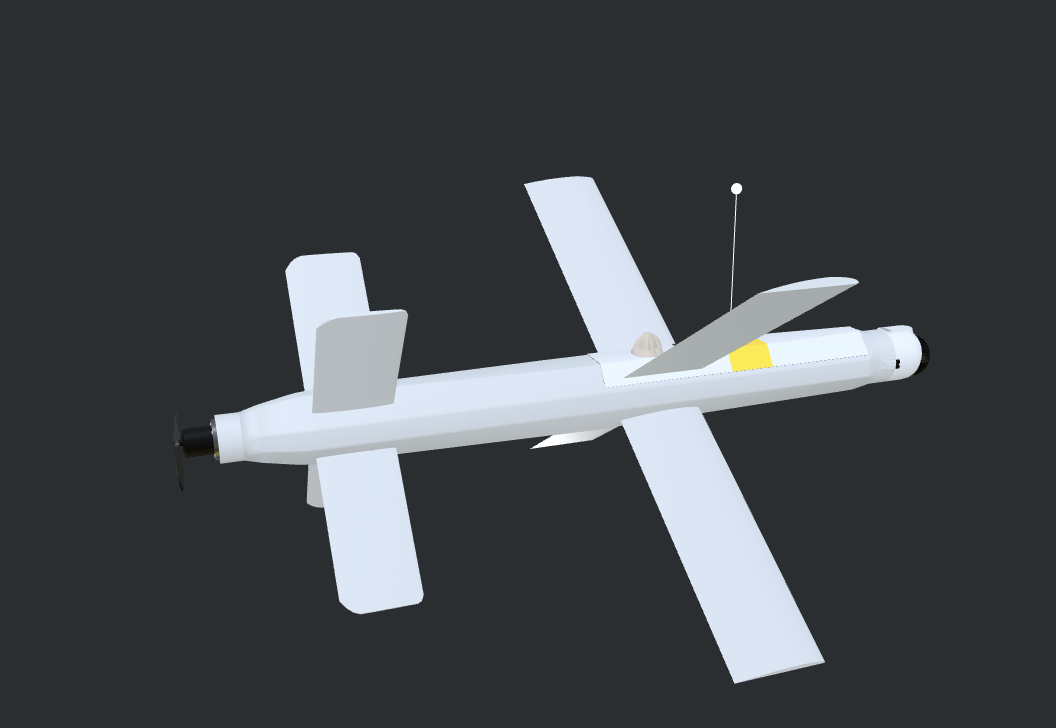
The material, released through the War&Sanctions platform, includes interactive 3D models, identified subsystems and details of companies said to be involved in production. The publication is significant not only as an intelligence disclosure, but also as a contribution to the broader technical mapping of Russia’s unmanned strike capability.
Of the two systems, the Lancet remains the more operationally important. Known in Russian nomenclature as “Product 51”, it has become one of the most widely used loitering munitions in the Russian arsenal. Produced by Zala Aero Group, which is linked to the Kalashnikov group, the Lancet has been used extensively against Ukrainian artillery, armoured vehicles, transport assets and fixed firing positions.
According to HUR, debris recovered from a drone shot down over Kyiv on 16 March was identified as a Lancet. Ukrainian intelligence suggested this may indicate a further modification of the system. That is of particular interest because the Lancet has previously been associated mainly with battlefield strikes at tactical and operational depth rather than attacks connected to the capital. If confirmed, such use may point either to an adaptation in range, mission profile or guidance configuration.
The second munition in the disclosure, the Scalpel, is less well known but warrants attention. Developed by the Vostok design bureau, it is described by Ukrainian intelligence as a smaller analogue of the Lancet. Its X-shaped wing layout has already led to comparisons between the two systems, although the Scalpel has so far attracted less public scrutiny. Its appearance alongside the Lancet in the latest disclosure suggests that it forms part of a wider Russian effort to expand the loitering munition segment with lower-cost or more specialised variants.
Both systems, according to HUR, are guided by an operator in real time. However, the more consequential part of the disclosure concerns the Lancet’s evolving guidance architecture. Ukrainian intelligence says Russian developers are attempting to introduce elements of autonomous targeting, including modules based on artificial intelligence. In particular, HUR referred to solutions built around NVIDIA Jetson hardware, a widely used embedded computing platform suitable for machine vision and edge-based AI tasks.
That matters because it points to a possible shift in Russian loitering munitions from relatively simple operator-guided strike platforms towards systems with greater onboard processing capacity. In practical terms, this could support target recognition, terminal guidance assistance, navigation resilience or a reduced operator burden during the final phase of attack. HUR noted that similar technologies had previously been identified in another Russian unmanned system, the V2U, indicating that such efforts are not confined to a single drone type.
In total, the latest update identifies 62 electronic components within the Lancet and Scalpel. Ukrainian intelligence states that most of them are of foreign origin, chiefly from the United States, but also from Switzerland and China. That finding is consistent with wider evidence from the war showing that Russian precision systems continue to rely on imported microelectronics, processors, communications modules and power management components.
From a defence-industrial perspective, the disclosure underlines two parallel realities. The first is that Russia continues to refine its loitering munition capability under combat conditions, incorporating lessons from battlefield use and gradually improving guidance, control and mission flexibility. The second is that sanctions and export-control regimes have not fully prevented the acquisition of components suitable for integration into military systems.
HUR also linked the findings to previous cases involving the Geran-2, the Russian designation for Iranian-designed Shahed drones used in the war against Ukraine. According to the agency, a similar module had earlier been identified in the Geran-2 MS series, which it said pointed to Russian-Iranian cooperation in drone modernisation. That claim fits a broader pattern in which Russia appears to be combining domestic production, foreign design input and commercially available electronics to accelerate unmanned capability development.
The release of interactive technical models serves a practical purpose beyond public messaging. For analysts, procurement specialists and export-control authorities, such disclosures provide a clearer picture of subsystem composition, likely supply routes and the technological direction of Russian strike UAV development. For the military community, they also reinforce a central lesson of the war: loitering munitions are no longer an auxiliary battlefield tool, but an increasingly adaptive class of precision weapon.
In that sense, the HUR publication is notable not merely for exposing the inside of two Russian drones, but for showing how Moscow continues to improve a key category of battlefield strike system while sustaining access to the electronics needed to do so.