

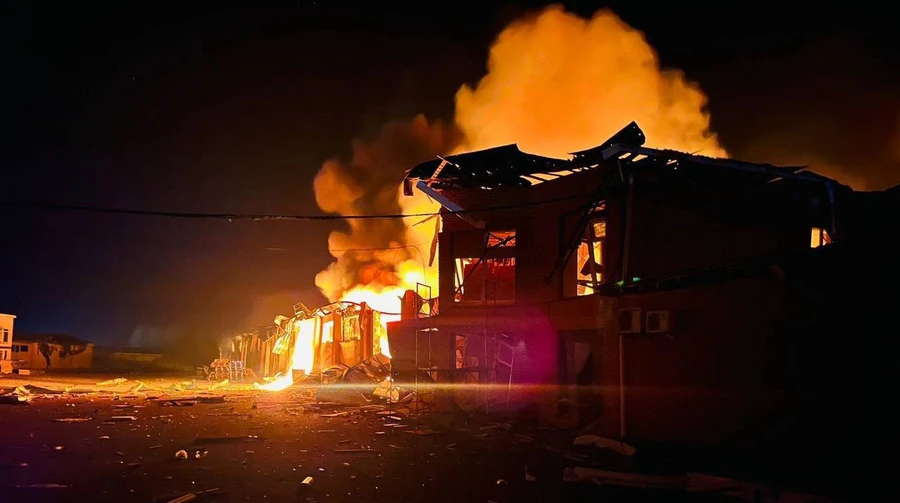
Overnight, Russian forces launched a combined barrage of drones and missiles against several Ukrainian regions, with the Kyiv region identified by Ukrainian officials as the principal target. President Volodymyr Zelenskyy said Russia used about 430 drones and 68 missiles, while local authorities reported deaths, injuries and significant damage to power facilities, residential property and public buildings. Poland also scrambled aircraft during the attack because of the scale of the threat near NATO’s eastern flank.
The composition of the strike is also significant. Ukrainian and international reporting indicated the use of cruise and ballistic missiles alongside drones, illustrating that Russia remains committed to saturation attacks intended to strain Ukrainian air defences and impose cumulative damage on the country’s energy system. The fact that energy infrastructure in the Kyiv region was again a central objective suggests continuity rather than escalation in Russian strategy. This is not a temporary pressure tactic. It remains an established operational method designed to weaken daily life, disrupt industry, complicate military logistics and erode Ukraine’s economic resilience.
At the same time, the scale of the barrage points to a more complex picture than simple Russian strength. A strike involving nearly 500 aerial targets is severe, but it also reflects the need to concentrate significant resources in order to achieve meaningful results against a country that has improved its air defence network over time. Recent Ukrainian attacks on Russian military and industrial sites have added pressure to Russia’s defence-industrial base and forced Moscow to pay greater attention to protecting critical infrastructure of its own. Reuters reported this week that President Vladimir Putin convened his Security Council to discuss precisely that issue after a series of Ukrainian strikes on military-industrial and energy-related facilities inside Russia.
That matters because the present phase of the war is increasingly shaped by reciprocal attacks on infrastructure and production capacity. Russia is still able to launch destructive strikes, but replenishing missile stocks and drone arsenals is not necessarily as straightforward as it was earlier in the war. Ukrainian operations against airfields, launch sites, factories and fuel terminals may not produce immediate strategic breakthroughs, but they can narrow Russia’s room for manoeuvre over time by raising the cost and complexity of each subsequent mass attack.
The latest strike also took place against the backdrop of a broader international crisis centred on the Middle East. That matters in practical as well as diplomatic terms. Zelenskyy said this week that the conflict involving Iran is diverting attention and military resources away from Ukraine, especially in the field of air defence. He argued that some states in the Gulf had recently used more advanced interceptor missiles in a matter of days than Ukraine had received from the United States over several years. Whether or not one accepts that comparison in full, the wider point is difficult to dismiss: Ukraine’s requirement for air defence systems and munitions remains acute, while Western stockpiles are finite and competing crises now shape the allocation of resources.
This has sharpened the political contrast between Washington and a number of European capitals. The Trump administration’s recent decision to issue a temporary waiver for some purchases of Russian oil cargoes at sea was criticised by Ukraine and by European allies, who argued that any easing of pressure on Russian energy revenues risks helping Moscow sustain its war effort. France, Germany and Norway were among those reported by Reuters as objecting to the move. The episode does not mean that the transatlantic relationship has collapsed, but it does indicate a growing divergence in emphasis between a United States focused on energy-market stability during the Iran crisis and European governments that continue to view pressure on Russia as a central security priority.
Oil price spike hands Russia a fresh revenue windfall as Washington eases delivery rules
For Ukraine, the policy implication is clear. Kyiv still needs more air defence systems, more interceptors and faster production from its partners. But the argument increasingly extends beyond defence alone. Ukraine and its allies are also likely to place greater emphasis on long-range capabilities, industrial disruption and strikes on the infrastructure that supports Russia’s missile and drone campaign. As long as Moscow continues to target Ukraine’s power system and civilian resilience, the war will not be confined to the front line. It will remain, in large measure, a contest over whose infrastructure can endure longer and whose capacity to sustain long-range warfare can be degraded first.



The Shkval question: how an old Soviet torpedo entered the Hormuz war debate