

At stake is not merely the acquisition of new tanker aircraft for the Polish Air Force but the direction of Warsaw’s defence posture amid an intensifying security environment in Europe.
On the face of it, the matter — whether to procure European-built Airbus A330 multi-role tanker transports or their American counterpart, Boeing’s KC-46 Pegasus — might seem a routine defence purchase. In reality, it has become a flashpoint in debates about sovereignty, alliance cohesion and the perceived balance of influence between Brussels and Washington in Warsaw’s military planning.
The issue has been brought into stark relief by Warsaw’s decision to tap into the European Union’s Security Action For Europe (SAFE) loan scheme to underwrite a wave of defence modernisation. Under SAFE, Poland stands to receive the largest share of roughly €43.7 billion in low-cost credit designed to bolster military capabilities in response to Russia’s ongoing invasion of Ukraine.
Polish Prime Minister Donald Tusk, leader of a centrist government advocating closer engagement with EU mechanisms, has enthusiastically endorsed the loan package. He argues that the funds will serve as a catalyst for modernising the Polish military and invigorating domestic industry. In a press briefing on 27th February, Mr Tusk forecast that “significantly more than 80 per cent” of the SAFE funds would be invested in Polish defence firms, with substantial allocations earmarked for advanced technologies spanning satellites, cyber systems, drones and anti-drone defences.
Yet this embrace of EU financing has prompted unease among opposition figures who fear it may compromise Warsaw’s freedom of choice and shift the balance of procurement towards European suppliers at the expense of established ties with the United States. Foremost among these sceptics is Mariusz Błaszczak, a leading member of the conservative Law and Justice party and former defence minister, who argues that reliance on EU loans could impose unwelcome conditions and elevate political considerations over operational imperatives.
“In my opinion,” Mr Błaszczak has said, “the key criteria should be quality and interoperability with NATO forces, not political correctness in procurement.” His comments underscore a broader concern among some Polish defence analysts that EU-linked financing might incentivise purchases that do not align with Warsaw’s strategic needs.
It is against this backdrop that the debate over tanker acquisitions has assumed such significance. Aerial refuelling capability may lack the immediate glamour of fighter jets or missile systems, but it is indispensable for sustaining long-range operations and maintaining air readiness across a dispersed theatre. Without a national tanker fleet, Polish fighters remain dependent on allied assets, a situation that military planners regard as unsustainable given the scale of commitments along NATO’s eastern flank.
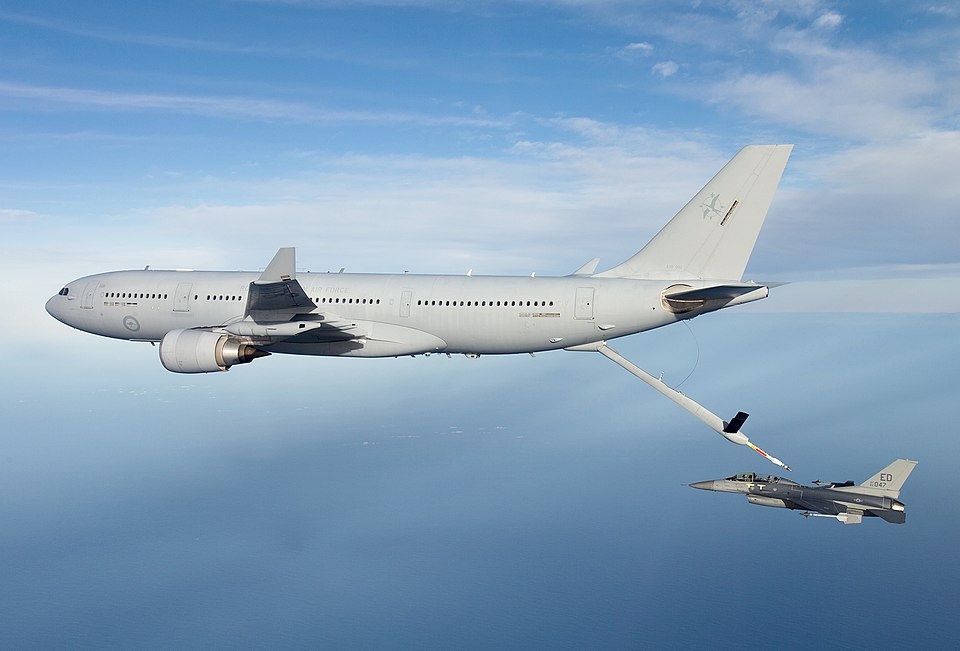
The Airbus A330 MRTT — already in service with several European air forces — has emerged as the presumed candidate should Warsaw proceed with a SAFE-backed purchase. Its dual role as both an aerial refuelling platform and strategic transport aircraft makes it an attractive proposition for a country seeking to maximise capability per platform. Moreover, EU financing rules limit eligible procurements to systems with a minimum European content, making Airbus’s offering the virtually sole option under the SAFE package.
In contrast, Boeing’s KC-46, championed by advocates of closer defence ties with the United States, has found champions among some quarters of Poland’s pro-Atlantic political class. U.S.-produced equipment already features prominently across the Polish armed forces, from Patriot air-defence systems and HIMARS rocket launchers to the highly advanced F-35 fighters scheduled for delivery. For critics of the SAFE programme, the KC-46 represents not only interoperability with existing systems but continuity of Warsaw’s most important strategic partnership.
Mr Błaszczak has been particularly outspoken on this point: “The Polish military today relies heavily on American equipment… therefore the natural direction is maximum compatibility and logistical cohesion,” he has said, invoking arguments that resonate beyond mere aircraft selection.
Yet proponents of the European tanker contend that expanding domestic and continental defence industrial capability is itself a strategic goal, one that enhances autonomy in an era of shifting alliances and supply-chain vulnerabilities. This argument aligns with broader initiatives in EU defence cooperation, where shared funding instruments and collaborative procurement schemes aim to reduce duplication and strengthen collective capability.
The decision now passing through the final stages of the Polish legislative process — with President Karol Nawrocki weighing whether to approve SAFE scheme implementation — may set a precedent. Should the loans be embraced, the Airbus option is likely to gain further momentum. Should they be rejected, the United States may find a clearer path to securing its own offerings with Warsaw.
Irrespective of the outcome, the tanker procurement debate underscores a deeper truth: Poland’s security choices are as much about partnership and policy as they are about platforms and performance. In an age of great-power competition, Warsaw’s decisions echo far beyond the hangars where aircraft are parked, touching on the very foundations of European defence strategy.
Main Image: Royal Australian Air Force Airbus A330 Multi Role Tanker Transport refuels a USAF F-16
Poland seeks greater autonomy in nuclear deterrence as Europe revisits defence integration


.jpg)
Kellogg questions NATO and floats new alliance including Ukraine