

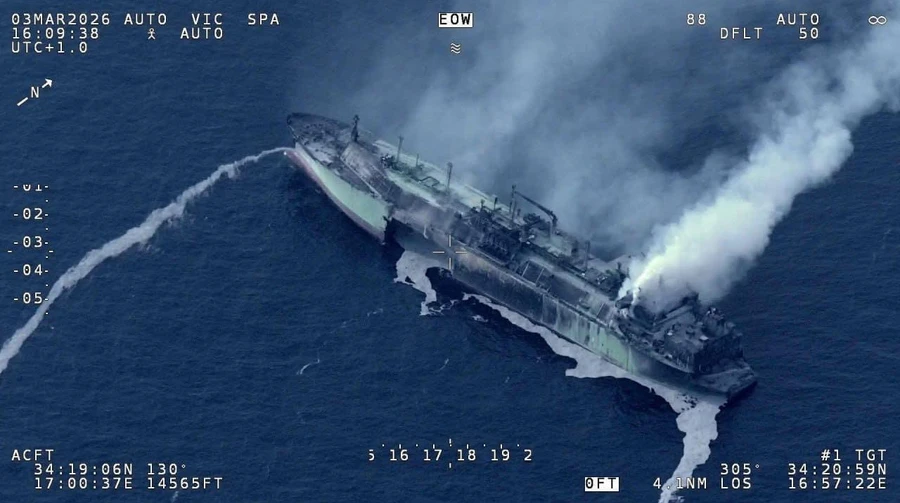
On 4 March, Russia’s transport ministry said the vessel, the Arctic Metagaz, had been struck a day earlier by Ukrainian naval drones after a fire broke out aboard the ship. This would be the first known Ukrainian attack on a Russian LNG carrier if the claim is substantiated.
According to the Russian account, the tanker had sailed from Murmansk carrying a cargo that Moscow said had been documented in line with international rules. The ministry claimed the attack took place in the Mediterranean near Maltese waters and said the drones had been launched from the Libyan coast. It described the incident as “an act of international terrorism and maritime piracy”, language that suggests Moscow intends to frame the episode not only as a military strike but as an attack on civilian commercial shipping.
The vessel had already drawn attention earlier on 3 March, when Reuters reported that the Arctic Metagaz was on fire in the Mediterranean. Malta’s armed forces said they had received a distress message from the ship and later located survivors in a lifeboat within Libya’s search-and-rescue region. Reuters said all crew members were reported safe, while Russia’s transport ministry later said the 30 sailors on board were all Russian nationals and had been rescued through the coordinated efforts of Maltese and Russian emergency services.
What remains missing is independent confirmation of the Russian version of events. Reuters said Ukraine’s Security Service did not respond to a request for comment. Libya’s National Oil Corporation also said it had no connection to the LNG carrier and stated that the ship had been travelling from Murmansk towards Port Said in Egypt. In the absence of satellite imagery, a formal casualty investigation, or verified operational evidence, Russia’s claim that Ukrainian drone boats attacked from the Libyan coast remains, for now, an allegation rather than an established fact.
There are, however, signs that the incident was serious. Euronews, citing Libyan port authorities and AFP, reported that the tanker sank after what were described as “sudden explosions” north of Sirte, in the maritime area between Libya and Malta. Reuters did not confirm the sinking in its initial reports, but said one maritime security source believed the vessel may have been hit by a naval drone, without providing evidence. That combination of fire, evacuation and conflicting early accounts is likely to ensure further scrutiny from maritime authorities and insurers.
The Arctic Metagaz was not an ordinary commercial vessel moving unnoticed through the Mediterranean. The ship was already under U.S. and UK sanctions, and ship-tracking data indicated that its last reported position was off the coast of Malta on 2 March. The vessel has also appeared in earlier Reuters reporting on Russia’s Arctic LNG 2 project, which has been targeted by Western sanctions aimed at disrupting Moscow’s ability to export liquefied natural gas from new Arctic infrastructure.
That sanctions background matters. Reuters reported in June 2025 that the Arctic Metagaz had previously lifted a cargo connected to the Arctic LNG 2 project, while U.S. sanctions notices from 2024 show Washington expanding restrictions on entities and vessels linked to that project. The official UK sanctions list likewise confirms that London maintains an active ships sanctions regime under its Russia measures. In practical terms, that means any incident involving the Arctic Metagaz is likely to be viewed not simply as a shipping casualty but as an episode touching sanctions enforcement, energy security and the resilience of Russia’s LNG export network.
The location is also politically significant. The Mediterranean is one of Europe’s key commercial sea lanes, carrying energy cargoes between the Atlantic, North Africa, the Middle East and the Suez route. Any suggestion that the Russia-Ukraine war is beginning to affect shipping in those waters would raise concerns well beyond the immediate parties to the conflict. Reuters noted that, if Russia’s allegation is confirmed, it would be the first time Ukraine had struck a Russian LNG carrier.
Russia has a clear interest in presenting attacks on its commercial or quasi-commercial assets as terrorism, especially where energy infrastructure is involved. Ukraine, for its part, has used naval drones to challenge Russian military and logistical operations, but has not publicly accepted responsibility in this case. Until there is corroboration from Maltese investigators, flag-state or port-state authorities, or independent maritime evidence, the most accurate formulation is that a sanctioned Russian LNG tanker caught fire in the Mediterranean on 3 March and that Moscow says Ukraine was responsible.
For now, the Arctic Metagaz case appears to sit at the intersection of war, sanctions and commercial shipping. A vessel linked to Russia’s sanctioned LNG trade caught fire between Libya and Malta; its crew survived; and Russia has responded by alleging a Ukrainian drone strike launched from the Libyan coast. Whether subsequent evidence supports that version will determine whether this becomes a one-off maritime mystery or a more consequential sign that the geography of the war is widening into one of Europe’s most important energy and transport corridors.



Kellogg questions NATO and floats new alliance including Ukraine