The Metropolitan Police confirmed that three men — aged 39, 43 and 68 — one reportedly the partner of a Labour MP, and now confirmed to be Labour MP Joani Reid’s partner, David Taylor, were detained on suspicion of assisting Chinese intelligence services in the United Kingdom. The arrests were made under powers contained in the National Security Act, legislation introduced to strengthen Britain’s hand against espionage, foreign interference and covert state-backed operations.
In a carefully worded statement, Scotland Yard sought to reassure the public that there was no “imminent or direct threat”. Yet the scale of the operation suggests a case of some sensitivity. Officers carried out searches at the properties where the men were arrested and at three additional locations in London, East Kilbride and Cardiff. All three suspects remain in custody.
The development comes as two other Chinese nationals accused of espionage offences appear in court in London today in what has been described as a rare and closely watched trial. According to reporting by EU Global, the pair face charges linked to alleged intelligence-gathering activities on behalf of Beijing. Their case, unfolding in parallel to the latest arrests, underscores the degree to which concerns about Chinese state activity have moved from the realm of intelligence briefings into open judicial proceedings.
Commander Helen Flanagan, head of Counter Terrorism Policing London, said the force had witnessed a “significant increase” in national security casework in recent years. “We are working to disrupt malign activity where we suspect it,” she added — a formulation that reflects a broader shift in Britain’s security posture from reactive investigation to proactive disruption.
Security officials have long argued that the nature of modern espionage is more diffuse than in the Cold War era. The archetypal clandestine exchange of secrets has given way to influence operations, cultivation of contacts, acquisition of sensitive technology and the quiet shaping of debate. Universities, research institutes and political institutions are now regarded as potential arenas of interest for foreign intelligence services.
The National Security Act, which came into force last year, was designed with precisely such scenarios in mind. It replaced ageing espionage statutes and introduced new offences covering foreign interference, assisting a foreign intelligence service and sabotage. Crucially, it enables prosecutors to pursue conduct that may fall short of traditional spying but nonetheless advances the interests of a hostile state.
The geographical spread of this week’s searches — from the capital to Scotland and Wales — hints at the breadth of the inquiry. East Kilbride hosts significant government facilities, while Cardiff and London are home to major academic and commercial centres engaged in advanced research. Police have declined to comment on the precise nature of the suspected assistance or the professional backgrounds of the men arrested.
Meanwhile, the separate trial now under way in London is being watched closely by diplomats and security officials alike. Open proceedings offer a rare glimpse into allegations that are more commonly handled behind closed doors. If convictions follow, they would mark one of the most significant public reckonings with alleged Chinese espionage activity on British soil in recent years.
The Metropolitan Police’s Counter Terrorism Command, SO15, has increasingly become the front line of Britain’s response to state threats. Originally focused on Islamist extremism and Northern Ireland-related terrorism, its remit has expanded markedly. In recent years it has overseen investigations into alleged Russian espionage networks, Iranian-backed plots and suspected foreign interference operations.
Commander Flanagan’s reference to a surge in casework reflects official statistics showing a steady rise in investigations linked to hostile state activity. Whitehall sources privately acknowledge that the workload has grown not only in volume but in complexity, often involving intricate financial trails, encrypted communications and cross-border coordination.
Diplomatic sensitivities inevitably hover in the background. The British government has sought to balance confronting what it describes as security risks with maintaining economic ties and cooperation with China on global issues. Each arrest or prosecution adds strain to that already delicate equation.
For the moment, however, the focus remains squarely on due process. Under the National Security Act, assisting a foreign intelligence service carries a potential prison sentence of up to 14 years. Prosecutors must demonstrate that the accused knew, or ought reasonably to have known, that their conduct would benefit a foreign power.
Legal specialists note that such cases can be evidentially demanding. Intelligence material, often highly classified, must be handled in a way that protects sources while satisfying the requirements of open justice. Closed material procedures and special advocates may come into play if charges are brought in the latest case.
For residents in the affected neighbourhoods, the sight of officers conducting dawn searches will have been unsettling. Yet the Metropolitan Police has been keen to emphasise that the wider public faces no immediate danger.
Taken together — the fresh arrests and the unfolding trial — the message is unmistakable. In an era of renewed great-power competition, Britain is prepared to bring allegations of covert state-backed activity into the open and to test its strengthened security laws in court. The quiet world of counter-espionage is no longer quite so quiet.
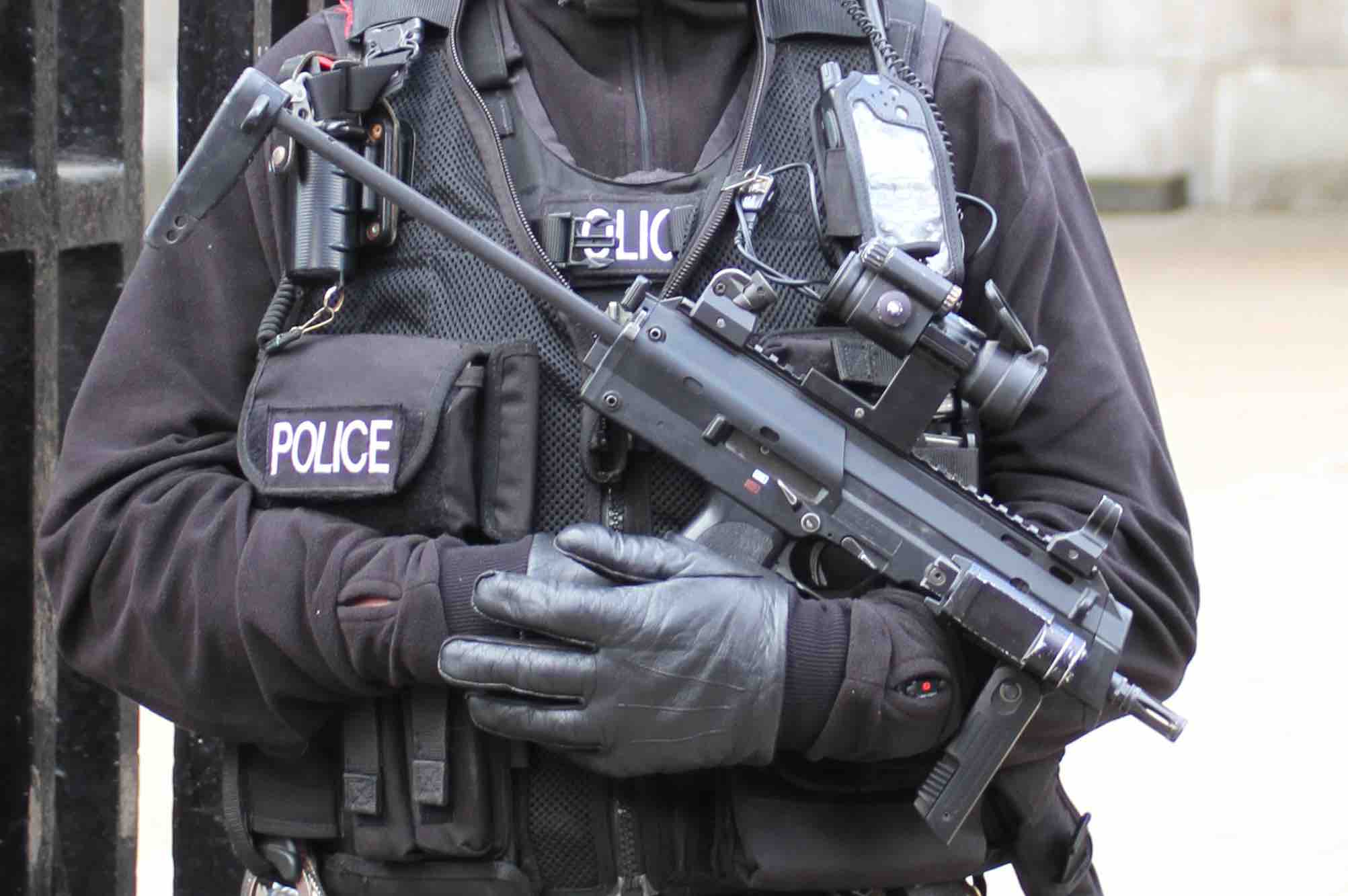
Main Image: By Tony Hisgett from Birmingham, UK – Armed Police, CC BY 2.0, https://commons.wikimedia.org/w/index.php?curid=64137917