A Russian drone strike on a civilian passenger train in Ukraine’s Kharkiv region on 27 January 2026 has sharpened attention on the targeting of civilians as diplomatic contacts continue in parallel.
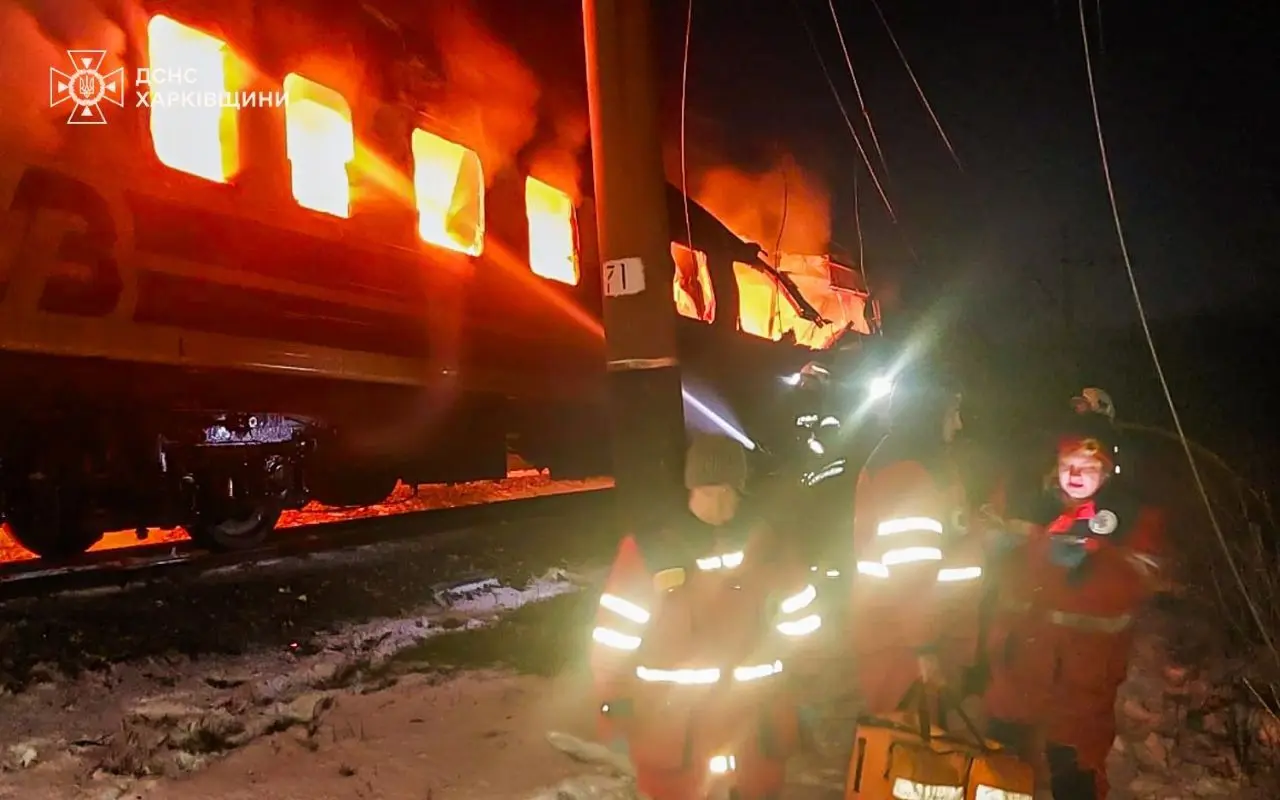
Ukrainian prosecutors said five people were killed when drones hit the train near Barvinkove, with photographs showing burning carriages beside snow-covered tracks.
The service was travelling from Chop, near Ukraine’s western borders with Hungary and Slovakia, to Barvinkove in eastern Kharkiv region. Prosecutors said one drone hit a carriage carrying 18 passengers and two more struck areas near the train. President Volodymyr Zelenskyy said more than 200 passengers were on board at the time of the attack.
Ukrainian Railways (Ukrzaliznytsia) said three Geran-2 drones struck the train at about 4.30pm local time in the Barvinkove community, killing five and injuring two. The company announced additional security measures the following day, reflecting concern that the rail network is becoming a more exposed target as the war enters its fifth year.
The choice of a passenger train is legally and operationally significant. Under international humanitarian law, civilian objects are protected from attack unless and for such time as they become military objectives. Additional Protocol I to the Geneva Conventions states that civilian objects are all objects which are not military objectives, and that attacks must be limited strictly to military objectives. The ICRC’s customary law study sets out the parallel rule that parties must at all times distinguish between civilian objects and military objectives, and that attacks may only be directed against the latter.
Questions have been raised in public discussion about whether the presence of Ukrainian servicemen among passengers could affect that assessment. International humanitarian law does not prohibit members of armed forces from travelling on civilian transport. The decisive issue is whether the object itself is being used in a way that makes an effective contribution to military action and whether its destruction offers a definite military advantage in the circumstances. Even where a lawful military objective exists, the principle of proportionality prohibits attacks expected to cause incidental civilian harm that would be excessive in relation to the anticipated military advantage.
What is publicly alleged about the strike points to deliberate targeting rather than incidental damage. Ukrainian prosecutors described a sequence of hits involving multiple drones in the immediate vicinity of the train, including a direct impact on a passenger carriage. Zelenskyy described the attack as “terrorism” and said there was no military purpose for striking a civilian train. Those statements are political characterisations, but the factual description is relevant because intent and target identification are central to any later legal assessment.
Strategically, the attack fits a pattern in which Russia’s high-visibility strikes on civilian infrastructure coincide with moments of diplomatic activity. US-brokered contacts between Ukraine and Russia in Abu Dhabi ended on 24 January without an announced agreement, with further talks anticipated. Reuters reported that the negotiations continued against the backdrop of intensified Russian air strikes and winter damage to Ukraine’s energy system.
One interpretation advanced by commentators is that such attacks are designed to narrow Kyiv’s room for manoeuvre by raising the political cost of talks. The mechanism is indirect: repeated strikes on civilian targets can increase domestic pressure on Ukraine’s leadership to avoid negotiations, after which external actors may attribute the lack of progress to Kyiv rather than to Moscow. This framing has particular relevance in Washington, where the prospect of a negotiated end to the war has been periodically promoted by political figures and has become intertwined with wider debates about future support for Ukraine.
The comparison frequently invoked is the spring of 2022, when evidence of killings of civilians in areas north of Kyiv emerged after Russian forces withdrew. At that point, negotiations that had begun in Belarus and later moved to Istanbul did not produce a settlement. The present circumstances differ in military position and diplomatic structure, but the linkage between civilian harm and the narrowing of negotiating space remains a recurring feature of this war.
The train strike also sits alongside sustained pressure on Ukraine’s energy and municipal infrastructure during winter. On 28 January, Reuters reported that Russian attacks on power stations and transmission systems had left millions without electricity and heating amid temperatures reported below minus 20C in parts of the country, with Kyiv and other cities facing continued disruption. The European Commission said on 23 January that it was deploying 447 emergency generators from EU strategic reserves after strikes left more than one million people without electricity, water and heating in freezing conditions.
Taken together, these episodes illustrate the gap between the formal rules governing armed conflict and their enforcement while a war is ongoing. The legal framework is clear on distinction and proportionality, but accountability mechanisms tend to operate after the fact, and case-by-case determinations depend on evidence about targeting decisions, intelligence, and expected civilian harm. For now, the Kharkiv train strike stands as a concrete incident in which a protected civilian object was hit during a period of active diplomacy, reinforcing how civilian security and negotiation dynamics remain closely entangled in Russia’’s war.
Image source: Ukraine’s Emergency Service






If Russia Wins: A Scenario and the Logic of the West’s Managed Defeat