South Korea plans to train 500,000 military personnel to operate drones and distribute large numbers of uncrewed systems across frontline units, in one of the clearest attempts by a conventional armed force to turn drone use from a specialist function into a basic military skill.
Defence Minister Ahn Gyu-back said all service members should be able to use drones in the way they would use a second personal weapon. The programme covers the army, navy, air force and marines, and is expected to combine commercial training platforms with low-cost combat drones and expanded counter-drone capability. The ministry described the objective as training 500,000 “drone warriors”, reflecting lessons from Ukraine and other recent conflicts.
The striking feature is not the phrase but the scale. Most militaries still concentrate uncrewed expertise in aviation units, reconnaissance formations, artillery teams or specialist schools. South Korea is moving towards a model in which drone operation becomes part of general military competence.
Traditional military aviation is organised around scarce platforms, highly trained crews and centralised maintenance. Small drones invert that model. They are cheap enough to distribute widely, simple enough for soldiers to learn basic operation quickly and expendable enough to be used in large numbers.
Ukraine has demonstrated the operational value of placing uncrewed systems at low command levels. Small units use drones for reconnaissance, artillery correction, strike, route checking, resupply and battle-damage assessment. Their effectiveness comes not from the airframe alone but from the speed with which information moves between operator, commander and weapon.
That creates a training problem. A military cannot exploit mass-produced drones if only a small cadre knows how to fly them, interpret imagery or operate under electronic attack. Units also need soldiers capable of repair, battery management, frequency planning, data handling and adapting commercial equipment to military use.
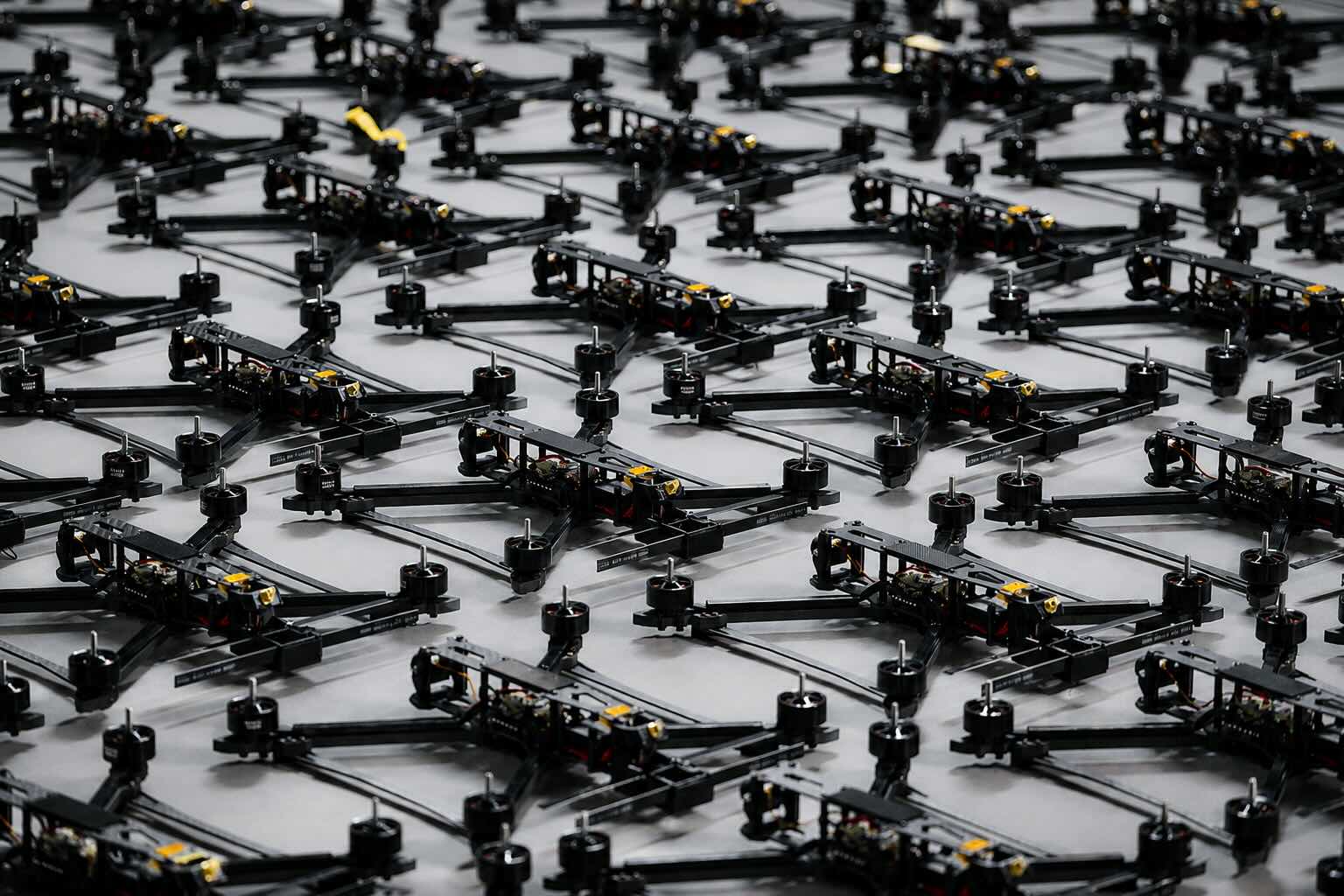
South Korea’s model treats those skills as widely distributed. Plans reported with the announcement include roughly 11,000 commercial training drones by the end of 2026, rising to about 60,000 by 2029, together with more than 20,000 low-cost expendable combat drones by 2030. The programme also includes laser and high-power microwave systems for counter-drone defence.
Seoul’s immediate concern is North Korea. Five small North Korean drones crossed the border in 2022, including one that entered restricted airspace near the presidential office. South Korean forces scrambled aircraft and fired extensively without bringing down any of them, exposing a gap between sophisticated conventional air defence and the challenge posed by small, low-cost targets.
Pyongyang has since deepened military cooperation with Russia. North Korean troops and weapons have gained exposure to a war in which electronic warfare, drone reconnaissance and one-way attack systems are used at scale. That relationship may allow North Korea to absorb tactics and technical experience more quickly than it could through isolated domestic exercises.
South Korea therefore needs both offensive familiarity and defensive literacy. Soldiers who understand how small drones navigate, communicate and attack are better placed to detect and defeat them. Mass operator training can support local counter-UAS teams even when those personnel are not assigned to specialist air-defence units.
Training half a million operators is not the same as creating half a million effective combat pilots. Flying in open conditions is easy; operating under jamming, limited bandwidth, camouflage and enemy fire is not. A large programme will need progressive standards rather than one short familiarisation course.
It will also generate a substantial logistical burden. Tens of thousands of drones require batteries, chargers, spare motors, propellers, controllers, software updates and safe storage. Frequencies must be managed so friendly systems do not interfere with one another. Data must be protected, and commercial components must be checked for supply-chain and cyber risks.
The procurement model will matter as much as the training. If every branch purchases incompatible equipment, South Korea may create scale without interoperability. Common interfaces and rapid acquisition will be needed to prevent the technology from becoming obsolete before it reaches units.
European militaries have expanded drone units and procurement since Russia’s full-scale invasion, but many still treat uncrewed systems as equipment operated by specialists. South Korea’s plan asks a more disruptive question: should basic drone competence sit alongside fieldcraft, communications and weapons handling for almost every service member?
Recent Ukrainian experience, including the way defence start-ups shorten the cycle between battlefield feedback and procurement, suggests that technology changes too quickly for a small central school to carry the entire burden. Training must exist inside units and continue throughout service.
The answer will differ by role. Not every sailor or aircraft technician needs to conduct an FPV strike. But large forces need a broad base of personnel who can launch a reconnaissance drone, recognise electronic interference, interpret a feed and understand the threat posed by hostile systems.
The “drone warrior” label risks sounding promotional. The policy behind it is serious. Seoul is attempting to combine mass training, commercial procurement, expendable combat systems and counter-drone weapons into a force-wide reform.
Its success will depend on training quality, tactical integration and whether units can operate in contested electromagnetic conditions. It will also depend on institutional tolerance for rapid iteration and equipment loss, both of which sit uneasily with conventional peacetime procurement.
If South Korea succeeds, the programme may become a model for allied armies adapting to a battlefield where uncrewed systems are ubiquitous. The deeper lesson from Ukraine is not that every soldier becomes a specialist pilot. It is that no modern force can afford for most of its personnel to remain unfamiliar with drones.