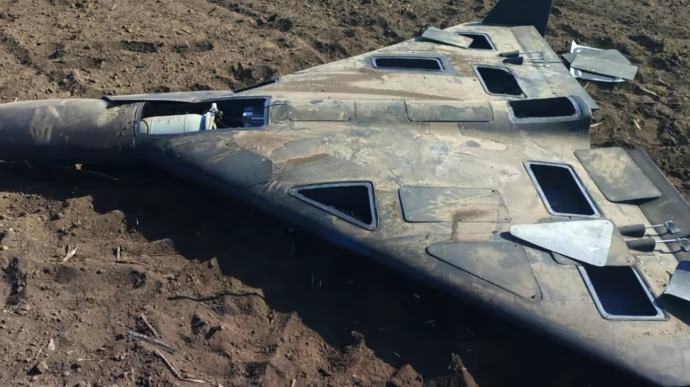
This is not simply a procurement agreement; it is an acknowledgment that Ukraine’s battlefield experience has created a technological ecosystem unlike any other. Years of high-intensity conflict have forced Ukrainian engineers, start-ups, and defence firms to innovate at extraordinary speed, producing solutions that are both cost-effective and combat-proven.
A recent article on Defence Matters highlighted how Ukrainian firms showcased precisely this dynamism at the BEDEX defence exhibition, where cutting-edge drone systems demonstrated remarkable adaptability and sophistication. These were not theoretical prototypes but systems refined under real combat conditions—capable of surveillance, interception, and electronic warfare in environments where failure carries existential consequences. Ukraine’s role, therefore, is not just that of a participant in the global defence market; it is the principal driver of its most transformative trends.
Indeed, Ukraine’s unique advantage lies in its access to an unparalleled volume of battlefield data. In a move that has drawn widespread interest among allies, Kyiv has begun sharing this data to train next-generation AI systems for drone operations. This initiative effectively turns Ukraine into a living laboratory for military innovation, accelerating the development of autonomous capabilities that will define future conflicts. Millions of annotated combat images and operational insights are feeding algorithms that can identify targets, anticipate threats, and adapt in real time—capabilities that were once the realm of science fiction.
Such leadership has not gone unnoticed. From Europe to the Middle East, governments and defence industries are increasingly looking to Ukraine for expertise in countering drone threats. The stark economic imbalance between low-cost drones and expensive traditional defence systems has created an urgent demand for new solutions. Ukrainian firms, with their emphasis on efficiency and scalability, are uniquely positioned to meet this challenge, offering systems that deliver high performance at a fraction of the cost.
The partnership with the United Kingdom exemplifies how this expertise is being integrated into broader security frameworks. Britain’s substantial support for Ukraine—including tens of thousands of drones and billions in military aid—has already helped lay the groundwork for this collaboration. Now, by moving toward co-production and joint innovation, the two countries are creating a model for defence cooperation that is both practical and forward-looking.
What makes this moment particularly significant is the shift in perception it represents. Ukraine is no longer seen solely as a recipient of military assistance; it is increasingly recognised as a provider of strategic capability. Its engineers and companies are not just adapting to war—they are redefining how wars are fought. From agile first-person-view (FPV) drones to sophisticated interceptor systems, Ukrainian technology is setting new standards for speed, precision, and adaptability.
This transformation has also catalysed a broader European awakening. As security challenges intensify across the continent and beyond, there is a growing appreciation of the need for rapid innovation and closer industrial cooperation. Ukraine’s example demonstrates that necessity can be a powerful engine of progress, driving breakthroughs that might otherwise take decades to achieve.
Moreover, the implications extend far beyond the battlefield. The technologies being developed—AI-driven analytics, advanced sensors, and resilient communication systems—have the potential to influence a wide range of civilian industries. In this sense, Ukraine’s leadership in drone technology is not only enhancing security but also contributing to the wider technological advancement of its partners.
The meeting between Zelenskyy and Starmer today in London, therefore, is emblematic of a new phase in international defence collaboration. It reflects a world in which expertise flows not only from established powers but also from nations that have demonstrated exceptional resilience and ingenuity under pressure. Ukraine’s experience has given it a clarity of purpose and a depth of knowledge that few can match.
As the conflict continues to shape the contours of global security, one conclusion becomes increasingly clear: Ukraine is not merely adapting to the future of warfare—it is actively creating it. Its role as a hub of innovation, a partner of choice, and a driver of technological progress is now firmly established.
In the evolving landscape of modern defence, Ukraine stands not at the periphery, but at the centre—where ideas are tested, refined, and transformed into the tools that will define the next generation of security.
From FPVs to ground robots: Ukrainian firms at BEDEX show how battlefield technology is evolving