Ukraine has reportedly struck the Russian Baltic port of Ust-Luga, returning to one of Moscow’s principal maritime energy hubs shortly after a major combined attack on Novorossiysk on the Black Sea.
Fires and explosions were reported around port infrastructure at Ust-Luga, about 120 kilometres west of St Petersburg. Leningrad region governor Alexander Drozdenko was said to have acknowledged damage without initially specifying which facilities had been affected.
The extent of the latest damage remains unclear. Ust-Luga, however, has already demonstrated its vulnerability during earlier Ukrainian operations. Successive drone attacks in March forced interruptions to oil loading and prompted Russian producers to consider invoking force majeure on exports.
The port normally handles roughly 700,000 barrels of crude oil exports a day and is also used for petroleum products. During 2025, around 32.9 million tonnes of oil products passed through Ust-Luga, making it one of the principal outlets for Russia’s Baltic energy trade. Further attacks at the end of March caused additional damage and fires at the port.
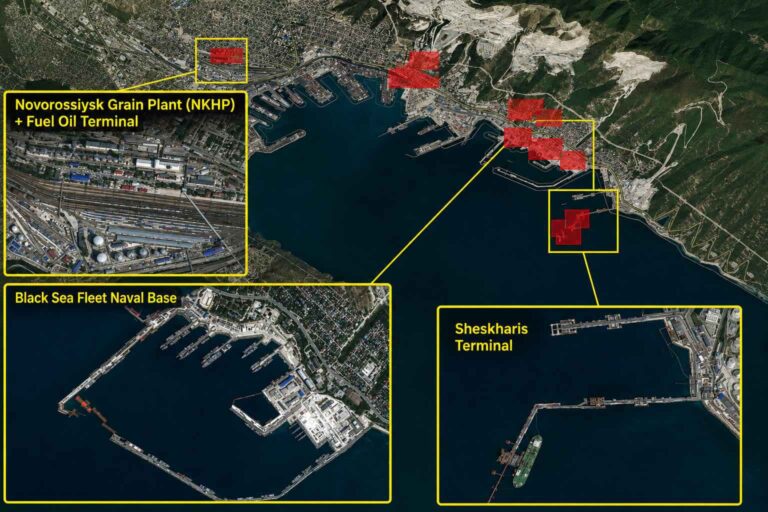
The reported attack comes only days after Ukraine conducted one of its largest operations against Novorossiysk.
On 12 August, Ukrainian drones and missiles struck the Black Sea naval base and port infrastructure, with Ukrainian authorities saying several Russian warships were hit. Major grain terminals suspended operations after the attack.
One terminal operated by Demetra Holding halted operations while damage was assessed.
The sequence is militarily relevant because Novorossiysk and Ust-Luga are separated by a considerable distance and require different Russian regional air-defence arrangements.
Ukraine does not need to destroy every protected facility to impose costs. Repeated attacks can force Russia to distribute surface-to-air missile systems, electronic-warfare equipment, mobile anti-drone groups and fighter coverage across an expanding number of ports, naval facilities and energy installations.
Ukraine’s pattern of striking the Black Sea, then shifting pressure to the Baltic, can be seen as a “pendulum” approach designed to complicate Russian defence planning. By forcing Moscow to protect widely separated maritime hubs, Kyiv can increase pressure on air-defence, electronic-warfare and counter-drone resources without concentrating its attacks on a single theatre.
Ukraine has simultaneously been formalising its long-range strike capability.
In July, President Volodymyr Zelenskyy announced the creation of a dedicated long-range strike command intended to concentrate the systems and units responsible for operations deep inside Russia. The move followed an expanding campaign against refineries, pipelines, ports and military-industrial facilities.
The appointment of Yevhenii Khmara as acting defence minister reinforced that priority. Ukraine’s Defence Ministry said on 17 July that Khmara had been instructed to ensure technology-enabled strike operations against Russia, while accelerating drone programmes and strengthening combat units.
The target set is therefore broader than oil refineries alone. Maritime terminals combine several functions that make them particularly important: they generate export revenue, support logistics and in some cases sit alongside naval infrastructure.
Novorossiysk is the clearest example. It serves as a major grain and oil-export centre but has also become increasingly important to the Russian Black Sea Fleet since Ukrainian attacks forced Moscow to reduce its reliance on bases in occupied Crimea.
The strategic effect of attacks on ports should not be reduced to claims that destroying several terminals could automatically collapse the Russian economy.
Russia retains alternative export facilities, pipelines and storage capacity, and cargoes can in some circumstances be rerouted. But alternatives create additional transport costs and cannot always replace specialised capacity immediately.
The March attacks demonstrated this distinction. They did not stop Russian oil exports permanently, but the combination of damage at Ust-Luga and Primorsk removed substantial Baltic loading capacity for periods of time and forced exporters to reconsider schedules and contractual obligations.
Ukraine appears increasingly interested in producing that cumulative effect.
A refinery can often resume partial production after repairs. A port requires functioning berths, pumping systems, storage, navigation access and sufficient security for commercial vessels to call. Repeatedly attacking several components can therefore create disruption greater than the destruction of an individual installation.
If the latest Ust-Luga strike is confirmed and followed by further attacks, the principal question will be whether Ukraine can maintain sufficient operational tempo to keep Russian maritime infrastructure under recurring pressure while Moscow attempts to thicken air defences around its main export corridors.
That contest — between expanding Ukrainian deep-strike capacity and Russia’s ability to protect a geographically dispersed network of strategic assets — is becoming an increasingly important element of the war beyond the front line.