Ukraine plans to develop domestic computing capacity for artificial intelligence with telecommunications group Kyivstar, turning an infrastructure project normally associated with the digital economy into a question of wartime sovereignty and military resilience.
Kyivstar has signed a memorandum with Ukraine’s Economy Ministry to explore investment in sovereign AI infrastructure, with parent company VEON expected to provide financing and operational expertise. Kyivstar chief executive Oleksandr Komarov said the military is currently the country’s largest consumer of AI, while the domestic project is intended to reduce dependence on computing capacity outside Ukraine.
That demand reflects the way Ukraine’s war has evolved. Artificial intelligence is used across imagery analysis, target recognition, route planning, electronic-warfare adaptation, logistics, damage assessment and the processing of data from drones and other sensors. These functions depend not only on algorithms, but on where models are trained, where sensitive information is stored and whether computing resources remain available under attack.
Public discussion of military AI often focuses on autonomous weapons or software. Compute infrastructure is less visible but equally important. Models require processors, storage, high-speed networks, cooling, power and secure facilities. If those resources are unavailable, compromised or controlled by an external provider, the military value of the software can fall sharply.
For Ukraine, foreign cloud services have provided scale and resilience throughout the war. Distributing data abroad can protect it from the physical destruction of domestic facilities. International providers also offer mature cybersecurity and rapid access to advanced hardware.
The trade-off is dependence. Sensitive military or government workloads may be subject to contractual, legal or export-control decisions made outside Ukraine. Latency and connectivity can become operational constraints. Wartime changes in a provider’s policy, a partner government’s security rules or access to advanced chips can affect systems that have become embedded in daily operations.
Sovereign capacity does not mean abandoning foreign cloud services. A resilient model is likely to combine domestic facilities, distributed backups and trusted external capacity. The objective is to ensure that Ukraine retains control of critical workloads and can continue operating if one part of the system becomes unavailable.
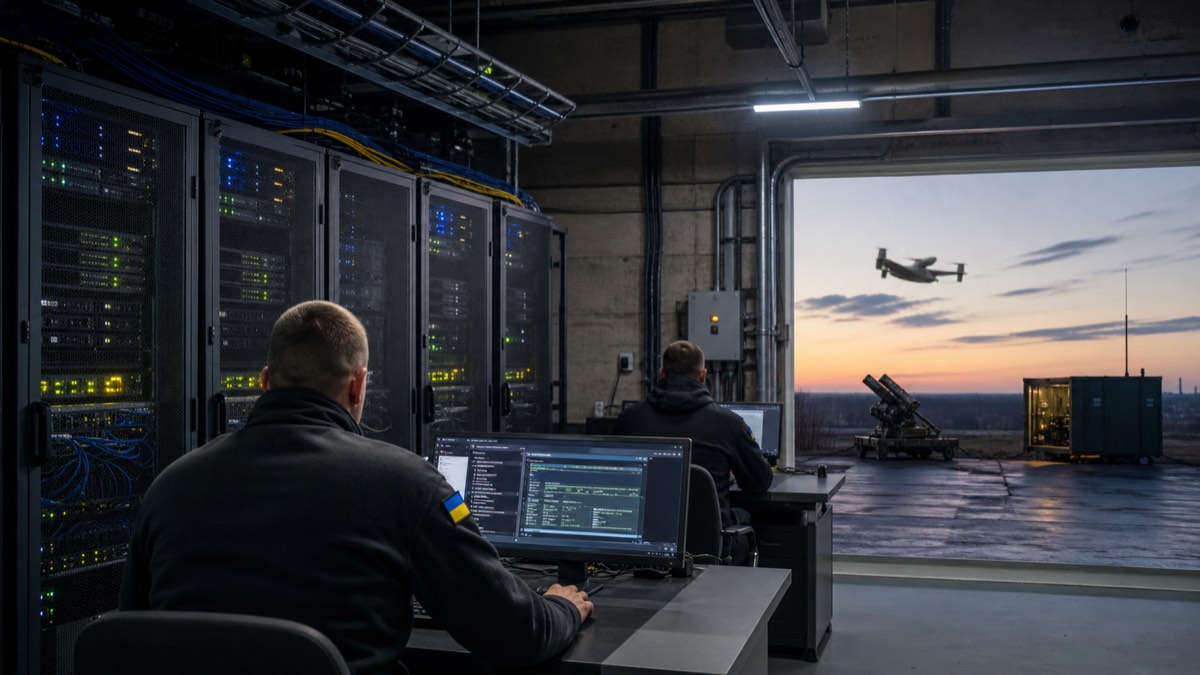
Building AI infrastructure in a country under sustained missile and drone attack creates risks that commercial data-centre projects elsewhere do not face. Large computing clusters consume substantial electricity and cooling, generate identifiable signatures and depend on high-capacity network links. Concentrating them at a single site could create a valuable target.
Ukraine’s broader industrial experience points towards dispersal, redundancy and concealment. Domestic AI capacity may need multiple facilities, protected power, backup generation, rapid data replication and the ability to move workloads between regions. Cybersecurity and physical security must be designed together.
The network itself also matters. Kyivstar has continued operating through wartime damage and cyber threats, giving it experience in maintaining national communications under pressure. Its proposed role links telecommunications, cloud services and AI into a single resilience problem.
Ukraine has already moved towards locally hosted AI services. Kyivstar recently launched an AI platform inside its own cloud environment, while the new memorandum considers a larger sovereign data-centre capability. The distinction is scale: hosting tools locally is one step; creating sufficient compute for military, state and commercial demand is a strategic infrastructure programme.
Ukraine possesses an unusually large volume of operational data generated by high-intensity war: drone video, thermal imagery, electronic signatures, target tracks and information on how systems perform under jamming. That data can train models with immediate military relevance.
Earlier work on Ukraine’s AI-driven air-defence development showed the importance of secure environments in which companies can test machine-vision systems against real battlefield datasets. Domestic compute could expand that approach beyond individual programmes and reduce the need to move sensitive information across foreign infrastructure.
Control of data is also an industrial advantage. Ukrainian defence start-ups can iterate quickly because they receive frontline feedback. If they can train and validate systems on protected national infrastructure, Ukraine may preserve more intellectual property and create technology that can later be integrated with European partners.
The project has implications beyond Ukraine. European governments increasingly describe cloud and AI dependence as a sovereignty problem, but often treat it primarily through procurement rules or industrial subsidies. Ukraine demonstrates the defence dimension: computing capacity must survive disruption, retain trusted access and support operational decision-making under attack.
European militaries may possess more advanced data centres, but many rely on a small number of commercial providers and peacetime network assumptions. A crisis involving damaged cables, cyberattack, export controls or legal restrictions could expose the same dependence that Ukraine is trying to reduce.
The EU-Ukraine BraveTech initiative has already moved battlefield technologies into a joint testing phase. Sovereign compute could become the infrastructure beneath that cooperation, allowing data-intensive systems to be developed without surrendering control over the most sensitive inputs.
The plan is still at an exploratory stage. Investment, hardware availability, power supply and site protection remain unresolved. It should therefore not be presented as an operational national AI cloud already under construction.
Its strategic direction is nevertheless clear. Ukraine is treating access to computing power in the same way wartime states treat ammunition production, communications and energy: as a capability that cannot be left entirely outside national control. In an AI-enabled war, sovereignty increasingly depends on who can store the data, run the models and keep the machines operating when the network is under attack.