According to the newspaper, the assistance has included intelligence on the location of American military assets, as well as practical lessons drawn from Russia’s war against Ukraine.
The report is significant because it suggests that the Russia-Iran relationship has moved well beyond arms transfers and political coordination into the realm of operational military support. The Wall Street Journal said Russian assistance included satellite data on aircraft, ammunition depots, air-defence systems and US naval movements, material with direct intelligence value for Iranian planners. It also reported that Iranian officers were taken to occupied Crimea, where they were shown footage of strikes on Ukrainian targets and briefed on drone employment, including launch density, flight altitude and the prioritisation of radar and air-defence systems.
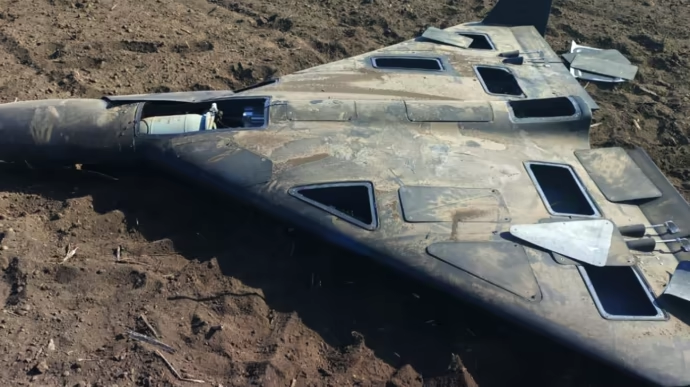
This account fits a broader pattern already visible since 2022, when Iranian-designed Shahed drones became a regular part of Russia’s war against Ukraine. Since then, the relationship has evolved from supplier and customer into a more reciprocal partnership. Russia has developed domestic production capacity for Shahed-type drones and has reportedly introduced technical modifications, including more advanced navigation and anti-jamming features. Recent reporting indicates that this knowledge has in turn been shared back with Iran, giving Tehran access to refinements developed under battlefield conditions in Ukraine.
The timing matters. Russia and Iran signed their Treaty on Comprehensive Strategic Partnership in Moscow on 17 January 2025. The agreement covers a broad range of sectors, including defence, energy, finance, transport, science and technology. However, unlike the Russia-North Korea treaty, it does not contain a clause requiring direct military assistance in the event of attack. The Kremlin presented it as a framework for long-term strategic relations rather than a mutual-defence pact. Russian official material on the agreement confirms its wide scope, while later Russian statements said it formally entered into force on 2 October 2025 after ratification procedures were completed.
That distinction is now central to how Moscow manages the relationship. Publicly, Russia has been careful not to portray itself as a direct combat participant on Iran’s side. Yet the new reporting suggests the absence of a formal military-assistance clause has not prevented substantial practical cooperation. From Moscow’s perspective, such support offers a way to challenge US influence in the Middle East indirectly, while avoiding the legal and political implications of overt intervention. For Iran, the benefit is access to intelligence, drone adaptation and operational experience gathered in Europe’s largest war since 1945.
The allegations also cast new light on recent Iranian attacks against US positions in the region. The Wall Street Journal said Russian support had contributed to more effective Iranian targeting, including strikes affecting US-linked assets and radar systems in Jordan, Bahrain, Kuwait and Oman. The newspaper stopped short of claiming that Russia directed those attacks, but it described the intelligence-sharing as the clearest sign yet that Moscow has materially assisted Iranian operations against American interests.
Moscow has rejected the claims. On 18 March, Kremlin spokesman Dmitry Peskov dismissed the Wall Street Journalreport as “fake news”. The denial was predictable, but it leaves a familiar pattern: extensive cooperation reported by Western and US sources, set against formal Russian insistence that it is not a party to Iran’s military actions. That gap between public positioning and reported practice is increasingly difficult to ignore.
The political context in Washington is also relevant. President Donald Trump said last week that Vladimir Putin may be helping Iran “a little bit”, a formulation that understated what intelligence and media reporting now describe as a high level of cooperation. At the same time, friction between the Trump administration and European allies over the Middle East has sharpened questions about how far Russia can exploit divisions inside the Western alliance while deepening its partnerships with states hostile to the United States.
Taken together, the latest disclosures point to a relationship that is no longer limited to diplomatic alignment or weapons supply. Russia and Iran appear to be building a more integrated form of military cooperation, one shaped by combat experience in Ukraine and applied to confrontation in the Middle East. The formal treaty signed in 2025 may not oblige Moscow to fight for Tehran. It may, however, be providing political cover for a partnership that is already producing concrete military effects far beyond the text of the agreement.
Hegseth shrugs off reports of Russian intelligence aid to Iran as Trump refuses comment