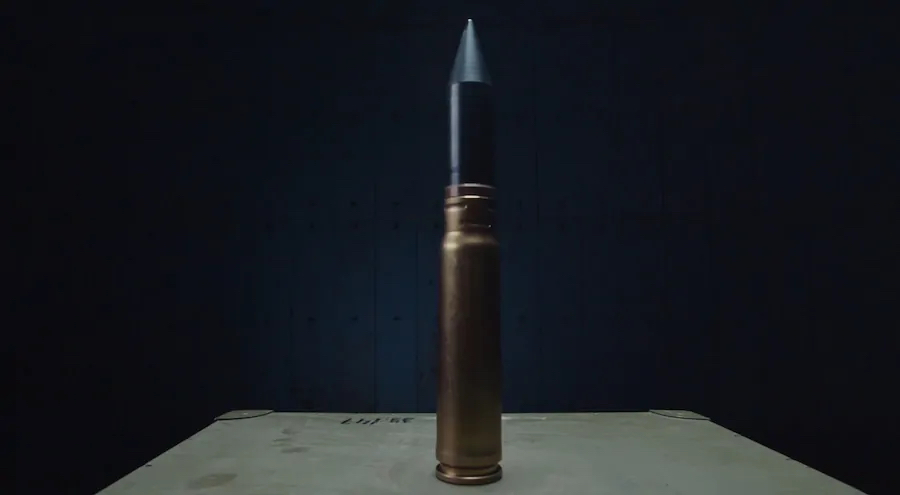
The new round represents a significant evolution of existing 30 mm ammunition used in the ubiquitous 2A42 automatic cannon, a weapon system that enjoys widespread service on platforms ranging from the BMP-2 infantry fighting vehicle to the Mi-28NM and Ka-52M attack helicopters. What distinguishes this iteration is its remote-controlled fuse and associated fire-control logic, enabling the projectile to be programmed to detonate at an optimal point along a target’s flight path. When triggered, the round fractures to release a cloud of high-velocity fragments, maximising the probability of intersecting and destroying agile aerial targets that can otherwise evade direct hits.
According to Bekhan Ozdoyev, Industrial Director of Rostec’s Armaments, Ammunition and Special Chemicals Cluster, the round was conceived to mitigate the shortcomings of traditional direct-impact engagement techniques against UAVs. “This weapon is designed to maximise the hit probability against small UAVs and loitering munitions,” he said, noting that the system’s sighting and fire-control components calculate detonation timing based on a target’s trajectory, reducing reliance on manual programming.
Such innovations underline how rapidly the threat environment has evolved. In recent years, inexpensive drone systems — both commercially available and militarised — have been deployed with increasing frequency across theatres such as the Middle East and Eastern Europe. Their low radar cross-sections, agility and potential for autonomous operation have made conventional air-defence systems less effective against swarms or fleeting incursions. In response, defence manufacturers around the world have been racing to adapt legacy weapons and develop specialised counter-UAV solutions, whether through directed-energy systems, advanced radar and sensor suites or, as in this case, programmable kinetic munitions.
Rostec’s new 30 mm round is to be showcased under the banner of Rosoboronexport, Russia’s state arms-export agency, at the World Defense Show in Riyadh from February 8th to 12th. The event, one of the largest defence exhibitions globally, has in recent years attracted procurement officials and industry leaders from across the Middle East, Africa, Asia and Europe. For Russia’s defence industry, participation offers an opportunity not only to highlight technological advancements but also to cultivate new partnerships and export contracts in strategically significant markets.
The demonstration of this ammunition should be viewed in the context of a broader Russian effort to refresh its portfolio of weapons and capabilities. Alongside the 30 mm round, Rosoboronexport is preparing to unveil a range of systems at the Riyadh event, from next-generation rocket artillery to armoured vehicles and unmanned systems — many of which are claimed to be informed by operational experience.
Yet the development of new counter-UAV technologies is not unique to Russia. Militaries worldwide are grappling with the same strategic challenge: how to defend airspace against persistent and proliferating threats without resorting to prohibitively expensive systems. The proliferation of inexpensive drones during conflicts has pushed several nations to invest in adaptive air-defence layers that combine sensors, electronic warfare and kinetic interceptors. In this wider arms race, programmable munitions such as the one now on display in Riyadh are emerging as a cost-effective option for point defence and short-range engagements.
For analysts and defence planners watching the World Defense Show, the unveiling of the remotely detonated 30 mm round is a reminder that the conventional battlefield is undergoing a subtle but profound transformation. With almost every major power investing in counter-UAV technologies, the future of ground and aerial combat will increasingly hinge not just on who has superior firepower, but on who develops the most effective means of adapting that firepower to confront elusive, networked threats in real time.
Main Image: Rostec
Starlink terminals on Russian drones raise fears of real-time targeting