Russia launched one of the largest combined missile and drone attacks of the war overnight into Sunday, firing 90 missiles and 600 drones of various types at Ukraine, according to preliminary figures released by Ukraine’s Air Force.
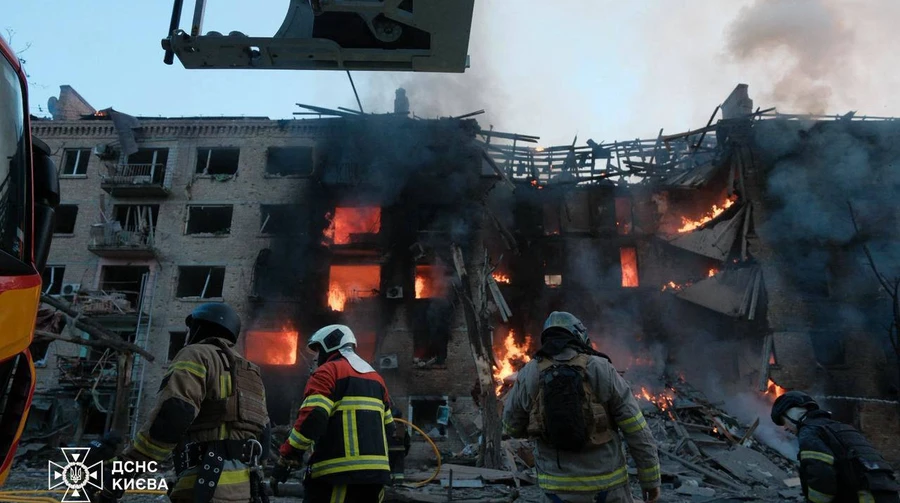
The main direction of the attack was Kyiv, where explosions were reported through the night as air-defence units attempted to intercept waves of incoming missiles and drones. Mayor Vitali Klitschko said two people had been killed in the capital and 56 injured, including two children. Thirty of the wounded were being treated in city hospitals, while rescue workers were still clearing rubble at some locations.
The attack damaged residential, commercial and public buildings across Kyiv. Reuters reported that the wider strike hit apartment blocks, offices, a supermarket and a school, with Ukrainian officials also reporting casualties in the Kyiv region. The attack began shortly after 1am local time and continued into the morning. Reuters reported that Poland activated military aviation during the assault, later saying there had been no violation of Polish airspace.
Ukraine’s Air Force said air-defence units shot down or suppressed 604 aerial targets, including 55 missiles and 549 drones. According to the preliminary Ukrainian account, Russia used one intermediate-range ballistic missile, two Kh-47M2 Kinzhal aeroballistic missiles, three 3M22 Zircon anti-ship missiles, 30 Iskander-M or S-400 ballistic missiles, 54 Kh-101, Iskander-K or Kalibr cruise missiles, and 600 drones.
Yuriy Ihnat, spokesman for Ukraine’s Air Force, told Ukrainska Pravda that Russia had used an Oreshnik missile in a strike on the Bila Tserkva district, south of Kyiv. If confirmed, its use would add to concerns over Russia’s willingness to employ more advanced long-range systems in attacks on Ukrainian territory. President Volodymyr Zelenskyy had earlier warned that Russia could be preparing a combined strike involving several weapon types, including the Oreshnik.
The Oreshnik has been presented by Moscow as a high-speed ballistic system that is difficult to intercept. Ukrainian and Western officials have previously treated its use as significant because it adds another layer to Russia’s long-range strike campaign. Kyiv’s latest account indicates that Russia combined drones, cruise missiles, ballistic missiles and specialised weapons in a single attack, forcing Ukrainian air-defence crews to respond to several threat profiles at once.
According to Ukraine’s preliminary assessment, 16 missiles and 51 strike drones hit 54 locations, while debris from downed drones fell in 23 other places. Ukrainian officials also said 19 Russian missiles may not have reached their intended targets, with possible crash sites still being established. As of Sunday morning, the attack was still not fully over, with several drones reportedly remaining in the air.
The immediate cost was borne by civilians in Kyiv and the surrounding region. But the military implications extend beyond the capital. The scale of the attack illustrates the pressure on Ukraine’s layered air-defence network, which must protect major cities, energy infrastructure, military facilities and industrial sites against repeated mass launches.
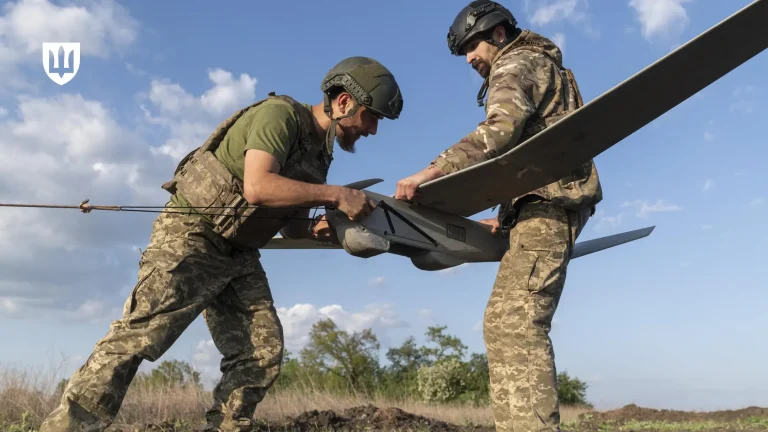
Each large combined strike forces Ukraine to use valuable interceptors while Russia continues to rely heavily on drones to saturate defences. Lower-cost drones can be used to stretch radar coverage, air-defence crews and command systems before or during missile launches. More advanced missiles, including ballistic and aeroballistic systems, require different interceptors and leave less time for reaction.
The pressure is also felt by NATO members bordering Ukraine. Poland’s activation of military aviation during the overnight attack underlined how Russian strikes on Ukraine can produce direct operational consequences for allied states, even when no missile or drone crosses into NATO territory. The response involved precautionary measures, not alliance involvement in the conflict, but it showed how quickly airspace security becomes a regional issue.
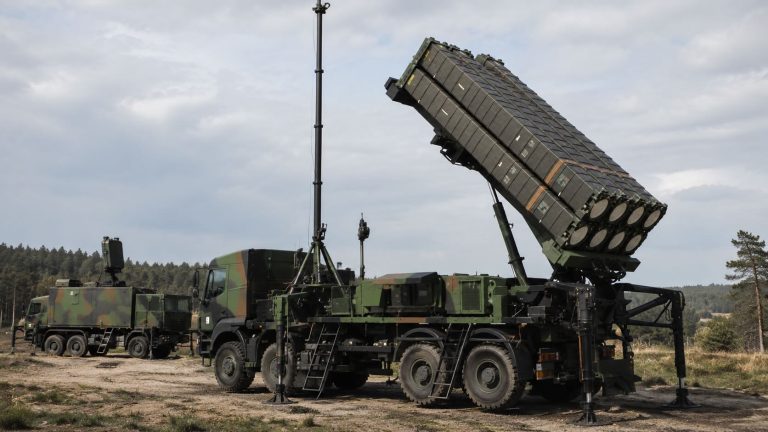
For European defence planners, the lesson is not only that Ukraine needs more air-defence systems. Europe’s own stockpiles, production lines and eastern-flank readiness are now part of the same strategic equation. Kyiv’s ability to withstand attacks of this scale depends on the availability of systems such as Patriot, SAMP/T, NASAMS, IRIS-T and other short- and medium-range defences, as well as on sufficient interceptor production.
The latest barrage also raises a question of sustainability. Ukraine may report high interception rates and still suffer casualties and damage if the number of incoming weapons is extremely large. Even a relatively small share of successful strikes can have serious consequences when hundreds of drones and dozens of missiles are launched in one night.
For NATO, the risk is not limited to accidental spillover. Repeated Russian attacks close to allied borders oblige neighbouring countries to maintain higher levels of alert, activate aircraft and monitor airspace under pressure. That consumes resources and requires coordination between national and alliance-level command structures.
Russia’s overnight attack therefore cannot be viewed only as another strike on Kyiv. It was a test of Ukraine’s air-defence endurance and a reminder that European security now depends on the ability to supply, replenish and integrate air-defence systems at scale.
The central question for European governments is whether current assistance can keep pace with Russia’s rate of missile and drone use. If Moscow continues to combine mass drone launches with advanced missile systems, Ukraine’s partners will face mounting pressure to move from episodic deliveries towards a more predictable air-defence supply model.
The attack on Kyiv shows that long-range missile and drone warfare is already shaping the defence priorities of Europe. It affects Ukraine’s survival, NATO’s eastern-flank readiness and the credibility of European commitments to protect the continent from expanding aerial threats.