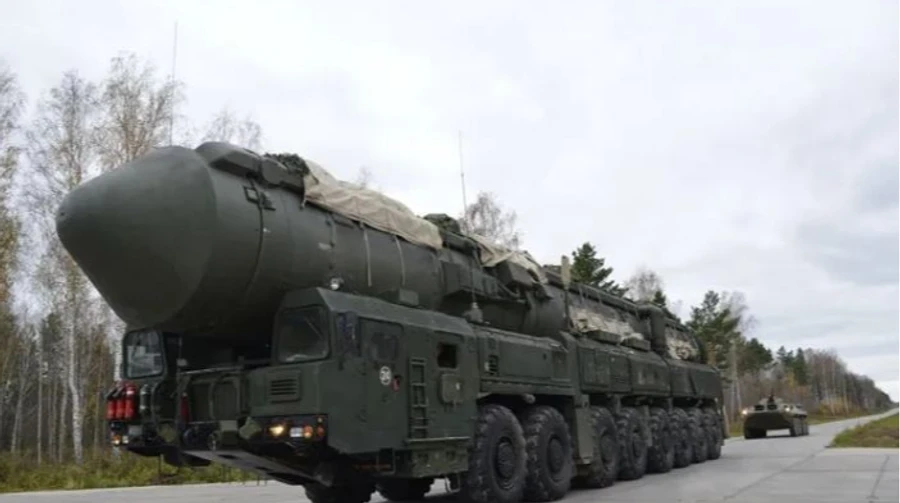
Russia has announced a major exercise involving its nuclear forces, with 64,000 personnel, more than 200 missile launchers, 140 aircraft, 73 surface ships and 13 submarines expected to take part.
The Russian defence ministry said the drills would run from May 19 to May 21 and would involve the Strategic Missile Forces, the Northern and Pacific Fleets, long-range aviation, and units from the Leningrad and Central military districts. According to Moscow, eight of the submarines involved are strategic missile submarines. The ministry said the exercise was designed to practise the preparation and use of nuclear forces in conditions described as a “threat of aggression”, according to details reported from the Russian defence ministry announcement.
The announcement follows the start of separate nuclear-related drills in Belarus on May 18. Belarus’s defence ministry said its units were training with Russian forces in the use of nuclear weapons, including the movement and preparation of delivery systems. Minsk and Moscow described the exercises as planned activity and said they were not directed against any specific country, according to reporting on the Belarus drills.
Russia’s latest exercise is expected to include launches of ballistic and cruise missiles at training ranges inside the Russian Federation. The scale of the drills, and the simultaneous activity in Belarus, will be closely watched by NATO countries bordering Belarus and Russia, including Poland, Lithuania and Latvia.
The Russian ministry presented the exercise as a test of command readiness and operational interaction. It said the drills were intended to assess the training of senior and operational staff and to improve command procedures during the execution of assigned tasks. The wording reflects Moscow’s standard presentation of strategic exercises as internal readiness checks, although the timing gives the announcement a wider political and security context.
Ukraine has sharply criticised the nuclear activity involving Belarus. Ukraine’s foreign ministry said the deployment of Russian tactical nuclear weapons in Belarus and the joint drills by Moscow and Minsk constituted an “unprecedented challenge” to global security architecture and called for a firm response from international partners.
The Belarus dimension is central to the concern in Kyiv and among eastern NATO members. Since the full-scale invasion of Ukraine in 2022, Belarus has served as a staging area for Russian military activity. It now also hosts Russian tactical nuclear weapons, while remaining under the political control of Alexander Lukashenko, whose government is closely aligned with Moscow.
The Kremlin dismissed warnings from President Volodymyr Zelenskyy that Russia could use Belarus as a platform for further operations against Ukraine or NATO members. Kremlin spokesman Dmitry Peskov accused Zelenskyy of raising tensions, while Belarus said its drills did not threaten regional security, according to Reuters reporting on the Kremlin’s response.
The exercise also comes at a time when Russia is seeking to demonstrate that its nuclear forces remain fully integrated across land, sea and air components. Western assessments have long treated Russia’s nuclear arsenal as one of the central pillars of Moscow’s deterrence posture. A recent assessment by the Bulletin of the Atomic Scientists estimated Russia’s stockpiled nuclear warheads at around 4,400, including deployed strategic warheads on land-based missiles, submarine-launched ballistic missiles and heavy bombers.
For NATO, the immediate issue is not only the number of systems involved, but the signalling effect of co-ordinated nuclear drills during an active war in Europe. Russia has repeatedly used nuclear rhetoric since the beginning of its full-scale invasion of Ukraine. The deployment of tactical nuclear weapons to Belarus widened that signalling by placing Russian nuclear assets closer to NATO’s eastern frontier.
There is no indication that the current drills change Russia’s formal nuclear posture by themselves. Exercises of strategic forces are not unusual for nuclear-armed states. However, their timing, scale and connection to Belarus add to a pattern in which Moscow uses military activity, nuclear language and allied territory to increase pressure on Ukraine and its partners.
The practical risk lies in miscalculation. Exercises involving strategic missile forces, submarines, long-range aviation and tactical nuclear delivery units require clear command procedures and communication. When such activity takes place during a large war, and close to NATO borders, the margin for political misunderstanding narrows.
For Ukraine, the message from Moscow is intended to reinforce escalation pressure at a moment when Russian forces continue military operations and missile and drone strikes against Ukrainian territory. For NATO and the EU, the issue is likely to remain part of a broader debate about deterrence, air defence, intelligence sharing and the security consequences of Belarus’s deepening military dependence on Russia.
The drills are therefore significant less as a single military event than as part of a wider strategic pattern. Russia is using nuclear exercises to underline its capacity for escalation, while Belarus is being drawn further into Moscow’s security architecture. That combination ensures that the activity will be treated not only as a Russian military exercise, but as a European security issue.