The immediate trigger has been a broader reassessment of deterrence in Europe, including remarks by Ukraine’s ambassador to the United Kingdom, General Valerii Zaluzhnyi, at Chatham House on 23 February, where he argued that modern war is changing rapidly and described nuclear weapons as resembling a “fig leaf” rather than an absolute guarantee. His address focused on the transformation of warfare, European security and deterrence capabilities.
The central question is not whether nuclear weapons have ceased to matter, but whether their credibility can be weakened by advances in missile defence, interception technology and strategic ambiguity over allied responses. That concern has been sharpened by a new Royal United Services Institute study, Conventional Prompt Strike in European Military Power, which argues that Europe’s two nuclear powers must preserve an assured retaliation capability against Russia at a time when US extended deterrence may be “retrench[ed] or overstretch[ed]”. The report warns that, in the coming decade, a more robust ballistic missile defence architecture around Moscow could emerge through the combination of the A-235 and S-500 systems.
That argument has now entered the British press. Reporting on the RUSI paper, British newspapers said the study raises the possibility that future Russian air and missile defences could threaten the credibility of British and French nuclear retaliation, particularly if Moscow can layer long-range interception and missile defence around key targets. The public claim is not that Russia can already neutralise Trident, but that Europe may no longer be able to assume that every missile needed for a retaliatory strike would certainly get through in the 2030s without further modernisation.
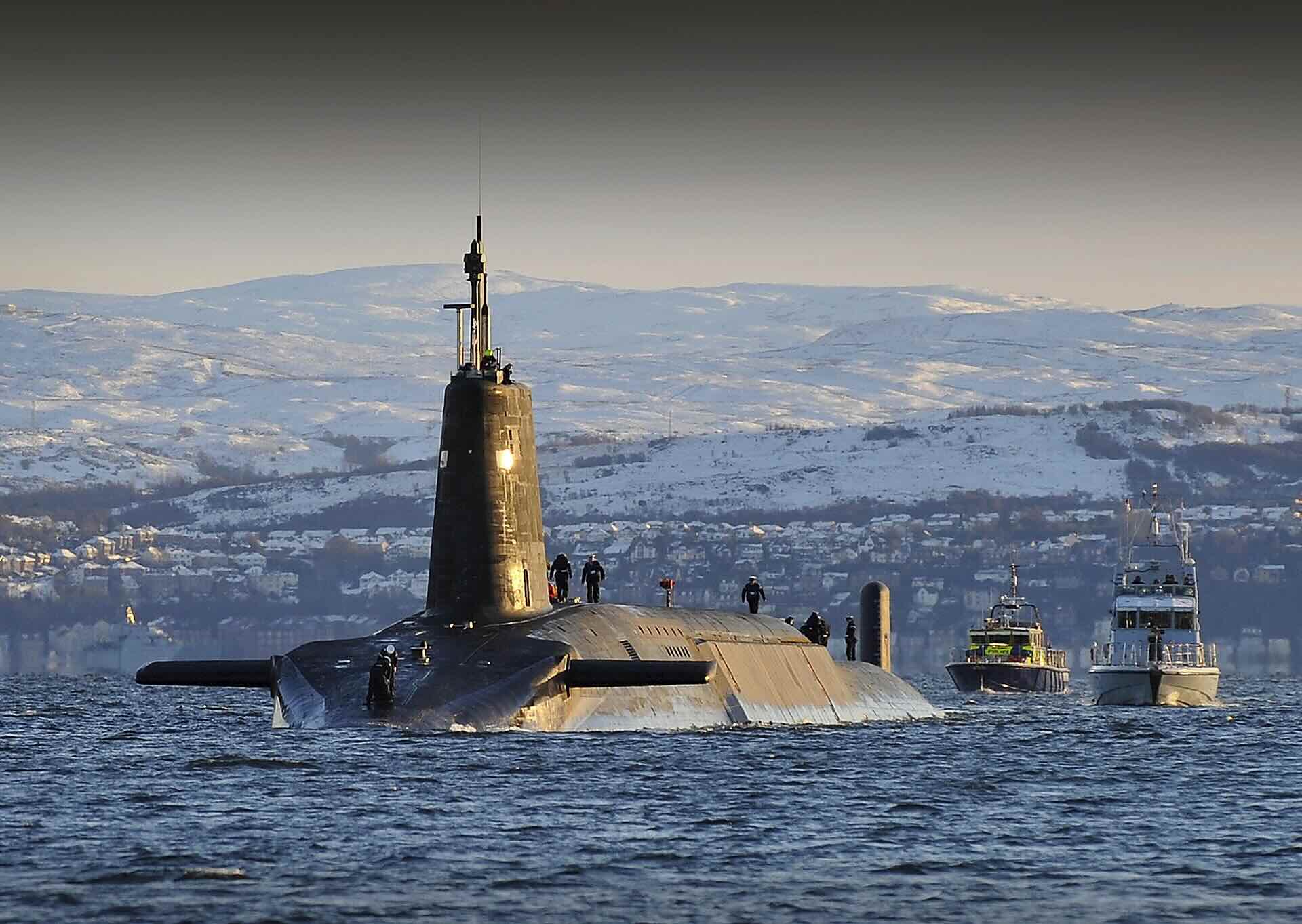
For Britain, the issue is especially sensitive because its deterrent is concentrated in one system: the continuous at-sea deterrent carried by Royal Navy ballistic missile submarines. The Ministry of Defence states that at least one nuclear-armed submarine has been on patrol continuously since 1969, that the four Vanguard-class boats have maintained the deterrent since the early 1990s, and that the Dreadnought-class replacement will enter service in the early 2030s. The Royal Navy says the Dreadnought boats will continue to carry Trident II D5 missiles and are being designed with lower acoustic signatures and improved survivability.
France’s position is different in style but similar in strategic importance. Paris has long maintained that nuclear deterrence is a sovereign national capability, yet President Emmanuel Macron has also said that French nuclear deterrence is a “critical element” of the defence of the European continent. In his April 2024 Europe speech, Macron linked the need for anti-missile defence, deep-strike capability and a more credible European defence posture to the fact that Europe now faces a nuclear-armed Russia that has expanded its ballistic capabilities. In a further address in March 2025, he again said France’s nuclear forces give it stronger protection than many of its neighbours.
The debate is therefore moving beyond warhead totals and into the question of penetration, survivability and mobility. Open-source assessments still show that Britain and France possess much smaller arsenals than Russia or the United States. SIPRI estimated that, at the start of 2025, the world’s nine nuclear-armed states held about 12,241 nuclear weapons in total, with around 3,912 deployed with operational forces and roughly 2,100 on high operational alert on ballistic missiles. Separate assessments continue to place France at about 290 warheads and the United Kingdom at around 225, with both countries relying heavily on submarine-based deterrence.
That helps explain why European discussion increasingly centres on delivery systems and counter-measures rather than simple stockpile expansion. The RUSI report argues that, if Russian missile defence around Moscow becomes denser and more capable, Europe may need more advanced long-range strike systems, including hypersonic or manoeuvring capabilities, to preserve deterrence credibility. CSIS’s Missile Threat project has for several years identified the S-500 as a system intended to engage ballistic and other advanced aerial targets, while broader strategic analysis has described Russian missile defence as part of a layered effort to protect key state and military centres.
There is also a budgetary dimension. NATO’s 2025 defence expenditure tables estimate Poland at 4.48 per cent of GDP, Lithuania at 4.00 per cent, Norway at 3.35 per cent, the United States at 3.22 per cent, the United Kingdom at 2.40 per cent and France at 2.05 per cent. At the Hague summit in June 2025, allies agreed to aim by 2035 for 3.5 per cent of GDP on core defence requirements and up to a further 1.5 per cent on resilience, infrastructure and related security spending. Britain’s own Strategic Defence Review and Downing Street statements commit the government to 2.5 per cent by 2027, with an ambition to reach 3 per cent in the next Parliament when fiscal conditions allow.
The strategic conclusion is not that Europe’s nuclear deterrent has ceased to function. Britain and France remain the continent’s only independent nuclear powers, and both base their deterrent on submarine-launched systems intended to guarantee a survivable second-strike capability. What the current debate does suggest, however, is that European policymakers are no longer willing to assume that this credibility will remain beyond question over the coming decade. The issue is therefore one of adaptation rather than abandonment: modernising submarines, refining delivery systems and developing more advanced long-range strike capabilities to ensure that deterrence remains credible against an evolving Russian missile defence architecture.