British and Norwegian naval forces have begun a maritime exercise in western Norway aimed at testing how air, surface and uncrewed systems operate together in one of Europe’s most demanding coastal environments.
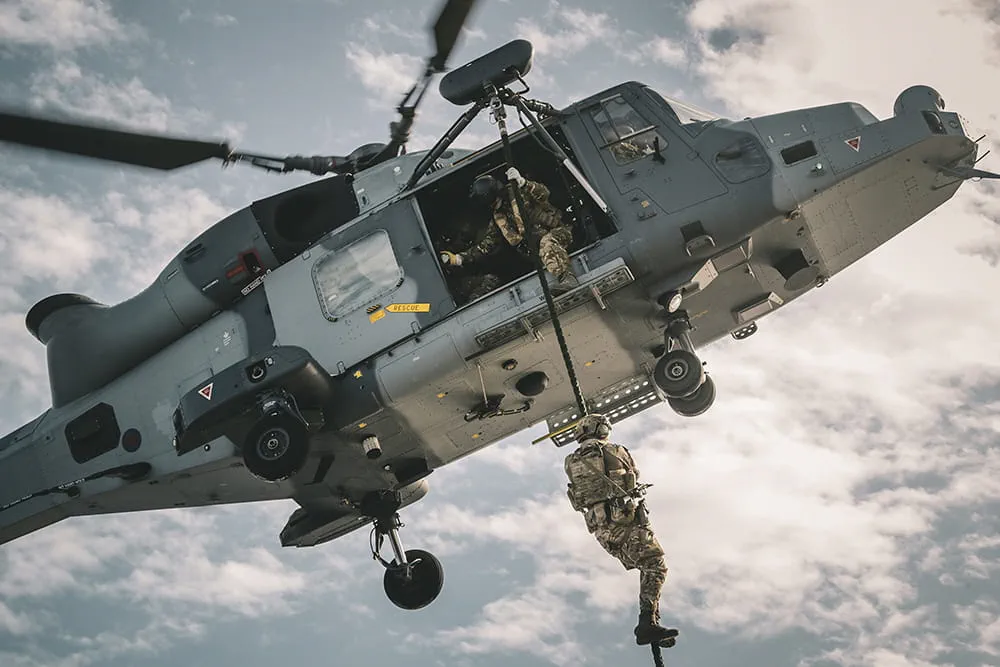
Exercise Tamber Shield 2026 commenced on 27 April, with activity focused around Bergen and the fjords of western Norway. The exercise brings together Royal Navy Wildcat maritime attack helicopters, P2000 patrol boats, Puma uncrewed aerial systems and Royal Norwegian Navy vessels, including Skjold-class missile boats.
The exercise is being conducted under the framework of NATO and the UK-led Joint Expeditionary Force, a grouping of northern European countries designed to act quickly in response to crises in the High North, Baltic Sea region and wider northern European area. The setting gives the exercise direct relevance to NATO’s northern flank, where maritime mobility, coastal defence, surveillance and rapid reaction remain central concerns.
The Royal Navy said the fourth iteration of Tamber Shield would test co-operation between military helicopters and uncrewed aircraft, as well as tactics for engaging small, fast-moving threats at sea. The training is being played out in the inlets and narrow waters around Bergen, where geography creates a difficult operating environment for both aircraft and vessels.
The UK contribution includes Wildcat helicopters from 815 Naval Air Squadron, Puma surveillance drones from 700X Naval Air Squadron, and four P2000 patrol boats: HMS Archer, HMS Explorer, HMS Exploit and HMS Biter. Around 150 UK personnel are involved.
Norway is contributing naval units suited to operations in its coastal waters, including Skjold-class missile boats. These vessels are fast, heavily armed and designed for littoral operations. Their role in the exercise gives British air and surface units a realistic training opponent in confined waters where detection, tracking and engagement are more difficult than in open sea conditions.
The exercise is particularly relevant to the Royal Navy’s development of crewed and uncrewed teaming. Puma drones are being used to scout ahead of the Wildcats, observing the movement of Norwegian and British boats and passing information to the helicopters for simulated attacks. The arrangement reflects a wider naval trend: using smaller uncrewed systems to extend the reach of crewed platforms, improve situational awareness and reduce the time between detection and decision.
For the Wildcat crews, the training also has a weapons-tactics dimension. The exercise was originally established in 2023 to support the development of tactics for the Martlet missile, a lightweight missile used against small, fast-moving targets. Those targets can include drones, speedboats and other mobile threats. In the fjords, where vessels can use terrain and weather to complicate surveillance, such training provides a more demanding test than routine open-water manoeuvres.
The operational setting matters. Norway’s fjord environment combines narrow sea lanes, steep terrain, short reaction times and limited visibility. For maritime forces, that creates a contested littoral environment in which aircraft, patrol craft, missile boats and uncrewed systems must work closely. It also reflects the type of geography that would be central to any crisis affecting the Norwegian coast or northern approaches.
The exercise also has a readiness value beyond the immediate UK-Norway relationship. NATO’s northern flank has gained greater attention since Russia’s full-scale invasion of Ukraine and the subsequent accession of Finland and Sweden to the Alliance. The High North is not only a question of Arctic policy; it is also linked to Atlantic reinforcement routes, undersea infrastructure, energy security, naval access and the defence of northern Europe.
Tamber Shield is therefore not simply a tactical drill for small boats and helicopters. It is a practical test of how allied forces operate in waters where speed, surveillance and interoperability can determine whether a threat is identified and engaged in time. The involvement of both NATO structures and the Joint Expeditionary Force gives the exercise an additional political and operational layer.
The JEF framework allows participating states to train and respond together in northern European scenarios without waiting for a larger NATO-wide mobilisation. For the UK, that gives Tamber Shield relevance to its role as a framework nation for regional security. For Norway, it supports rapid preparedness along a coastline that remains central to allied defence planning.
The exercise also illustrates a broader shift in maritime security. Large warships remain essential, but many operational problems now involve smaller, faster and harder-to-detect threats. Drones, fast attack craft, missiles and coastal surveillance systems are increasingly central to littoral warfare. Training that integrates helicopters, patrol craft, missile boats and uncrewed aircraft is therefore part of a wider adaptation to modern naval risk.
That question is likely to remain central to NATO’s northern planning. In the High North and adjacent waters, effective deterrence depends not only on the number of platforms available, but on whether allied units can operate together quickly, share information and respond in conditions where geography favours speed, concealment and surprise.