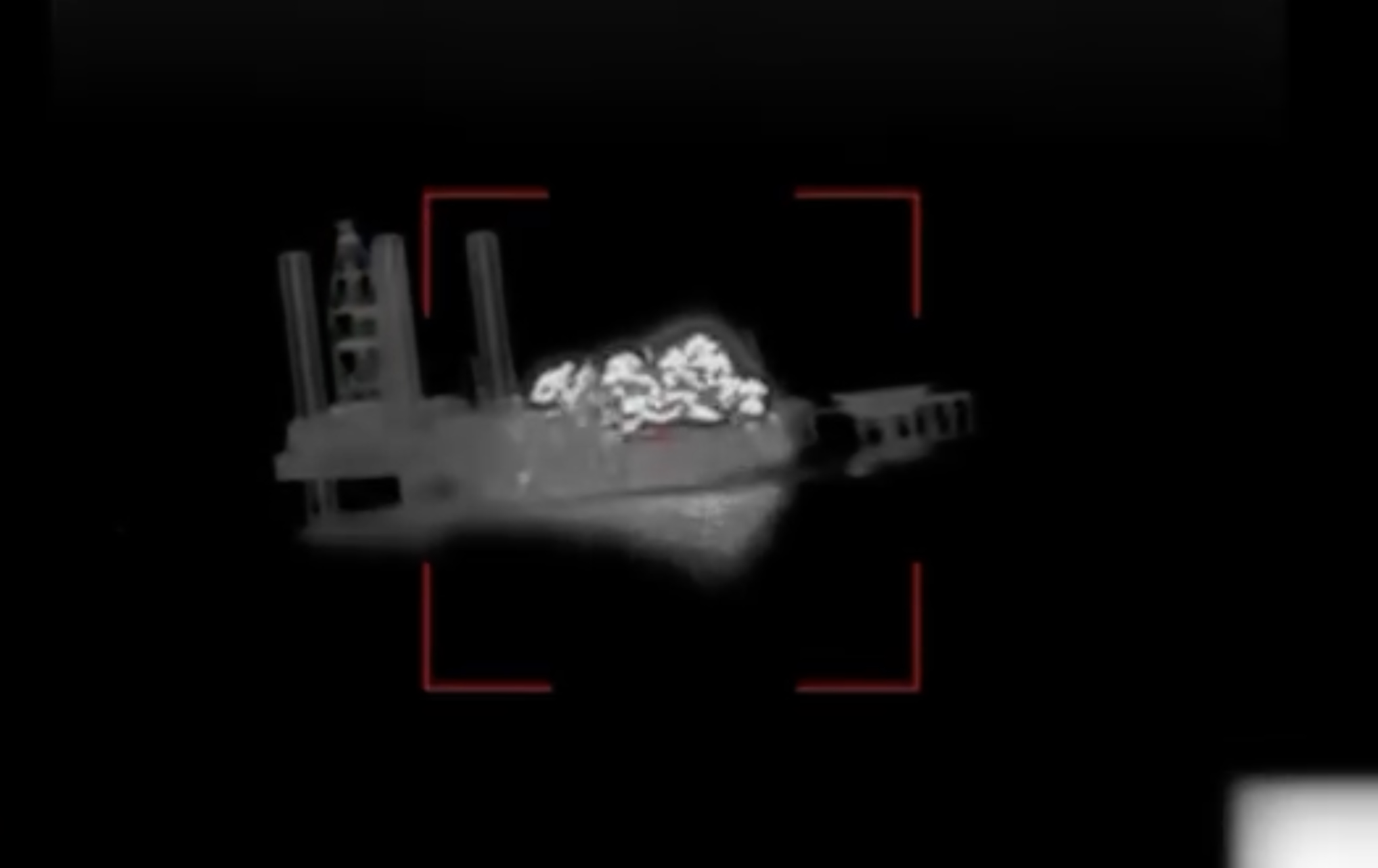
According to the official Ukrainian account, the platform had been used by Russian forces as a forward base for surveillance equipment, communications relay systems, electronic warfare assets and short-range air defence, helping Moscow monitor Ukrainian movements towards occupied Crimea and protect elements of the Black Sea Fleet.
The published footage has drawn particular attention because several defence analysts and Ukrainian military outlets say it appears to show the use of Swedish-made RBS-15 anti-ship missiles alongside naval and aerial drones. That assessment has been circulated by specialist defence publications, including Defence Express and Militarnyi. However, Ukraine has not formally identified the missile used in the strike, and the available official statements refer only to the combined use of naval and unmanned assets against the platform.
That distinction matters. The source material provided makes a series of broader claims about the system’s capabilities and about the exact variant allegedly supplied to Ukraine. Those claims go beyond what has been publicly confirmed. Saab, the Swedish manufacturer, describes the RBS-15 family as a missile system with anti-ship and land-attack capability, a flight range of more than 300 kilometres depending on the configuration, and a large warhead. Saab has also separately described the Mk3 missile as carrying a 200-kilogram warhead and being suitable for launch from land, sea or air platforms.
If the identification is correct, the significance would be considerable, though perhaps more in operational than symbolic terms. Russia has repeatedly used offshore platforms in the north-western Black Sea as military outposts since the full-scale invasion. The Ukrainian military statement said the Syvash platform hosted not only sensors and relay equipment but also elite special-purpose units, anti-tank guided missiles and systems intended to counter Ukrainian drones and boats. Removing or degrading such a position would narrow Russia’s surveillance coverage over part of the maritime approaches to Crimea and complicate efforts to build a layered defensive screen over the occupied peninsula and adjacent sea lanes.
The strike on Syvash also came during a broader wave of Ukrainian attacks linked to the Black Sea theatre. Ukrainian reporting on 6 April said that the same night saw strikes on the Sheskharis oil terminal at Novorossiysk, where the Ukrainian General Staff later reported hits and a large fire, with preliminary damage to tanker-loading infrastructure and pipeline equipment. Separate reporting also said a Russian frigate, Admiral Grigorovich, was struck during the Novorossiysk attack, though damage assessment was still under way.
Taken together, those operations suggest a familiar Ukrainian pattern: pressure Russian naval, surveillance and energy infrastructure simultaneously, forcing Moscow to divide attention across platforms, ports and coastal defence. Whether or not the Syvash strike marked the combat debut of the RBS-15, the footage underlines another point that has become increasingly clear over the past year. Ukraine’s Black Sea campaign is no longer centred on single-weapon strikes. It is based on layered attacks combining different unmanned systems, maritime drones and, where available, precision missiles intended to overload detection and interception.
There is, however, reason for caution in how far the conclusion is pushed. Publicly available evidence does not support some of the more expansive claims circulating online, including suggestions that Ukraine may already be using the newest long-range RBS-15 variants or that the missile has been officially integrated in large numbers. Sweden has continued to expand military support for Ukraine, including marine materiel, air-defence related systems and long-range capabilities, but official Swedish statements do not publicly spell out a transfer of RBS-15 missiles to Kyiv.
Even so, the practical message for Russia is straightforward. Ukraine says it has destroyed another offshore military node that helped shield Crimea and support Black Sea operations. Independent analysts believe the strike may also reveal a new Western missile capability in Ukrainian service. If that assessment proves correct, the appearance of the RBS-15 would represent not a dramatic break in the war, but a further tightening of the pressure Ukraine is already applying against Russian positions, logistics and naval infrastructure across the Black Sea basin.