

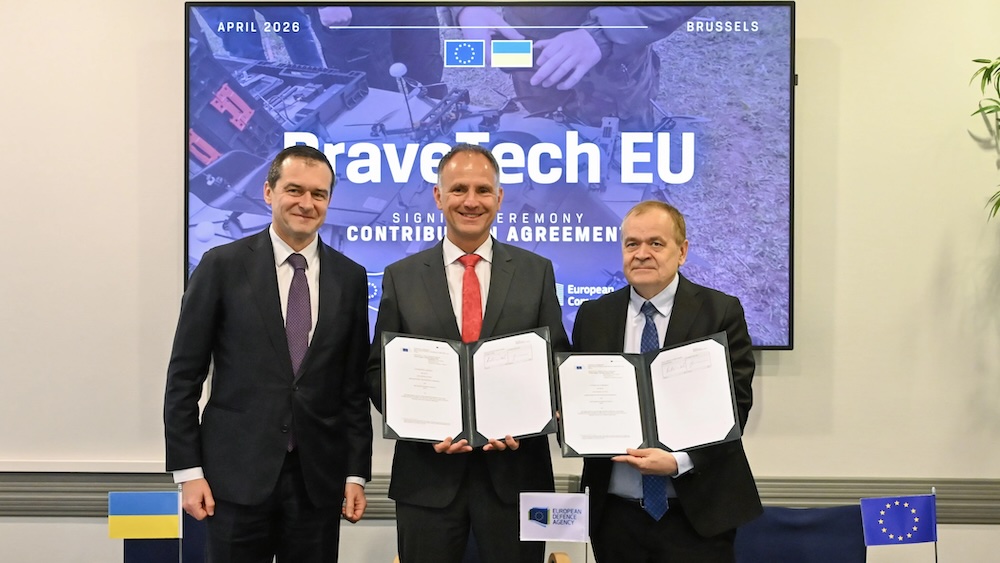
The European Defence Agency and the European Commission have signed a €35 million agreement giving the agency responsibility for the next phase of BraveTech EU, a joint European Union and Ukraine initiative designed to accelerate the development and testing of defence technologies.
The agreement, signed on 29 April, places EDA in charge of BraveTech EU’s second phase. This stage will focus on testing emerging defence technologies and ideas put forward by European and Ukrainian innovators, small and medium-sized enterprises, and start-ups.
According to the European Defence Agency, the proposed solutions will be assessed by military experts from EU member states, Ukraine, EDA and the European Commission. The testing will be carried out against operational scenarios drawn from the war in Ukraine, where rapid adaptation of technology has become a central feature of battlefield resilience.
BraveTech EU is intended to shorten the time between innovation and operational use. It brings together the European Defence Fund, the EU Defence Innovation Scheme, the European Defence Agency and Ukraine’s BRAVE1 platform in a common framework for joint development, testing and deployment of advanced defence solutions.
The initiative has a total budget of €100 million and is structured in two phases: Seed and Scale Up. The latest agreement concerns the Scale Up phase, in which EDA will lead testing activity and help link promising technologies with operational requirements.
The agency said the programme is intended to give EU member states and Ukraine faster, safer and more cost-effective access to battlefield-proven technologies, while strengthening the European defence industrial base and improving overall EU defence readiness.
The agreement also expands EDA’s role in defence innovation. The agency said the new phase builds on the model developed through its Hub for EU Defence Innovation, including its operational experimentation approach, which connects new technologies with military users and capability requirements.
EDA Chief Executive André Denk said the agency’s involvement showed its ability to turn promising technologies and ideas into solutions that can be assessed, matured and brought towards operational use.
He said BraveTech EU reinforced EDA’s position as a focal point for defence innovation in Europe by linking military needs, experimentation and capability development in a more operationally focused way.
Timo Pesonen, Director-General of the European Commission’s Directorate-General for Defence Industry and Space, said Ukraine’s battlefield experience had reshaped approaches to innovation in response to military requirements. He described the cooperation agreement with EDA as part of a broader commitment to supporting Ukraine and strengthening European security.
The announcement comes as the EU continues to adapt its defence structures in response to Russia’s full-scale invasion of Ukraine. Ukraine’s experience has highlighted the role of drones, electronic warfare, battlefield repair, artificial intelligence-enabled systems and rapid production cycles in modern conflict.
For European governments, one of the main challenges has been how to connect traditional defence procurement with faster innovation cycles. BraveTech EU is an attempt to create a mechanism through which operational lessons from Ukraine can be tested, assessed and scaled within an EU framework.
The programme is also relevant to European defence industry policy. By focusing on start-ups, SMEs and emerging technologies, BraveTech EU seeks to widen the pool of companies able to contribute to capability development. This reflects a wider concern that Europe’s defence industrial base must become more responsive to operational demand and less dependent on long procurement timelines.
The participation of Ukraine gives the programme a distinct operational dimension. Technologies developed or tested under the initiative will not be assessed in abstract laboratory conditions alone, but against scenarios derived from an active high-intensity war. That may give the programme practical value for both Ukrainian forces and EU member states seeking to improve readiness.
The EDA statement lists 27 participating member states, including Belgium, Germany, France, Italy, Poland, the Netherlands, Sweden, Finland and the Baltic states. The broad participation gives the programme potential relevance beyond Ukraine support alone, particularly if tested technologies can later feed into wider EU capability planning.
BraveTech EU does not remove the structural obstacles that have long affected European defence procurement, including fragmented demand, uneven national priorities and limited production capacity in some sectors. However, the agreement gives the EU a more formal mechanism for converting wartime innovation into tested defence applications.
For Ukraine, the programme offers an additional route for its defence technology sector to work with EU institutions and companies. For the EU, it provides access to practical operational experience that cannot easily be replicated through exercises or conventional research programmes.
The significance of the agreement will depend on whether tested technologies move beyond trials and into procurement, deployment and sustained industrial production. The immediate importance is that the EU and Ukraine have now moved BraveTech EU from concept and funding architecture into an operational testing phase.

Britain’s Consistent Message on Ukraine Carries Growing Weight at the OSCE