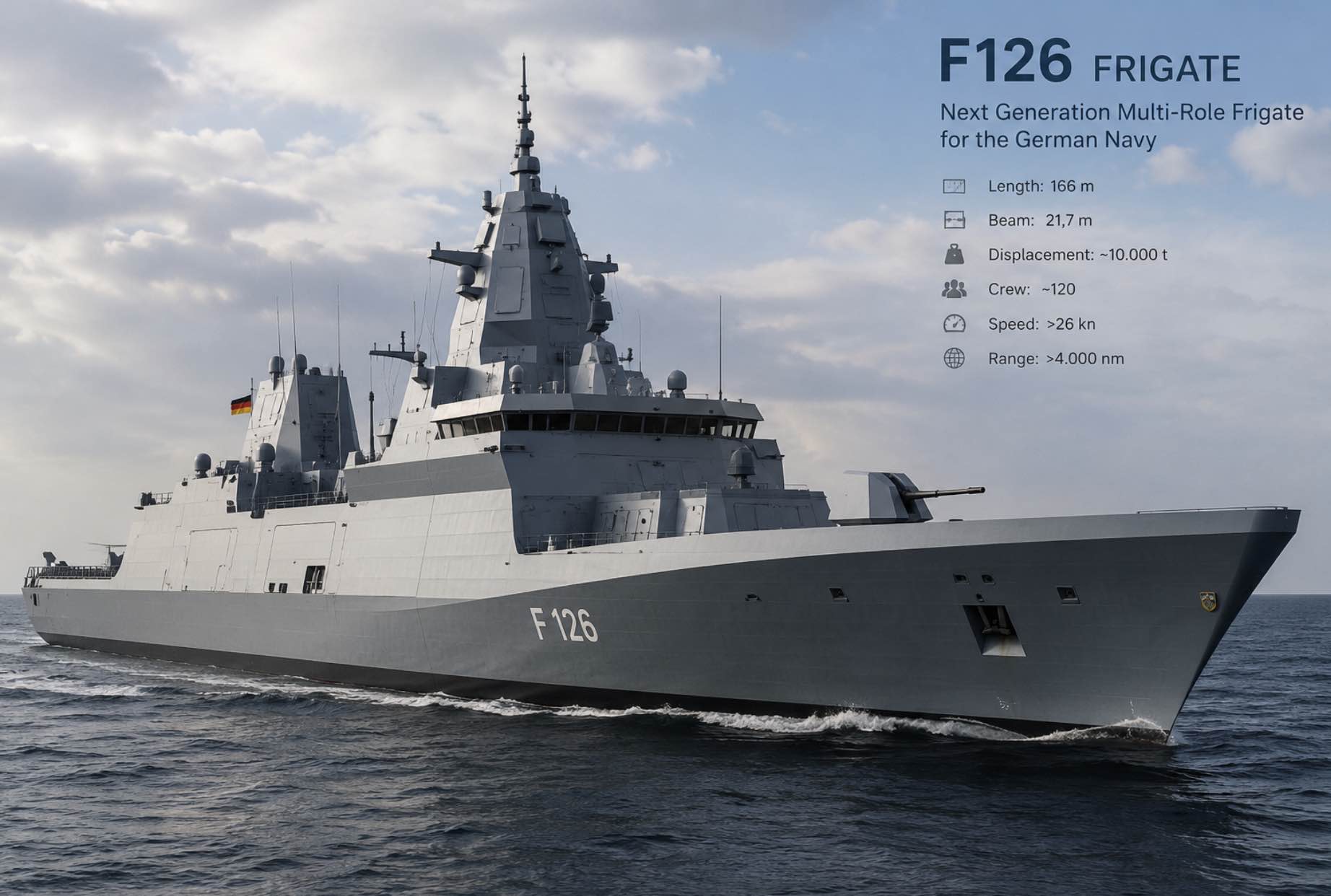
According to a report first carried by the Financial Times, the Düsseldorf-based manufacturer is seeking government backing to take over the delayed F126 frigate programme, a flagship project intended to deliver six advanced warships for the German navy.
The proposal would lift the total cost of the programme to around €14 billion, reflecting not only spiralling expenses but also the realities of inflation, supply chain disruption and the increasingly sophisticated demands placed on modern naval vessels.
At the heart of the issue lies a project beset by delay. Originally awarded to Dutch shipbuilder Damen Shipyards Group, the F126 programme has fallen significantly behind schedule, prompting Berlin to explore alternative arrangements. Rheinmetall’s plan would see it assume the role of general contractor, leveraging its recent acquisition of naval group NVL to reposition itself as a major maritime force.
The company’s terms reportedly include an inflation-linked pricing mechanism and a revised delivery timetable, with the first vessel now expected to enter service in 2032—some four years later than originally envisaged. Such delays, while unwelcome, are hardly unusual in large-scale defence procurement, particularly at a time when European militaries are racing to modernise after decades of underinvestment.
Officials in Berlin have been careful to stress that no final decision has yet been taken. A spokesperson for the German defence ministry confirmed that “extensive consultations” are ongoing with multiple industrial partners, reflecting both the strategic importance of the programme and the political sensitivity surrounding its escalating cost.
Yet the contours of a broader strategy are already becoming visible. Alongside the negotiations with Rheinmetall, Germany is pursuing parallel discussions with Thyssenkrupp Marine Systems over the purchase of MEKO A-200 frigates—smaller, off-the-shelf vessels priced at roughly €1 billion each. The first of these could be delivered as early as 2029, offering a stopgap capability while the more complex F126 programme is restructured.
This dual-track approach speaks to a growing urgency within Europe’s largest economy. Russia’s invasion of Ukraine in 2022 marked a turning point in German defence policy, triggering a surge in military spending and a renewed focus on operational readiness. Companies such as Rheinmetall have been among the principal beneficiaries, reporting swelling order books and expanding into new domains, including naval shipbuilding.
Indeed, Rheinmetall’s push into maritime defence has been both rapid and deliberate. Traditionally known for its land systems—tanks, armoured vehicles and munitions—the group has sought to transform itself into a diversified defence champion. Its acquisition of naval assets earlier this year was widely seen as a decisive step in that direction, positioning the company to compete for high-value contracts across multiple domains.
The stakes are considerable. Germany alone is expected to spend tens of billions of euros on naval capabilities over the coming decade, as part of a broader European effort to strengthen deterrence and secure critical sea lanes. For Rheinmetall, securing the F126 programme would represent not merely a lucrative contract, but a strategic foothold in a sector long dominated by specialist shipbuilders.
There are, however, risks as well as opportunities. The troubled history of the F126 project—marked by delays, budget overruns and contractor disputes—serves as a cautionary tale about the complexities of modern defence procurement. Taking over such a programme would require not only financial muscle, but also the managerial discipline to bring it back on track.
For Berlin, the decision will ultimately hinge on balancing cost, capability and credibility. A successful restructuring could restore confidence in Germany’s procurement system and deliver much-needed assets to the navy. Failure, by contrast, would risk further delays at a time when the strategic environment is growing ever more uncertain.
What is clear is that the debate surrounding the F126 frigates is about more than ships alone. It is a test of Europe’s ability to translate political ambition into industrial reality—a challenge that will shape the continent’s security for years to come.
Rheinmetall opens Europe’s largest artillery ammunition plant in Germany