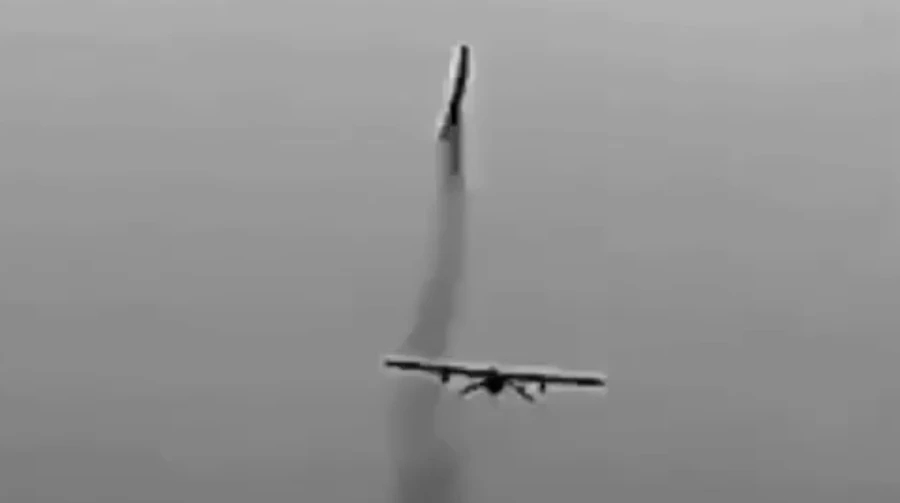
A Ukrainian FP-2 strike drone has reportedly been filmed launching a rocket during a flight over Russian-occupied Crimea, in a development that may add a further complication to Russian efforts to intercept Kyiv’s long-range unmanned systems.
The footage, circulated by open-source analysts and reported by Ukrainian Pravda, appears to show a munition mounted under the wing of the drone and released towards a ground target while the aircraft continues its flight. The target was described in Ukrainian reporting as a Russian mobile fire group, the type of unit increasingly used to engage drones with heavy machine guns and other short-range weapons.
The exact munition has not been independently confirmed. OSINT analyst Harbuz suggested that it appeared to be an unguided aircraft rocket, while Denys Shtilerman, co-founder of the Ukrainian drone and missile manufacturer Fire Point, commented on the footage by saying: “We can do this too.” The available material does not establish whether the rocket was guided or unguided, nor whether the configuration is already in regular use.
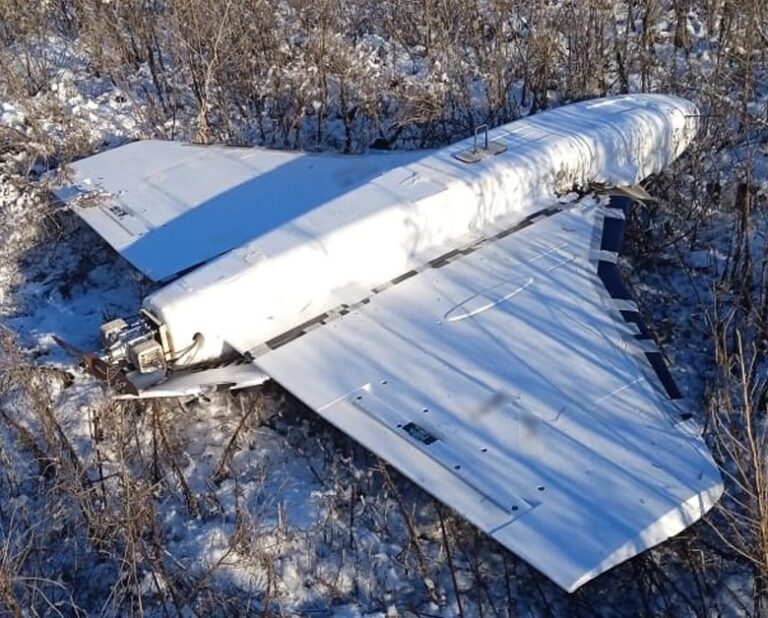
Even so, the development is notable because the FP-2 is already a substantial strike platform. According to details cited in the same Ukrainian Pravda report, the FP-2 is based on the longer-range FP-1 airframe, can reportedly carry a warhead of up to 105kg, and has a range of up to 200km. It can be used against fixed targets through autonomous guidance or against moving targets when controlled by an operator through a radio link.
That makes the possible addition of rocket armament tactically important. The FP-2’s main value lies in its ability to reach depots, command posts, fuel sites, logistics hubs, vehicle parks and other Russian military infrastructure behind the front line. If the drone can also engage a mobile fire group encountered en route, it may no longer need to rely solely on evasion before reaching its primary target.
Russia has sought to compensate for pressure on its conventional air defence systems by deploying mobile fire groups along likely drone approach routes. These units can be more relevant against slow, low-flying drones than larger missile systems in some circumstances, particularly where radar detection is difficult or where the target is not considered worth the use of a more expensive interceptor. A drone able to fire on such teams before continuing its mission would alter that calculation.
The significance may lie as much in uncertainty as in the weapon itself. Russian mobile fire groups do not need to assume that every FP-2 carries rockets for their behaviour to be affected. If even a limited number of drones are equipped in this way, interception teams may have to consider whether approaching or firing on one could expose them to direct attack.
The FP-2 has already been associated with Ukrainian strikes on Russian positions in occupied territory. In April, Ukraine’s Unmanned Systems Forces commander Robert Brovdi, known as “Madyar”, criticised the quality of some warheads used on Ukrainian strike drones after six FP-2 drones carrying 100kg warheads were used against a Russian command post in Kadiivka. His comments, reported by Defence Blog, underlined both the growing use of such systems and the continuing pressure to improve their reliability.
Fire Point has presented the FP-2 as a response to frontline demand for a heavier strike drone with real-time control options. According to United24 Media, the platform is designed to carry a 105–120kg payload and transmit live video, allowing an operator to adjust its flight path in a manner closer to FPV control than to traditional pre-programmed loitering munitions.
The same reporting says Fire Point is working on a longer-range version of the FP-2, with the aim of preserving a heavy warhead while extending the drone’s reach beyond the current approximate 200km range. That would fit a wider Ukrainian effort to build domestic long-range strike capacity while reducing dependence on imported missiles.
The apparent rocket launch also reflects a wider pattern in Ukraine’s wartime defence sector. Kyiv has repeatedly modified unmanned systems after combat use, including naval drones fitted with additional weapons for coastal strikes or air defence roles. Applying the same approach to fixed-wing strike drones would be consistent with that method: taking an existing platform and adding a secondary capability without changing its primary purpose.
The available footage does not prove that FP-2 drones have become “unmanned fighters” in any conventional sense. It does, however, indicate another step in the rapid adaptation of battlefield drones. For Ukraine, the aim is to increase the effect of each platform and complicate Russian interception. For Russia, the problem is that drones already difficult to detect or stop may now also pose a threat before reaching their intended impact point.
If confirmed at scale, the modification would make mobile fire groups less certain of their role as a low-cost countermeasure. Their task has been to engage drones that conventional air defence either misses or cannot economically intercept. A drone that can strike back during its approach would force those teams to weigh the risk of exposing themselves against the risk of allowing the drone to pass.
The war in Ukraine has already shown how quickly unmanned systems can move from experimental use to standard battlefield equipment. The reported FP-2 rocket launch does not yet establish a new class of weapon. It does, however, point to a further layer in the contest between Ukrainian drone innovation and Russian attempts to defend rear-area infrastructure.