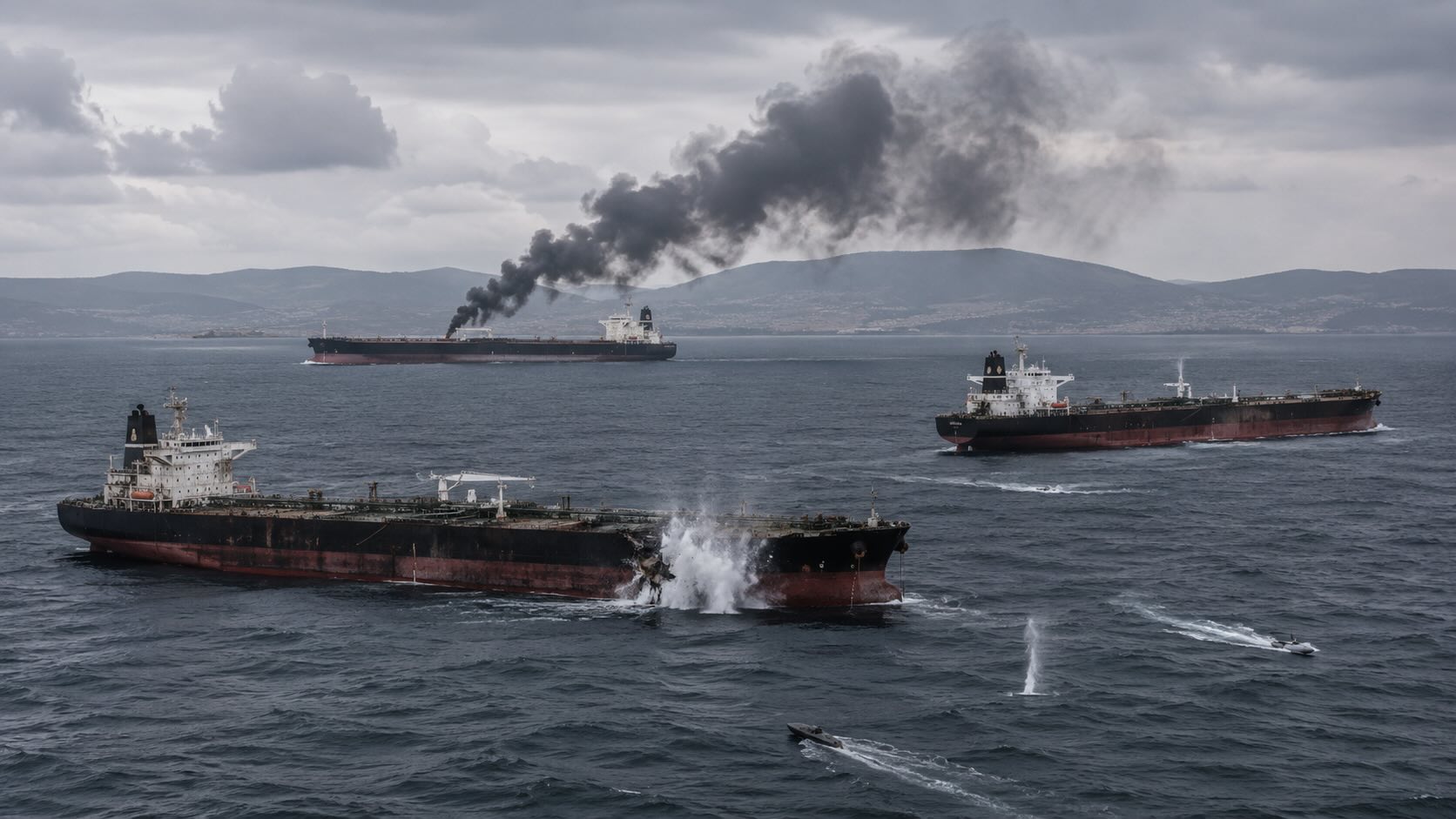
Three oil tankers associated with Russia’s shadow fleet were reportedly hit by drones in the Black Sea on Thursday, in an incident that underlines the vulnerability of vessels used to move Russian oil outside the Western sanctions framework.
According to Reuters, citing the shipping agency Tribeca, the Palau-flagged tanker James II was attacked around 50 miles north of the Türkeli area, off Turkey’s northern Black Sea coast. Two further vessels, the Sierra Leone-flagged Altura and Velora, were reportedly attacked in the same area while conducting a ship-to-ship operation. All three vessels were said to be in ballast, meaning they were not carrying cargo at the time.
The Associated Press reported that the three vessels were linked to the shadow fleet used to bypass Western restrictions on Russian oil exports. No casualties were reported, and Turkish coast guard or coastal safety vessels were sent to assist. At the time of writing, neither Ukraine nor Russia had claimed responsibility for the attacks, while Turkish officials had not issued a detailed public statement.
The incidents come amid a broader campaign of pressure on Russia’s oil export system. Since the full-scale invasion of Ukraine, Moscow has relied heavily on maritime exports of crude oil and petroleum products to sustain state revenue. As Western restrictions have tightened, Russian-linked trading networks have used older tankers, opaque ownership structures, flag changes and ship-to-ship transfers to keep oil moving to buyers outside Europe.
The European Union has continued to expand sanctions on Russia’s energy sector and maritime network. In its 18th sanctions package, adopted in July 2025, the EU lowered the crude oil price cap from $60 to $47.60 per barrel and added further measures against Russia’s shadow fleet. The European Commission has also issued guidance on the oil price cap, warning of circumvention risks linked to Russian crude and petroleum products.
The latest reported attacks point to the changing character of the maritime war in the Black Sea. Ukraine has already shown an ability to use naval and aerial drones against Russian warships, naval facilities and port infrastructure. The reported targeting of tankers near Turkey’s coast suggests that vessels associated with Russia’s sanctions-circumvention network are no longer insulated from the conflict simply by operating away from Russian ports.
For Moscow, the immediate financial loss from damage to individual tankers may be limited. The wider effect could be more significant. Russia’s oil export chain depends not only on production and pipelines, but also on port terminals, loading equipment, insurance arrangements, available tonnage and crews willing to operate in high-risk waters. Disruption at any point in that chain can raise costs, delay shipments and make participation in the trade more difficult for intermediaries.
This is particularly important because the shadow fleet was developed to reduce Russia’s exposure to Western maritime services, insurance restrictions and sanctions enforcement. Older ships with unclear ownership can allow oil to continue moving, but they are also harder to protect and more exposed to operational, legal and security risks.
The Black Sea remains a particularly sensitive operating area. Russian oil exported through ports such as Novorossiysk depends on maritime access through waters that have become increasingly contested. Tankers moving between Russian terminals and the Turkish Straits may seek to reduce exposure by sailing close to Turkey’s coast, but Thursday’s reported incidents indicate that proximity to a NATO member’s shoreline does not necessarily remove the risk.
The attacks also create a dilemma for Ankara. Turkey has sought to preserve commercial navigation in the Black Sea while avoiding a direct confrontation with either Moscow or Kyiv. Any repeated strikes near its coast could raise concerns over maritime safety, environmental risk and the possibility of the war spilling further into regional shipping routes.
For Ukraine, the strategic logic behind pressure on Russia’s oil network is clear, even where Kyiv does not claim specific operations. Russian oil revenue remains one of the main sources of funding for the war. Strikes on refineries, depots, pumping stations, export terminals and tanker capacity all impose costs on the system that allows Moscow to convert oil production into state income.
The danger for Russia is not only that individual vessels are damaged, but that the trade becomes more difficult to sustain. Even when ships are empty, attacks can remove tankers from service for extended repairs, increase insurance costs, deter crews and complicate the logistics of ship-to-ship transfers.
Thursday’s reported attacks therefore mark more than another isolated maritime incident. They show that Russia’s shadow fleet faces pressure not only from sanctions, port bans and regulatory scrutiny, but also from the physical consequences of a war in which energy infrastructure has become a central target.