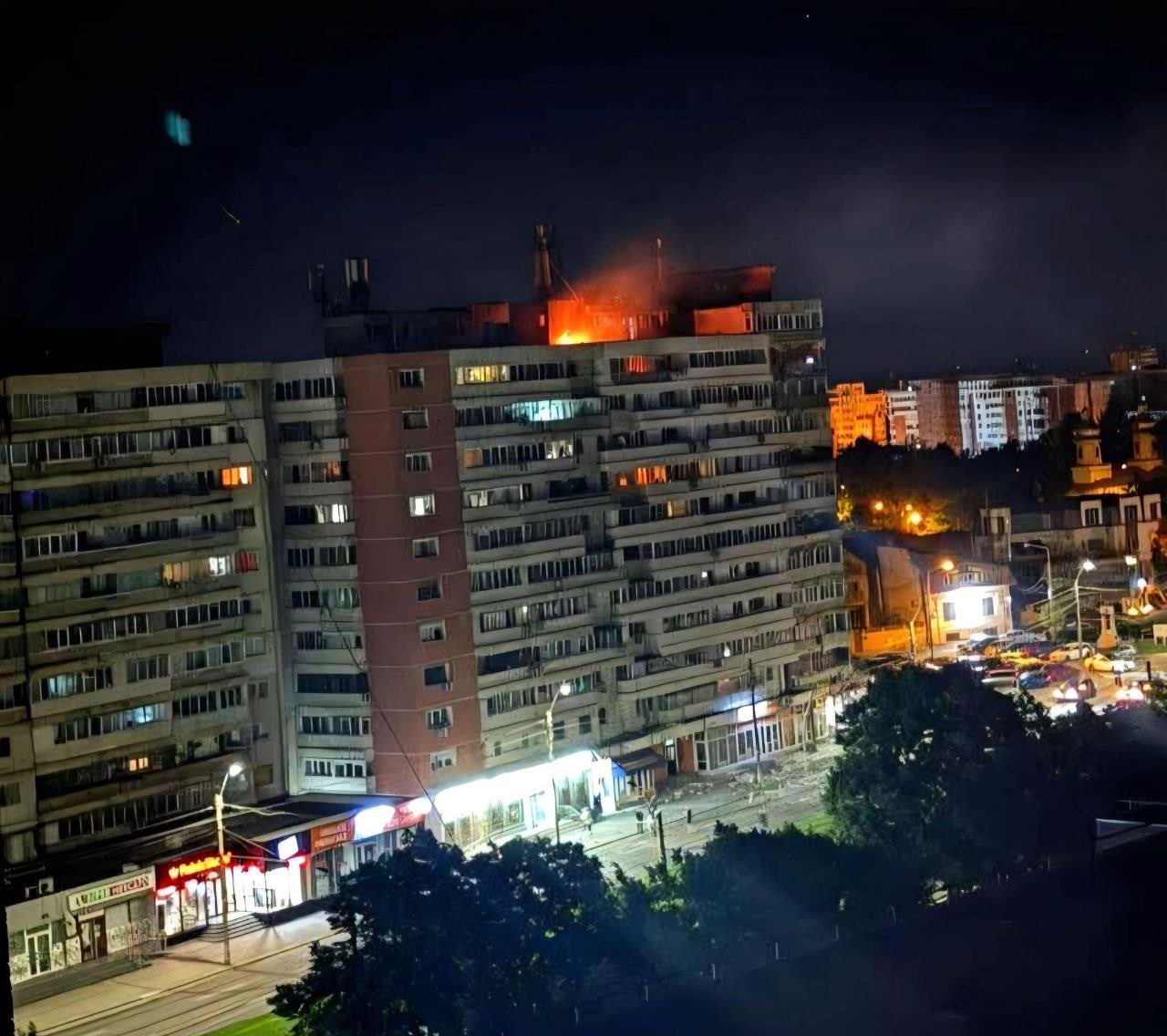
A Russian drone striking a residential building in Romania has brought the security consequences of Moscow’s war against Ukraine directly onto NATO territory. The incident in Galați, near Romania’s border with Ukraine, injured two people, caused a fire, and forced the evacuation of around 70 residents. Romanian authorities said the drone entered national airspace during an overnight Russian attack on Ukraine and crashed onto the roof of an apartment block.
The incident is significant not only because Romania is both an EU and NATO member, but because it appears to mark a further escalation in a pattern that has already tested allied restraint. Russian drones and fragments have repeatedly crossed into Romanian airspace since Moscow intensified attacks on Ukrainian ports and infrastructure along the Danube. According to Reuters, Romania’s defence ministry has recorded 28 airspace breaches and 47 drone-fragment recoveries since Russia began targeting Ukraine’s Danube ports.
Until now, many such incidents have been treated as dangerous spillover from the war rather than direct attacks on NATO territory. A drone striking a civilian building in a NATO country is harder to contain within that category. Romania’s foreign ministry described the drone’s flight as a serious violation of international law, while Bucharest has reportedly asked NATO to accelerate the delivery of anti-drone capabilities.
Romania’s defence ministry said the drone had been tracked by radar before it hit Galați. Romanian F-16 fighters and a helicopter were deployed, but the drone was reportedly flying at low altitude, limiting the opportunity for interception. The Associated Press reported that the drone crashed onto the roof of the building, causing a fire, while local emergency services said two people were injured.
The immediate question is whether this remains a Romanian security incident or becomes a wider NATO test case. The alliance has so far sought to avoid actions that could be presented by Moscow as direct NATO participation in the war. That caution has shaped responses to previous airspace violations, including drone fragments falling on Romanian territory and other incidents across the eastern flank. Yet the Galați strike demonstrates the limits of a defensive posture confined strictly to national territory.
One proposal likely to receive renewed attention is the creation of a limited joint air-defence zone along Ukraine’s western and south-western borders. Under such a model, aircraft or air-defence assets from neighbouring NATO states could be authorised to intercept Russian drones and missiles approaching allied territory, including over a clearly defined area of Ukrainian airspace. An initial operational zone of around 100 kilometres from the border could provide a limited starting point, allowing NATO members to protect their own airspace while reducing the risk of drones reaching civilian areas inside the alliance.
Such a step would be politically sensitive. It would require clear rules of engagement, allied consensus, and careful distinction between defensive interception and participation in Ukrainian offensive operations. It would also raise operational questions: which states would contribute aircraft, how targets would be identified, how command responsibility would be structured, and how incidents involving electronic warfare or misdirected drones would be handled.
Nevertheless, the argument for considering such arrangements has become more concrete. Russia’s use of drones against Ukrainian ports, grain infrastructure, and civilian areas near NATO territory has created a recurring risk to Romania, Poland, Slovakia, Hungary and the Baltic region. The problem is no longer theoretical. It involves radar coverage, reaction time, low-altitude threats, and the ability to intercept cheap drones before they reach populated areas.
The case for closer integration also reflects the broader reality of Ukraine’s role in European security. Ukrainian forces are already intercepting Russian missiles and drones that might otherwise threaten neighbouring states. Support for Ukrainian air defence is therefore not only assistance to Kyiv; it is also an investment in the security of the EU and NATO’s eastern border.
Sweden’s planned contribution of Gripen fighter aircraft to Ukraine, including training for Ukrainian pilots, fits within this logic. For Stockholm, support for Ukraine is linked to security in the Baltic Sea, where Russia retains military assets in Kaliningrad and continues to test regional defences. For Finland, Poland, Romania and the Baltic states, the same principle applies more directly: Russian pressure on Ukraine is also pressure on Europe’s frontier.
The Galați incident will not automatically trigger a fundamental change in NATO policy. The alliance will probably continue to balance deterrence with escalation management. But the political cost of inaction is rising. Each airspace violation, each drone fragment, and now each direct impact on a civilian building makes the existing approach harder to defend.
For Europe, the central issue is not only whether Russia intended to strike a Romanian apartment block. That question will be investigated by Romanian authorities. The more immediate issue is whether NATO’s current posture is sufficient to prevent the next incident. Galați suggests that the answer can no longer be assumed.