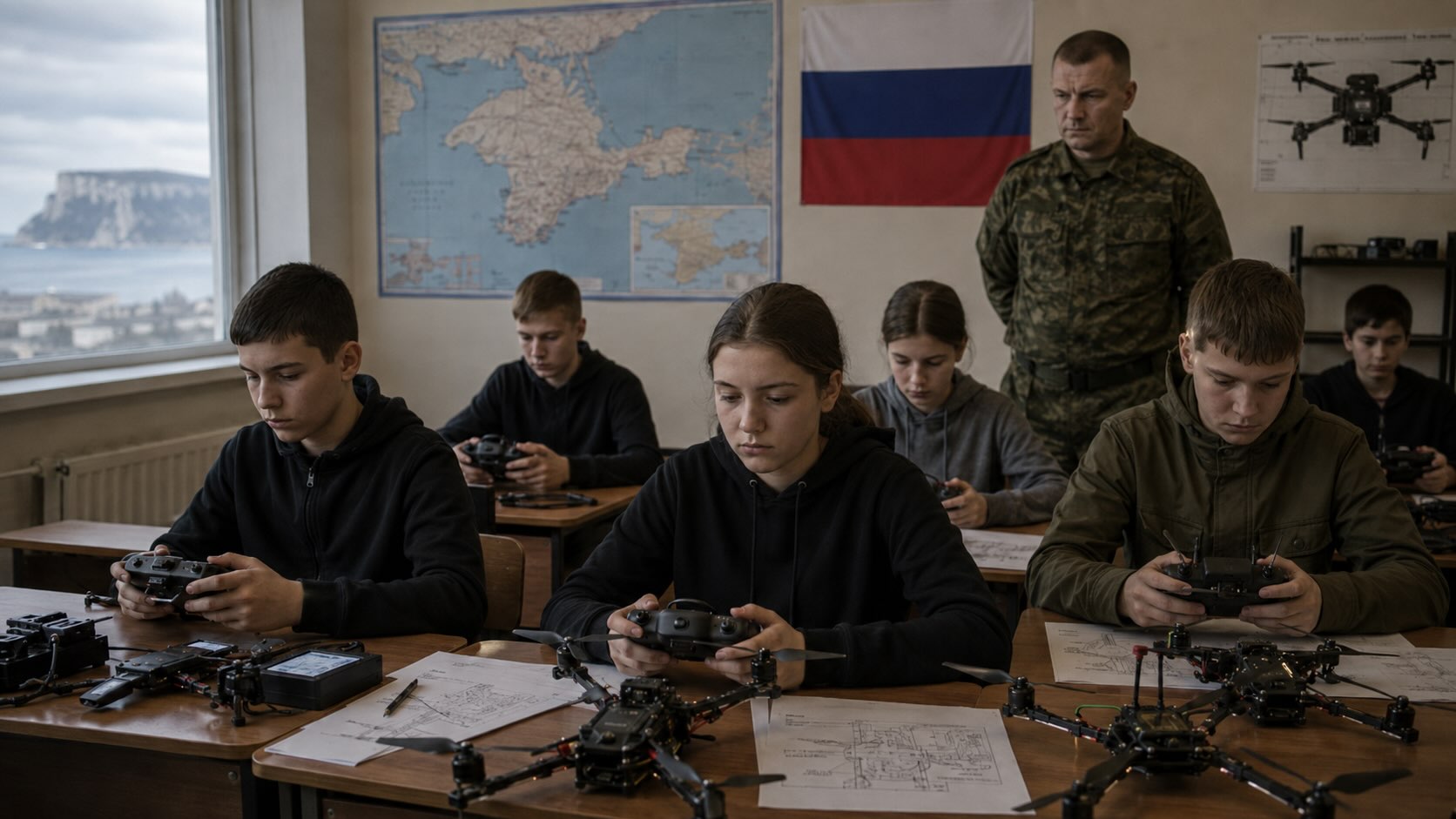
Russian occupation authorities in Crimea are expanding drone-related training for students and teenagers, raising renewed questions about the militarisation of education in territories held by Moscow since 2014.
The issue has gained attention after the Institute for the Study of War cited occupation-linked claims about UAV courses in Crimean colleges, technical institutions and children’s programmes. These initiatives have been presented publicly as vocational or technological education. In wartime conditions, however, the boundary between civilian technical instruction and preparation for military service is increasingly difficult to maintain.
The development is not confined to Crimea. Across Russia, drone instruction has become part of a wider state-backed educational and industrial programme since the full-scale invasion of Ukraine. An investigation by Novaya Gazeta Europe found that Russian schools, universities and other educational institutions have sharply increased spending on drones, simulators and training kits. The same outlet reported that drone-related topics were added to Russia’s school curriculum, including assembly, programming and operation.
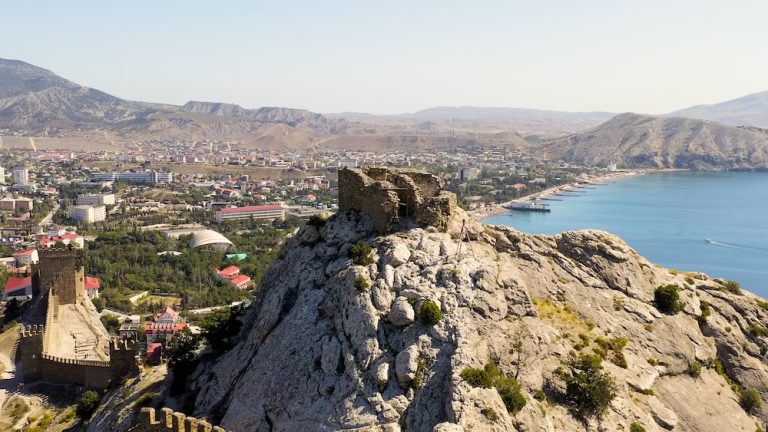
Crimea occupies a particular position in this system. The peninsula is both a heavily militarised occupied territory and a key platform for Russian operations in the Black Sea region. Since 2014, Moscow has integrated Crimea into its military infrastructure, while the European Union maintains a policy of non-recognition of the annexation. The reported use of local educational institutions to train young people in drone skills therefore carries legal and political implications beyond ordinary vocational education.
According to Ukrainian reporting, drone-piloting courses have been promoted in Crimea among college students and school-age children. Mezha reported earlier this year that drone courses were being organised for young people in occupied Crimea, including students in Kerch, while a drone league for schoolchildren had also been launched. UA.NEWS separately reported that the Artek children’s camp was being used for courses in which teenagers would be introduced to UAV operation through simulators and real drones.
The military relevance of such training is clear. Drones have become central to Russia’s war against Ukraine, from reconnaissance and artillery correction to one-way attack systems and first-person-view strike drones. Demand for operators, technicians and instructors has grown accordingly. Educational programmes that teach drone operation may therefore be presented as technological or vocational training, while also serving military requirements in practice.
The debate has been sharpened by the recent strike on Starobilsk, in the Russian-occupied part of Luhansk region. Russian authorities said a Ukrainian drone attack on 22 May 2026 hit buildings connected to a college and dormitory, killing 21 people and injuring dozens. Reuters, which visited the site on a Russian-organised media trip, reported that it could not independently verify the competing claims. Ukraine denied targeting civilians and said the strike hit a drone command unit, while Russian officials described the attack as a strike on a civilian educational facility.
Starobilsk Strike Raises Questions Over Russian Claims and Possible Military Use of College Site
The Starobilsk case illustrates the problem created when military-relevant activity is alleged to be taking place in or near civilian educational infrastructure. Meduza reported that friends of some of those killed disputed Ukraine’s claim that the site housed a Russian drone unit headquarters, while other reports noted that independent verification remains limited because the city is under Russian occupation. The allegation that the college site was being used for drone-related military activity remains contested, but the episode shows why the militarisation of educational premises carries direct civilian risks.
This creates a serious international humanitarian law issue. The law of armed conflict requires parties to distinguish between civilians and combatants, and between civilian objects and military objectives. Article 52 of Additional Protocol I to the Geneva Conventions states that attacks must be limited to military objectives, defined as objects which, by their nature, location, purpose or use, make an effective contribution to military action and whose destruction, capture or neutralisation offers a definite military advantage.
That definition does not mean that every school, college or student connected to drone education automatically becomes a lawful target. The legal assessment depends on the facts at the time, including the institution’s actual use, the purpose of the training, its connection to military operations and the precautions required to avoid civilian harm. The ICRC’s customary international humanitarian law database states that parties to a conflict must distinguish at all times between civilian objects and military objectives, and that attacks may be directed only against military objectives.
The problem for Russia is different but no less serious. By placing military-relevant training inside civilian educational settings, occupation authorities risk exposing minors and students to danger while blurring the protected status of civilian spaces. If a facility is used to make an effective contribution to military action, it may lose some of the protection normally afforded to civilian objects. If children or students are channelled into military preparation, they may be placed in proximity to activities that carry direct wartime risk.
This is why the reported drone programmes in Crimea are significant. They are not merely an educational curiosity or a technological initiative. They fit into a broader pattern of wartime social mobilisation, in which schools, colleges, youth organisations and patriotic programmes are used to normalise military service and prepare young people for roles connected to the conflict.
For Ukraine, the issue is also linked to the status of Crimea itself. Kyiv regards the peninsula as occupied Ukrainian territory and has repeatedly accused Russia of militarising children and young people there. The National Resistance Center has reported similar patterns across other occupied territories, including training in tactical medicine and drone operation under the cover of vocational guidance. For the EU, the matter intersects with its non-recognition policy, sanctions regime and wider concerns over Russia’s use of occupied territories to sustain the war.
The legal and ethical burden lies with the occupying power. Russia presents drone training as education, sport or technical modernisation. Yet in the context of an active war, and particularly in an occupied territory, such programmes cannot be separated from military need. The more Moscow embeds UAV skills into civilian institutions, the more it turns education into part of the war effort — and the more it exposes the young people under its control to risks they did not choose.