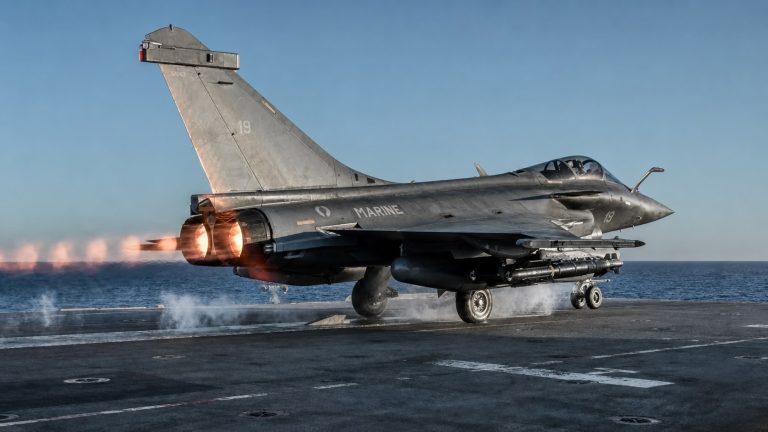
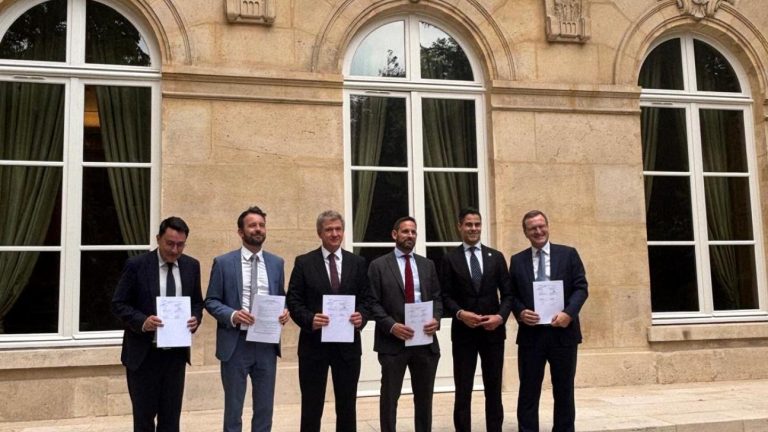
President Emmanuel Macron’s warning against go-it-alone defence strategies lands at a sensitive moment for European industry, after the effective breakdown of the Franco-German Future Combat Air System (FCAS) project exposed the limits of multinational weapons programmes.
Reuters reported that Macron called national go-it-alone defence strategies in Europe an absurdity. His remarks were not simply rhetorical. They followed years of tension over FCAS, the next-generation combat-air project meant to bring together France, Germany and Spain around a future fighter, drones, sensors and combat-cloud architecture.
FCAS was supposed to be a flagship of European strategic autonomy. Instead, it became a case study in workshare disputes, industrial control and national priorities. The rivalry between Dassault Aviation and Airbus Defence and Space was never only about engineering; it was about who controls design authority, intellectual property and the most valuable parts of the programme.
The failure matters because combat aircraft are not just another procurement category. A next-generation fighter system defines sensors, weapons integration, electronic warfare, engines, software and industrial skills for decades. If Europe cannot sustain a joint programme at this level, its claims of independent high-end defence capability become harder to believe.
Defence Matters has recently covered the way European rearmament is turning into real industrial demand, including Kongsberg’s surge in missile orders. FCAS shows the other side of the problem: demand alone does not guarantee cooperation when companies and governments disagree over control.
The workshare dilemma is familiar. Each participating state wants jobs, technology transfer and sovereign access to key systems. Industry wants clear leadership and protection of intellectual property. Military customers want equipment delivered on time. Multinational programmes often try to satisfy all three and end up satisfying none.
Macron’s criticism of fragmentation is strategically sound. Europe cannot afford separate national solutions for every high-end capability. But France has also insisted on preserving national industrial sovereignty in areas it regards as core to its strategic autonomy. Germany, meanwhile, has its own industrial and parliamentary constraints. The FCAS dispute reflects those tensions rather than a simple failure of political will.
The collapse or paralysis of FCAS also has consequences for Europe’s relationship with the United States. If Europe cannot deliver its own next-generation combat-air system, air forces may become even more dependent on US platforms, software and upgrade pathways. The F-35 has already reshaped European airpower. A failed FCAS would deepen that trend.
There may still be attempts to rescue parts of the programme or repackage cooperation around drones, sensors or engines. But the broader lesson is already visible. Joint European defence projects require early agreement on leadership, intellectual property, export policy and industrial return. Without that, strategic autonomy remains a slogan attached to programmes that cannot survive contact with national interests.
Macron is right that fragmentation is absurd. FCAS shows why Europe keeps producing it anyway.