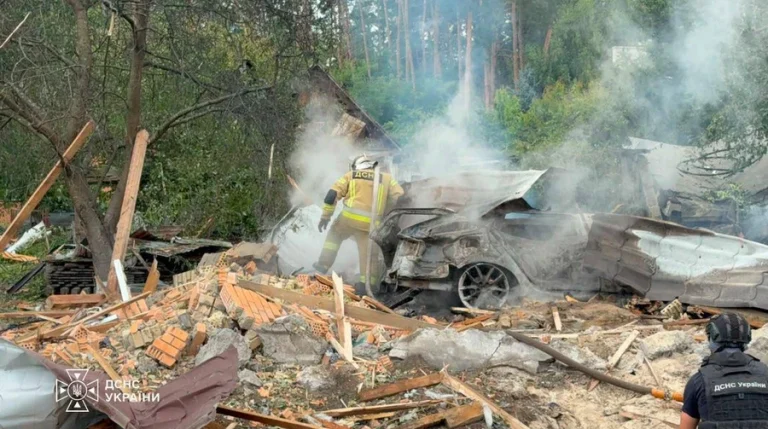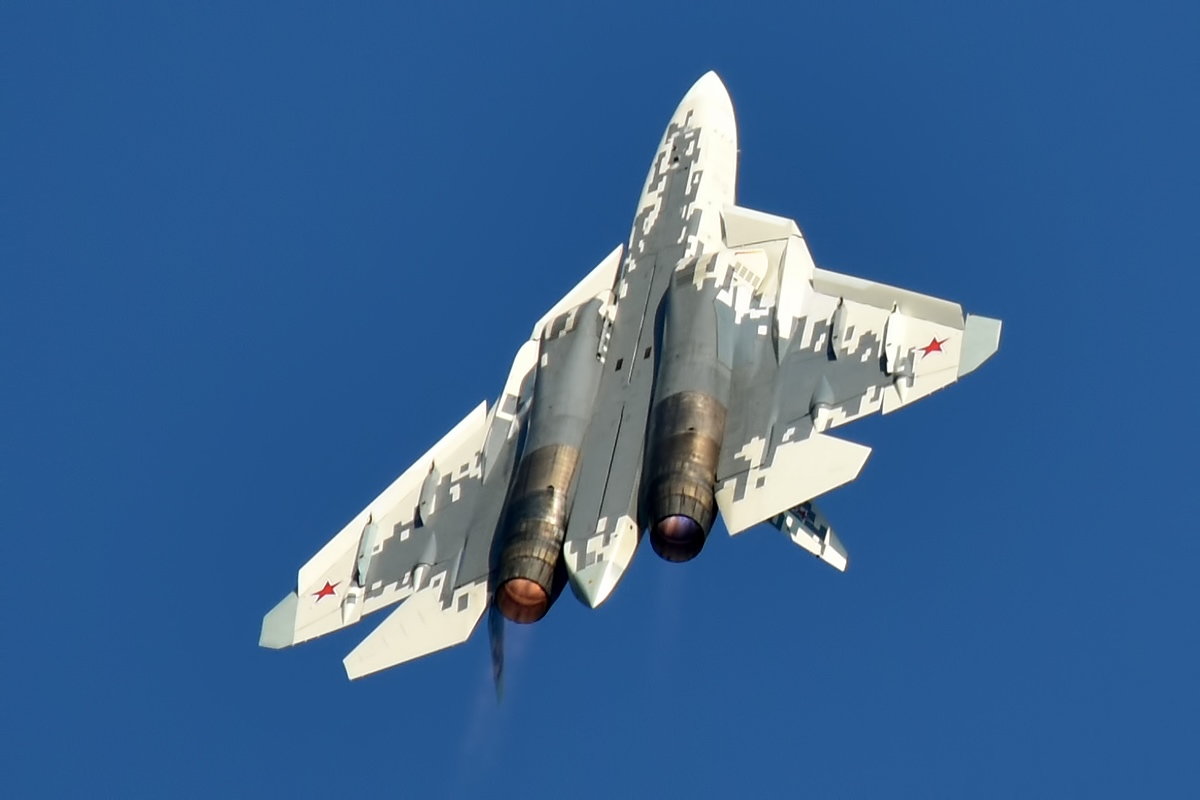
A Russian military aircraft reported to be an Su-57 fighter crashed near the village of Lutsino in the Moscow region on Thursday, 23 July, after encountering difficulties during take-off.
The pilot ejected and was not seriously injured. The aircraft fell in an unpopulated area, carried no ammunition and caused no reported damage on the ground, according to a statement attributed to the Russian Defence Ministry. The ministry said the preliminary cause was a technical malfunction, but described the aircraft only as a “combat trainer” and did not identify its model.
Russian aviation and security-linked channels, followed by reporting based on sources involved in the investigation, identified the aircraft as an Su-57. A criminal investigation was opened under provisions covering violations of flight rules or flight preparation. Military specialists and a Defence Ministry commission are also examining the cause.
Suggestions that the aircraft was shot down by Russian air defences emerged after a pro-war Russian Telegram channel said that questions should be directed at the BARS-Moscow air-defence unit. That comment did not provide evidence of a missile engagement. No official statement has confirmed friendly fire, and the available information does not support describing the incident as a confirmed shoot-down.
Nevertheless, the crash matters because every Su-57 represents a relatively large share of a fleet whose precise size Russia does not disclose.
United Aircraft Corporation continues to announce deliveries in unspecified batches. In February, it said it had transferred another group of Su-57s with an updated weapons complex, but did not say how many aircraft were included. The absence of numbers makes it difficult to determine how quickly Russia is expanding its operational inventory or replacing aircraft damaged in accidents and Ukrainian strikes.
Ukraine said it struck an Su-57 at Akhtubinsk airfield in June 2024, publishing satellite images showing blast marks near the parked aircraft. In April 2026, the Ukrainian Defence Ministry said two more Su-57s were hit at Shagol airfield in the Urals. The extent of the damage in those cases has not been independently established, but the claims illustrate the vulnerability of a small fleet concentrated at a limited number of bases.
The Su-57 is often assessed through competing absolutes. Russia presents it as a combat-proven fifth-generation aircraft with stealth characteristics, advanced sensors and the ability to employ long-range weapons. Its critics sometimes argue that Russia has no fifth-generation fighter at all, a claim also made in the commentary supplied for this article.
That conclusion is too categorical. There is no internationally binding definition of a fifth-generation fighter, but the term normally includes reduced radar visibility, internal weapons carriage, advanced sensors, data fusion and networked operations. The Su-57 was designed around those requirements. The more relevant question is how fully those capabilities have been implemented and whether Russia can field them at scale.
The engine remains one of the clearest indications that the programme is still evolving. Operational Su-57s have principally used derivatives of the AL-41 engine family. In December 2025, Russian industry announced that an Su-57 had begun flight testing with the new Product 177 engine.
Rostec says the engine offers increased thrust, lower fuel consumption and a longer service life. Its first flight was an engineering milestone, but it also showed that the intended next-stage propulsion system had not yet entered general fleet service more than 15 years after the Su-57 prototype first flew.
Development is continuing in other areas. In May 2026, United Aircraft Corporation began flight tests of the two-seat Su-57D prototype. The company says the variant is intended to perform combat, training and control functions, including co-ordination with unmanned aircraft.
Production scale remains the sharpest contrast with the American F-35 programme. Lockheed Martin delivered 191 F-35s during 2025, bringing the global fleet to almost 1,300 aircraft by the beginning of 2026. Large numbers create greater training capacity, maintenance experience, supply-chain depth and resilience after losses.
The comparison should not imply that the F-35 is free of serious problems. A June 2026 US government assessment found that its fleet-wide mission-capable rate had fallen from 67 per cent in 2021 to 44 per cent in 2025, while its fully mission-capable rate declined from 38 per cent to 25 per cent.
The Su-57 is therefore neither an imaginary aircraft nor demonstrably equivalent to the much larger F-35 enterprise. It is an operational but still developing system whose effectiveness is constrained by limited numbers, incomplete propulsion modernisation and a lack of independently verifiable combat data.
The 23 July crash does not by itself discredit the programme: all advanced military aircraft suffer accidents. Its importance lies in scarcity. For a large fleet, one technical loss is manageable. For Russia’s Su-57 force, each destroyed aircraft reduces an already limited pool of airframes available for testing, training and operations.