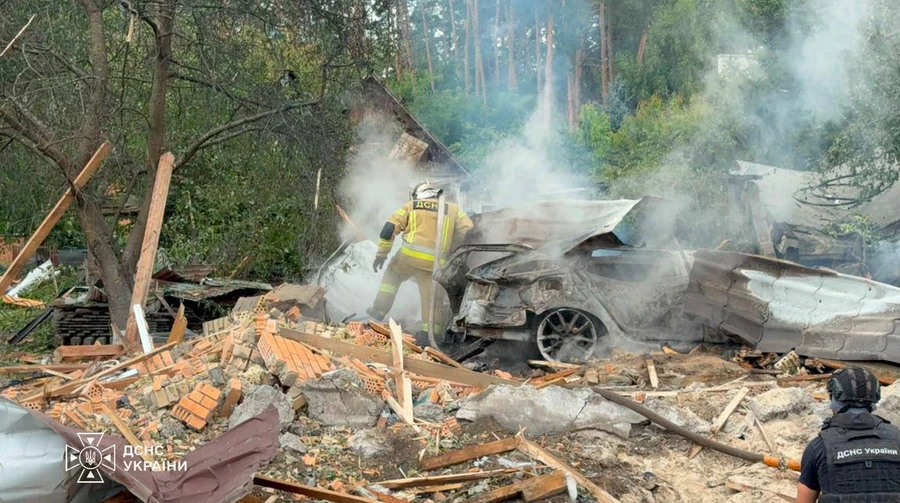
A Russian ballistic missile strike on a defence-industry gathering in the Kyiv region has killed 10 people and injured about 100, opening a criminal investigation into the organisation of the event and the security arrangements surrounding it.
President Volodymyr Zelenskyy initially confirmed that a rescue operation was under way, reporting six deaths and dozens of injuries. The casualty figures were subsequently revised by Prosecutor General Ruslan Kravchenko, who said 10 people had been killed and approximately 100 wounded.
The Kyiv regional authorities confirmed that a ballistic missile struck a private training ground where events were taking place. The Bucha district was the area most heavily affected, according to the regional administration.
Valerii Borovyk, founder of the Ukrainian defence manufacturer First Contact, said during a broadcast interview about the attack that an exhibition of weapons and military technology was being held at the training ground. He said acquaintances of his had been present and suggested that the strike may have been timed to coincide with the event.
That assessment has not been independently confirmed. Ukraine has not disclosed what intelligence Russia used to identify the target or whether the missile had been launched specifically because of the gathering.
The Ukrainian Council of Defence Industry confirmed that representatives of Ukrainian defence companies were at the location, but said it had not organised the event. It also stated that the participants’ precise location had not been made public.
This qualification is important. Public promotion of a defence exhibition may alert an adversary that a gathering is planned, identify participating organisations and narrow the period during which it is likely to occur. It does not necessarily provide the coordinates required for an accurate ballistic missile strike.
Russia could have obtained the location through several methods, including agents, intercepted communications, aerial reconnaissance, compromised devices or information unintentionally disclosed by participants. It may also have combined publicly available information with classified intelligence. No evidence has yet established which method was used.
Serhii Beskrestnov, known as “Flash”, an adviser to the Ukrainian president on defence technology, initially wrote that he and his team were safe. He later clarified that he had not attended the event.
Beskrestnov said he avoided events at training grounds when he identified risks including a lack of shelters, large numbers of participants, exposure to ballistic missiles and an early announcement of the venue. His clarification also corrected initial reports suggesting that he had been present during the strike.
The Prosecutor General’s Office has opened proceedings under the provision of Ukraine’s Criminal Code covering war crimes. A separate investigation concerns possible negligence in the organisation and conduct of the gathering.
According to Kravchenko, investigators will establish who approved the event, who agreed its location, timing and format, what security measures were planned and whether the risks associated with holding it during wartime were properly assessed.
The investigation will therefore address two distinct questions. The first concerns Russia’s responsibility for launching the missile. The second concerns whether Ukrainian organisers unnecessarily concentrated valuable personnel and equipment at a location without adequate protection.
Defence engineers, drone developers, electronic-warfare specialists and air-defence technicians have become direct targets in the war. Their value is not limited to individual weapons systems. They connect battlefield units with manufacturers, adapt technology in response to Russian tactics and transfer knowledge between companies and military institutions.
Ukraine has previously faced comparable security questions. On 19 August 2023, a Russian missile struck central Chernihiv while a drone-related event was being held inside the city’s theatre. The Ukrainian Interior Ministry later reported that seven people were killed and 148 injured. Those inside the theatre had moved to its shelter, while many victims were outside, in vehicles or nearby buildings.
The Kyiv-region strike indicates that security procedures for defence-sector events remain an operational issue. Removing an address from an invitation is not sufficient if other information reveals the likely location, date, route or group of participants.
Effective precautions may require smaller and decentralised meetings, restrictions on mobile devices, secure transport, protected venues, limits on attendance and disclosure of the location only shortly before an event begins. Organisers must also consider whether a public announcement is necessary before the gathering has concluded.
Defence exhibitions and technical meetings remain necessary because Ukraine’s military innovation depends on direct communication between manufacturers and battlefield users. The challenge is to preserve that exchange without creating a concentrated and predictable target.
The findings of the criminal investigation will determine whether errors were made in this case. Its wider importance lies in whether Ukraine introduces stronger rules for protecting the limited number of specialists on whom its defence-industrial capacity increasingly depends.