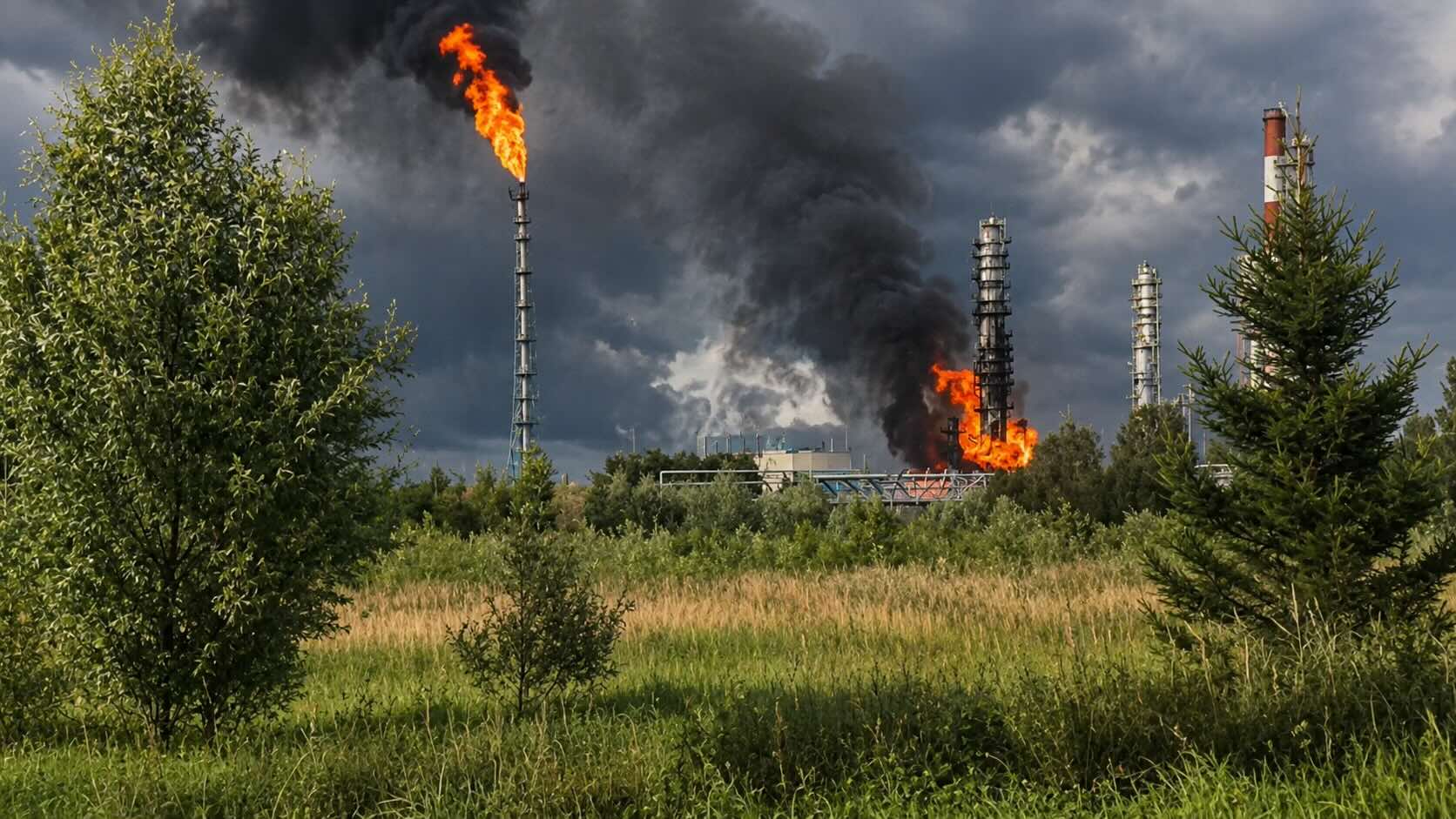
Ukrainian forces struck a major petrochemical complex in Russia’s Tyumen region on 10 August, damaging a gas-fractionation installation at a site more than 2,000 kilometres from Ukraine.
The Ukrainian General Staff confirmed the strike on the Tobolskneftekhim complex, saying the operation formed part of efforts to reduce Russia’s military-economic potential. Kyiv said the central gas-fractionation unit had been hit and put its processing capacity at approximately 6.6 million tonnes of feedstock a year.
Russian authorities separately acknowledged the drone attack without initially identifying the facility. Tyumen regional governor Alexander Moor said on his official Telegram channel that several drones had fallen on the territory of an industrial enterprise, causing a fire. Emergency services were deployed to the site.
The Ukrainian military identified the target as the petrochemical complex at Tobolsk associated with SIBUR. Ukraine’s Special Operations Forces said its Deep Strike units had participated in the operation and claimed the drones travelled more than 2,000 kilometres before reaching the target. The precise launch point, route and type of unmanned aircraft used have not been disclosed publicly.
Tobolsk is an important location within Russia’s petrochemical industry.
SIBUR has invested heavily in gas processing and polymer production at the site. The company previously said that commissioning a second gas-fractionation unit had increased processing capacity at Tobolsk to 6.6 million tonnes annually. A subsequent expansion raised total fractionation capacity across the production site further, illustrating the scale of the industrial cluster.
The wider ZapSibNeftekhim complex is designed for large-scale polymer production, including polyethylene and polypropylene. These products have extensive civilian industrial uses, but petrochemical feedstocks and derived materials also enter supply chains relevant to defence production.
The Ukrainian General Staff said the Tobolsk facility produces materials including butadiene, isobutylene, maleic anhydride and MTBE and described them as important to Russia’s military-industrial sector. That assessment should be distinguished from evidence that all production at the plant is destined for military customers.
SIBUR’s own descriptions show the breadth of civilian applications. The company says maleic anhydride is used in construction, agriculture, automotive manufacturing, pharmaceuticals, coatings and fuel components. The complex is therefore better characterised as a major dual-use industrial site than as a dedicated weapons plant.
The principal defence significance of the Tobolsk operation is its geography.
Russia has traditionally benefited from strategic depth. Major industrial sites in the Urals and Siberia were separated from western borders by distances that made conventional air attack difficult without penetrating Russian airspace with crewed aircraft or long-range missiles.
Long-range unmanned systems are changing that calculation.
Tobolsk lies roughly 2,200 kilometres from the nearest parts of Ukraine. A successful attack at that distance means industrial installations well beyond Moscow, the Volga region and the Urals may have to be considered within the potential operating radius of Ukrainian long-range drones.
This does not mean that every Russian facility within a similar radius is equally vulnerable. Long-distance drone operations depend on launch location, navigation, route planning, weather, electronic warfare and the disposition of Russian air defences.
The problem for Moscow is instead one of scale.
Russia must protect military airfields and headquarters, oil refineries, fuel depots, ammunition facilities and defence factories while also maintaining coverage of major population centres. If industrial sites in western Siberia require additional protection, the geographical area across which Russia must distribute radar, electronic-warfare equipment and short-range air-defence systems expands considerably.
Tobolsk is also not an isolated indication of that pressure. Previous Ukrainian operations have already demonstrated the ability to reach the Tyumen region, approximately 2,000 kilometres from Ukraine, increasing evidence that western Siberia is within the practical envelope of Kyiv’s long-range drone programme.
Russian regional authorities are simultaneously tightening controls on information generated during drone attacks.
Moor has warned residents that photographs and video of drones, wreckage and air-defence activity must not be published online, citing regional security rules and penalties for violations.
Such restrictions have a clear military purpose. Images uploaded shortly after an attack can reveal impact locations, provide evidence about the effectiveness of air defences and allow analysts to assess damage to specific installations.
They also make independent verification of strike results more difficult.
For Ukraine, the Tobolsk attack therefore has two dimensions. The immediate objective was a large petrochemical processing site that Kyiv regards as part of the industrial base supporting Russia’s war effort.
The broader consequence is strategic. Industrial facilities more than 2,000 kilometres inside Russian territory can no longer rely on distance alone as a defensive barrier.
The extent of the damage and its effect on production at Tobolsk remain to be established. The confirmed penetration of Russian territory to this depth, however, adds another requirement to an air-defence network already responsible for protecting targets spread across the world’s largest national territory.