Czechoslovak Group’s first-half figures translate Europe’s rearmament from political promises into revenue, orders and a heavy working-capital requirement.
Czechoslovak Group reported first-half revenue of €3.25 billion as demand for ammunition and other defence equipment continued to turn European rearmament programmes into industrial orders.
The Czech group said revenue in its Defence Systems business increased by 27 per cent and that its firm backlog and pipeline under negotiation together reached €46 billion. The figures offer unusually clear evidence of the scale of demand created by military support for Ukraine, the replenishment of depleted stockpiles and the longer-term expansion of European armed forces.
They also reveal a less comfortable side of the mobilisation. Rapid growth consumes cash before it generates it. Manufacturers must buy materials, build inventory, expand plants and reserve production capacity well before customers make final payments. CSG’s negative operating cash flow, partly associated with strategic pre-stocking, is therefore not a footnote. It is part of the economics of rearmament.
The group’s investor reporting should be read as an industrial-capacity statement as much as a set of company accounts.
The €46 billion figure requires care. A backlog normally consists of contracted orders that have not yet been recognised as revenue. A pipeline consists of potential business under negotiation and carries a different probability of conversion. Adding the two demonstrates the scale of commercial opportunity, but it does not mean CSG has €46 billion of guaranteed sales.
That distinction is particularly important in defence. Government procurement can be delayed by budgets, elections, technical requirements or production schedules. Framework agreements may not be exercised in full, while export licences and political decisions can alter delivery plans. A large pipeline supports confidence about future demand without eliminating execution risk.
Even so, the trend is striking. In its first-quarter trading statement, CSG reported a €17 billion backlog and a €27 billion pipeline, producing a combined opportunity of €44 billion. The first-half total indicates that demand has continued to expand despite the group converting existing orders into revenue.
This is what a sustained procurement cycle looks like in corporate accounts. Announced defence budgets become tenders; tenders become contracts; contracts require inventory, labour and machinery; only then do deliveries become sales.
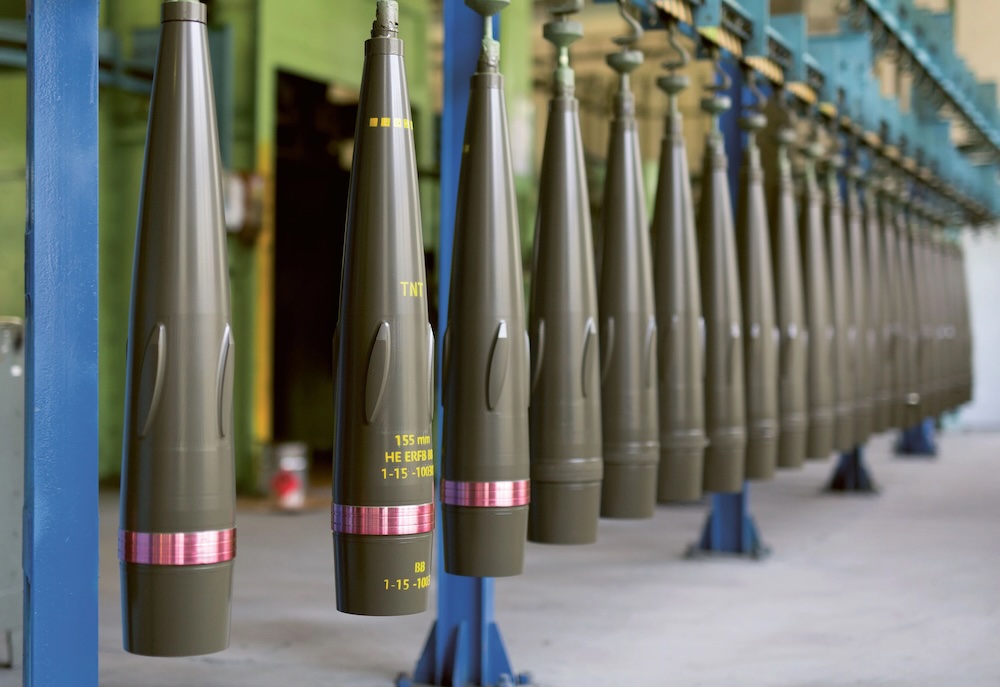
The war in Ukraine exposed the gulf between peacetime production and wartime consumption. Artillery ammunition that European factories had produced in relatively small annual volumes was being fired at rates that required a fundamentally larger industrial base. Governments responded with national contracts, EU financing and multinational purchasing initiatives, but adding capacity takes time.
CSG sits near the centre of that expansion. Its businesses cover medium- and large-calibre ammunition, land systems, defence electronics and small-arms ammunition. This breadth allows the company to benefit from several procurement priorities while also creating a complex demand for explosives, metals, components and skilled labour.
Revenue growth shows that factories are delivering more. It does not by itself prove that Europe has closed its capability gaps. Much of the output may replace ammunition transferred to Ukraine or rebuild stocks from historically low levels. Armed forces must also hold sufficient reserves for training and for the possibility of a prolonged high-intensity conflict.
The order book therefore measures both industrial success and accumulated shortage. A manufacturer’s expanding backlog is good for future revenue, but for defence planners it can also mean long waits for equipment that is needed sooner.
CSG’s cash-flow profile illustrates why political promises require financial engineering. An ammunition producer may need to purchase copper, steel, energetic materials and other inputs months before delivery. It may build stocks to protect against shortages or to accelerate production when a contract is signed. New lines require construction and qualification before they operate at scale.
These outlays appear as working capital and capital expenditure. They can depress cash generation even while profit and revenue rise. A company with strong orders can consequently require more financing, not less.
For governments, the lesson is that predictable contracting matters. Short awards and uncertain annual budgets force manufacturers to bear more risk. Multi-year orders give them a stronger basis for borrowing, hiring and investing. Advance payments and common specifications can reduce the cash burden and prevent factories from building separate lines for fragmented national requirements.
The same logic applies to raw materials. Strategic pre-stocking protects production against disrupted supply chains, but somebody must finance the inventory. If Europe expects its defence industry to maintain surge capacity, procurement rules must recognise that resilience has a carrying cost even when a factory is not using every stored component immediately.
CSG’s expansion brings challenges alongside opportunity. It must integrate acquisitions, increase output without weakening quality control and recruit in markets where engineering and manufacturing skills are scarce. Ammunition production involves hazardous processes and strict certification; capacity cannot safely be improvised.
The company must also manage exposure to changing demand. Ukraine’s needs remain urgent, but the balance between emergency orders and long-term European replenishment may shift. Customers in Asia and other regions can diversify the order base, although they introduce export-control and geopolitical considerations.
Investors will therefore watch whether revenue growth is accompanied by stable margins and, eventually, stronger cash conversion. Defence ministries should watch different indicators: delivery times, new qualified capacity and the proportion of orders that represent additional output rather than a longer queue.
Europe’s defence debate often treats spending commitments as the result. They are only the beginning. Military capability emerges when companies can finance inputs, manufacture equipment at the required rate and deliver it on time.
CSG’s €3.25 billion first-half revenue and €46 billion combined backlog and pipeline show that demand is no longer hypothetical. They also show the pressure that demand places on balance sheets and supply chains. The next test is whether Europe can turn this unprecedented commercial opportunity into durable, diversified production before the strategic need becomes still more acute.