

Beneath the rhetoric of “Global Britain” lies an uncomfortable truth: the United Kingdom’s defences are stretched, under-resourced, and in some critical areas—most notably anti-missile and air defence—alarmingly inadequate.
This is not simply a matter of budget lines or procurement delays. It is a question of strategic neglect. In an age where warfare is defined by precision strikes, hypersonic weapons, and saturation missile attacks, Britain appears to be preparing—if it is preparing at all—for a conflict that no longer exists.
The most glaring omission is the lack of a robust, layered anti-missile defence system. While allies and adversaries alike have invested heavily in integrated air and missile defence networks, the UK has largely stood still. There is no comprehensive equivalent to Israel’s Iron Dome, nor even a scaled version adapted for British needs. Ground-based air defence has withered over decades, reduced to a handful of systems that are neither numerous nor sophisticated enough to counter a determined modern attack.
This vulnerability is not theoretical. It has been exposed in stark terms by recent events, including the inability to mount any meaningful response to Iran’s attack on RAF Akrotiri. That incident should have triggered a national reckoning. Instead, it passed with little more than muted concern and vague assurances. If a British overseas base can be targeted with such impunity, what does that say about the defence of the British mainland itself?
One might expect such shortcomings from a Labour government historically sceptical of military spending. Under Sir Keir Starmer, whose leadership has often been characterised as cautious to the point of inertia, there has been little sign of urgency in addressing these gaps. The language is managerial rather than strategic, focused on reviews and frameworks rather than capability and readiness. It is difficult to escape the impression of a government more comfortable talking about defence than actually delivering it.
And yet, to lay the blame solely at Labour’s door would be both unfair and inaccurate. The roots of this malaise run deeper, extending back through years of Conservative-led governments that presided over a steady erosion of Britain’s military strength. Successive defence reviews promised transformation while quietly cutting capacity. The result is a force structure that looks impressive on paper but lacks the depth and resilience required for sustained operations.
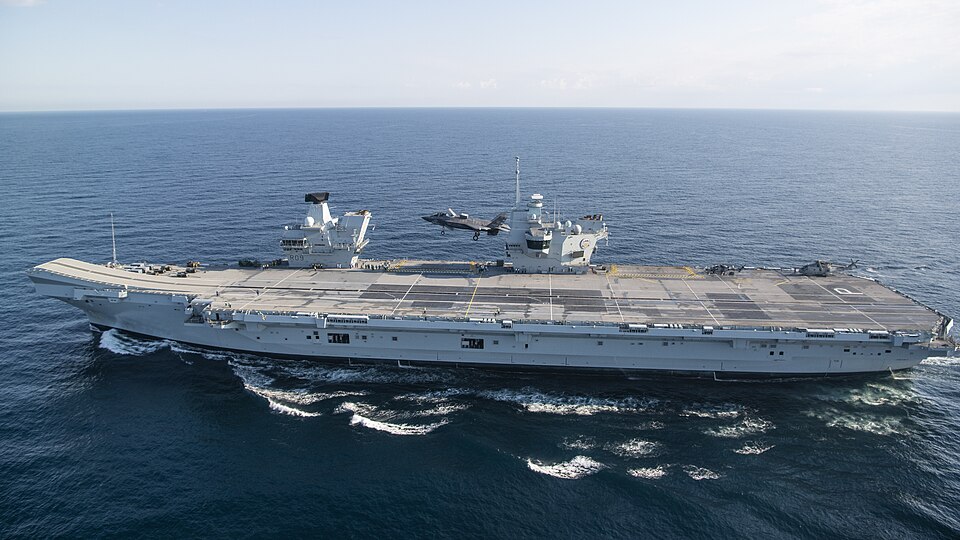
Nowhere is this more evident than in the Royal Navy’s flagship assets: the two aircraft carriers. HMS Queen Elizabeth and HMS Prince of Wales were intended to symbolise Britain’s return to blue-water naval power. In reality, they risk becoming symbols of something quite different—ambition untethered from practical defence.
Aircraft carriers are, by their nature, high-value targets. In any conflict involving a capable adversary, they would be among the first assets targeted by long-range missiles. Protecting them requires a layered defence: advanced radar systems, interceptor missiles, electronic warfare capabilities, and—crucially—a sufficient number of escort vessels equipped to detect and neutralise threats before they reach the carrier.
Britain currently lacks that protective umbrella. The carriers themselves are not equipped with significant anti-missile defences. Instead, they rely on their escorts—Type 45 destroyers and Type 23 frigates—to provide cover. But here again, numbers tell a troubling story. The Royal Navy simply does not have enough surface warships to guarantee a fully protected carrier strike group at all times. Maintenance cycles, operational commitments, and personnel shortages further reduce the number of ships actually available for deployment.
The consequence is stark: in a high-intensity conflict, Britain’s carriers would be dangerously exposed. A coordinated missile strike could overwhelm their defences, particularly if launched by an adversary with advanced capabilities. The uncomfortable conclusion is that these multi-billion-pound assets are unlikely to survive their first encounter with a determined enemy.
This is not alarmism; it is a reflection of modern warfare. Recent conflicts have demonstrated the effectiveness of relatively inexpensive missiles against high-value targets. The proliferation of drone technology and loitering munitions has further complicated the defensive equation. It is no longer sufficient to rely on a handful of sophisticated platforms. Survivability now depends on redundancy, integration, and sheer volume of defensive systems—areas where the UK is currently lacking.
The broader issue is one of strategic coherence. Britain continues to pursue a global military posture without the means to sustain it. Carrier strike groups are deployed to distant waters, projecting an image of power that is not fully backed by capability. Meanwhile, the homeland itself remains inadequately defended against the very threats that define contemporary conflict.
There is also a troubling complacency in political discourse. Defence is often treated as a secondary concern, overshadowed by domestic priorities and constrained by fiscal caution. While prudence in public spending is necessary, it should not come at the expense of national security. The cost of inaction, or of half-measures, is ultimately far greater.
Rebuilding Britain’s defences will not be quick or easy. It will require sustained investment, clear strategic direction, and a willingness to make difficult choices. Ground-based air defence must be expanded and modernised, incorporating systems capable of intercepting a range of threats from drones to ballistic missiles. The Royal Navy needs more escort vessels, not just to protect carriers but to ensure overall maritime security. The carriers themselves should be retrofitted with enhanced defensive systems, reducing their reliance on external protection.
Equally important is a shift in mindset. Defence policy must move beyond the assumption that the UK can rely indefinitely on allies for critical capabilities. While partnerships remain vital, they should complement—not substitute—national strength. The current trajectory risks leaving Britain dependent and vulnerable at precisely the moment when self-reliance is most needed.
Sir Keir Starmer’s government has an opportunity to address these shortcomings, but time is not on its side. The strategic environment is deteriorating, with rising tensions and increasingly assertive adversaries. Incremental adjustments will not suffice. What is required is a comprehensive reassessment of Britain’s defence posture, grounded in the realities of modern warfare.
At the same time, there must be an honest acknowledgement of how the country arrived at this point. The erosion of capability did not happen overnight, nor was it the result of a single administration. It reflects years of underinvestment, misplaced priorities, and a reluctance to confront uncomfortable truths. Recognising that history is essential if Britain is to avoid repeating it.
Ultimately, the question is not whether the UK can afford to strengthen its defences, but whether it can afford not to. The world has changed, and the threats facing the country are more complex and more immediate than at any time in recent memory. Continuing on the current path—hoping that deterrence alone will suffice—is a gamble that grows riskier by the day.
Britain still possesses many of the ingredients required for effective defence: skilled personnel, advanced technology, and a strong industrial base. What is lacking is the political will to bring these elements together in a coherent and adequately resourced strategy. Until that changes, the gap between rhetoric and reality will continue to widen.
And in that gap lies the real danger.
“No Winston Churchill”: Keir Starmer’s Credibility Shrinks with the Royal Navy


