Stoyanov told reporters in Sofia that the government did not envisage providing additional weapons to the Ukrainian army, arguing that the war could not be resolved on the battlefield. According to remarks reported from Sofia, he said Ukraine needed more personnel rather than more arms, and called for negotiations aimed at what he described as a just peace agreed by both sides.
The statement is politically significant because Bulgaria is both a member of NATO and the European Union, and because it has played a practical role in supplying Ukraine since Russia’s full-scale invasion in February 2022. Although Bulgarian governments have often avoided public emphasis on weapons transfers because of domestic divisions, the country’s stock of Soviet-era equipment and its munitions industry made it a useful supplier, directly or indirectly, at earlier stages of the war.
The new position reflects the line taken by Prime Minister Rumen Radev, whose government took office after elections in April. Radev has long been cautious about military support for Kyiv and has argued that diplomacy, rather than continued arms deliveries, should be the priority. His government’s stance now places Bulgaria among those European states where support for Ukraine is being reframed through the language of negotiation, even as other EU and NATO members continue to press for expanded military assistance.
Rumen Radev seeks to fill Orbán’s place as Moscow’s interlocutor inside the EU
The decision does not mean Bulgaria is abandoning defence rearmament. Stoyanov also said Sofia plans to increase defence spending to 5 per cent of GDP by 2030. Bulgarian public radio reported that the plan includes 3.5 per cent for direct military expenditure and 1.5 per cent for defence-related areas such as infrastructure and cyber security, with army modernisation projects to be accelerated through the new spending plan.
That distinction is central to the political meaning of Tuesday’s announcement. Bulgaria is signalling that it intends to meet the higher defence-spending expectations now being placed on European NATO allies, while separating national military modernisation from continued arms transfers to Ukraine. The approach allows Sofia to present itself as aligned with NATO’s rearmament agenda, while limiting its direct contribution to Kyiv’s battlefield needs.
NATO has moved towards a much higher spending benchmark after years of pressure from Washington and a deteriorating security environment in Europe. Under the alliance’s latest framework, allies have committed to reaching 5 per cent of GDP annually for core defence requirements and defence and security-related spending by 2035, including at least 3.5 per cent for core defence expenditure, according to NATO’s defence investment guidance.
Bulgaria’s proposed timetable is therefore more ambitious than the alliance-wide 2035 horizon. Yet the same announcement also underlines a broader problem for Ukraine: higher defence budgets in Europe do not automatically translate into more weapons for Kyiv. Some governments are prioritising their own force structure, air defence, ammunition stocks, infrastructure and cyber resilience, rather than transferring existing equipment to Ukraine.
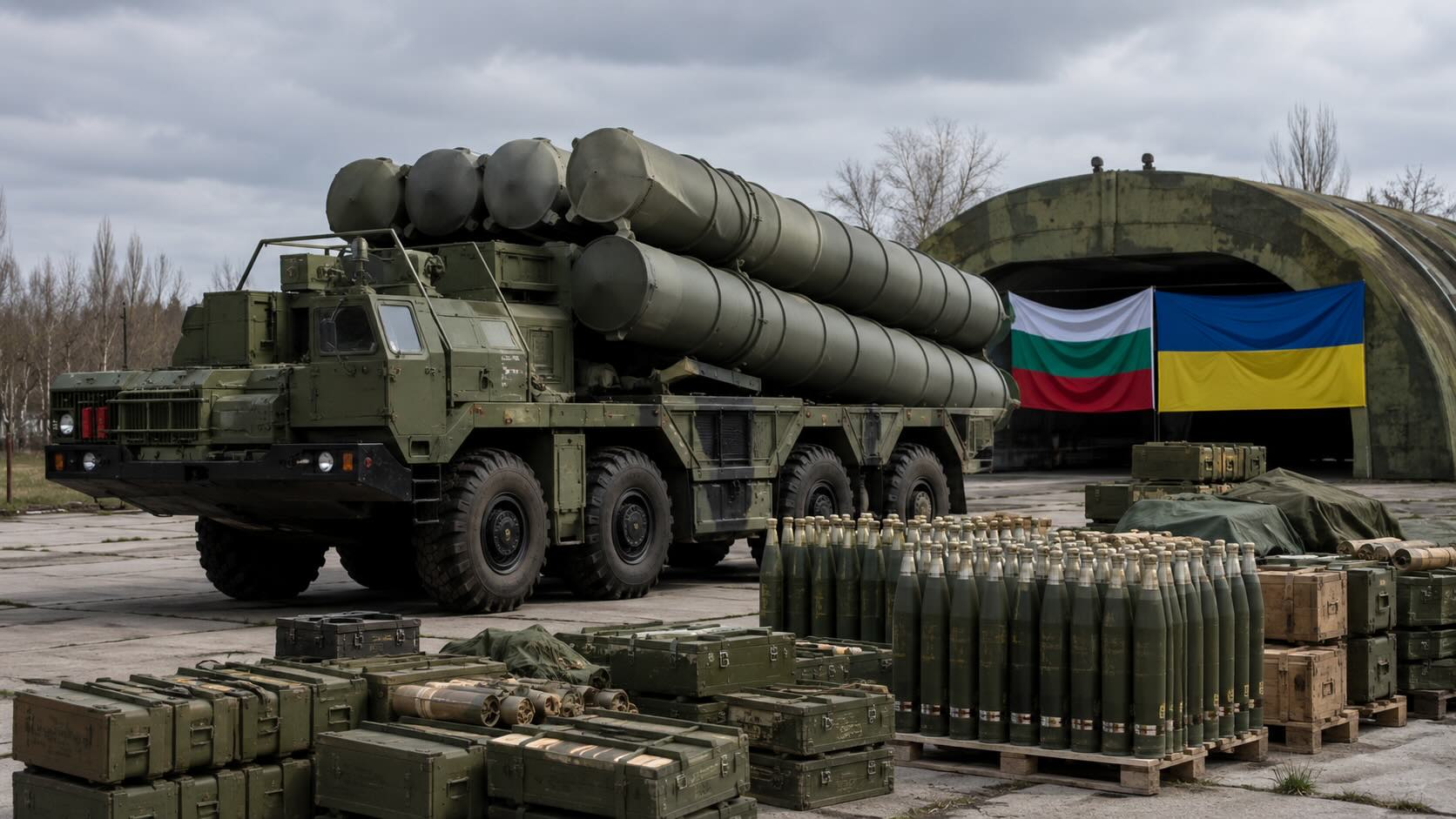
The Bulgarian case also highlights the political sensitivity of Soviet-era stocks in eastern Europe. Ukraine has relied heavily on ammunition, air-defence components and equipment compatible with Soviet-designed systems. For countries such as Bulgaria, those stocks are tied both to Ukraine’s immediate needs and to their own capability gaps while they transition towards NATO-standard equipment. The choice between transferring old systems, retaining them for national defence, or selling through indirect channels has often been politically contested.
Earlier Bulgarian governments approved military assistance despite domestic opposition. In 2023, Bulgaria’s parliament backed additional aid to Ukraine, including defective S-300 missiles that could be repaired or used for spare parts, as well as small-calibre ammunition. That decision exposed divisions between pro-Ukraine parties and political forces opposed to supplying arms, including nationalist and pro-Russian groups, according to the parliamentary vote reported at the time.
The new government’s position may therefore have consequences beyond the size of Bulgaria’s own contribution. It will be watched in Kyiv and across NATO as an indication of whether support fatigue is deepening among some allies, particularly where domestic politics makes military aid controversial. It may also strengthen arguments within Europe that long-term Ukraine support cannot rely only on bilateral donations of existing weapons, but must be tied to defence production, procurement and industrial co-operation.
For the EU, Sofia’s stance adds another complication to an already uneven European approach. Some member states continue to push for faster deliveries, expanded ammunition production and the use of frozen Russian assets to support Ukraine. Others are more cautious, either because of domestic politics, budgetary pressure or concern that military escalation will leave diplomacy with fewer options.
Bulgaria is not leaving NATO’s defence-spending consensus. On the contrary, it is promising to spend more and modernise faster. But by drawing a line under further weapons supplies to Ukraine, Sofia has exposed a growing distinction inside Europe’s security debate: rearming Europe and arming Ukraine are related, but they are not always the same political decision.