

Yet the philosophy behind it has changed markedly since the Second World War. What was once openly justified as a means of breaking civilian morale is now officially denied even when it occurs.
This shift reflects not merely advances in technology but a transformation in the moral language of war.
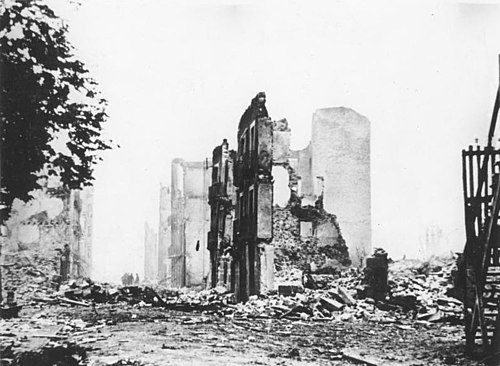
The deliberate destruction of civilians from the air first entered the public consciousness during the Spanish Civil War. On 26th April 1937, aircraft of the German Condor Legion, fighting in support of the Nationalist forces of Francisco Franco, reduced much of Guernica to rubble.
The attack itself was militarily modest by the standards of later conflicts. Yet its symbolism was enormous. The bombing appeared to demonstrate a new and terrifying proposition: that the civilian population of a town could be treated not as collateral damage but as the primary object of attack.
The strategic thinking behind such operations had been articulated earlier by the Italian air power theorist Giulio Douhet. Writing in the 1920s, Douhet argued that air forces could bypass armies and strike directly at the population centres that sustained them. By attacking cities—destroying infrastructure, spreading panic and undermining morale—an enemy could be forced to surrender without prolonged ground fighting.
Guernica seemed to provide a demonstration of this theory in action. News of the bombing spread rapidly across Europe, assisted by reporting from journalists such as George Steer. The outrage it generated was magnified further by Pablo Picasso, whose famous painting Guernica became an enduring symbol of civilian suffering in war.
For the leadership of Nazi Germany, however, the attack represented something different: a practical experiment in modern warfare.
When the Second World War erupted in 1939, the bombing of cities soon became central to the strategies of all major belligerents. The early German air raids on British cities during the The Blitz were intended in part to break civilian morale and force Britain to negotiate.
The philosophical underpinning of such attacks reflected the worldview of Adolf Hitler and his military planners. War, in this conception, was not simply a contest between armies but a struggle between entire societies. Civilian populations therefore became legitimate targets. Factories, housing, railways and power stations formed part of a single war system that could be attacked from the air.
Yet Germany was not alone in adopting this logic. As the war progressed, the Allies themselves embraced strategic bombing on an immense scale. British bomber forces under Arthur Harris carried out area bombing campaigns against German cities such as Hamburg and Dresden. Meanwhile the United States Army Air Forces conducted devastating raids against Japanese urban centres, culminating in the atomic destruction of Hiroshima and Nagasaki.
By the war’s end the philosophy of bombing had become brutally pragmatic. Military planners argued that destroying cities shortened the conflict and ultimately saved lives that would otherwise be lost in prolonged ground combat.
The human cost, however, was staggering. Hundreds of thousands of civilians died beneath the bombs. Entire urban landscapes were erased.
The advent of nuclear weapons after 1945 transformed the debate. The atomic bomb introduced the possibility that entire societies could be destroyed in minutes. Strategic bombing doctrine evolved into the concept of nuclear deterrence, in which the threat of annihilating enemy cities was intended to prevent war altogether.
This paradoxical philosophy dominated the Cold War. Both the United States and the Soviet Union possessed arsenals capable of obliterating urban civilisation. Yet precisely because such destruction would be catastrophic, neither side dared initiate it.
The moral framework surrounding bombing therefore began to shift. While military planners continued to calculate potential civilian casualties in nuclear scenarios, political leaders increasingly emphasised the language of deterrence rather than deliberate destruction.
Simultaneously, technological advances began to reshape conventional air warfare. Precision-guided munitions offered the possibility—at least in theory—of striking specific military targets while avoiding civilian populations.
By the late twentieth century Western governments frequently described their air campaigns as “surgical”. Whether in the Gulf War or later interventions in the Balkans and Middle East, the official narrative stressed accuracy and restraint.
The wars of the twenty-first century, however, have demonstrated that the older philosophy of bombing cities has not entirely vanished. In conflicts involving authoritarian regimes, civilian infrastructure has often once again become an instrument of coercion.
The conduct of Russian forces during the Russian invasion of Ukraine has revived comparisons with earlier eras of aerial terror. Cities such as Mariupol and Kharkiv have endured prolonged bombardment, while energy networks, apartment buildings and hospitals have repeatedly been struck.
Observers have drawn parallels between this approach and the wartime thinking of Nazi Germany. Both systems reflect a view of warfare in which civilian resilience itself becomes the target. Destroy the infrastructure that sustains daily life—electricity, water, transport—and the population may pressure its government to concede.
Critics argue that the strategy employed by Vladimir Putin echoes the brutal logic that shaped earlier authoritarian wars. Like Hitler’s Germany, they contend, Russia has at times sought to weaken resistance by inflicting hardship upon the civilian population rather than focusing exclusively on battlefield targets.
The comparison is controversial, yet it illustrates the enduring debate about the ethics and effectiveness of bombing cities.
Perhaps the most significant change since the Second World War lies not in the tactics themselves but in the language used to justify them.
During the 1940s, political and military leaders often spoke openly about breaking enemy morale. Strategic bombing was presented as a legitimate and necessary tool of total war.
Today such candour is rare. Even when civilian areas are struck, governments typically insist that their operations are directed solely at military objectives. The concept of “collateral damage” has become a central element of contemporary military discourse.
This rhetorical shift reflects the emergence of international legal norms intended to protect civilian populations. Agreements such as the Geneva Conventions emphasise the principle of distinction between military and civilian targets.
Yet the persistence of urban bombardment in conflicts around the world demonstrates the limits of these norms. War remains, at its core, an exercise in coercion. And cities—densely populated, economically vital and symbolically powerful—remain tempting targets for those seeking to compel an adversary’s surrender.
Nearly ninety years after the bombing of Guernica, the philosophical debate surrounding aerial bombardment continues unresolved. Technology has advanced dramatically; modern aircraft carry weapons capable of striking within metres of a chosen target. Surveillance systems provide unprecedented intelligence about enemy positions.
Yet the essential dilemma remains unchanged. Air power offers the ability to project force quickly and decisively. But when cities become battlefields, civilians inevitably suffer.
Guernica therefore stands not merely as a historical episode but as a warning. It marked the moment when the world first glimpsed the destructive potential of bombing the civilian realm.
Since then, the philosophy of aerial warfare has oscillated between ruthless pragmatism and uneasy restraint. The twentieth century saw cities deliberately targeted as instruments of total war. The twenty-first century proclaims a commitment to precision and humanitarian law—even as conflicts continue to test those ideals.
In that sense, the shadow cast by Guernica still stretches across the skies of modern warfare.
Kyiv left without heat in 5,635 apartment blocks after Russian overnight strike
Main Image: By Bundesarchiv, Bild 183-H25224 / Unknown author / CC-BY-SA 3.0, CC BY-SA 3.0 de, https://commons.wikimedia.org/w/index.php?curid=5434009


