

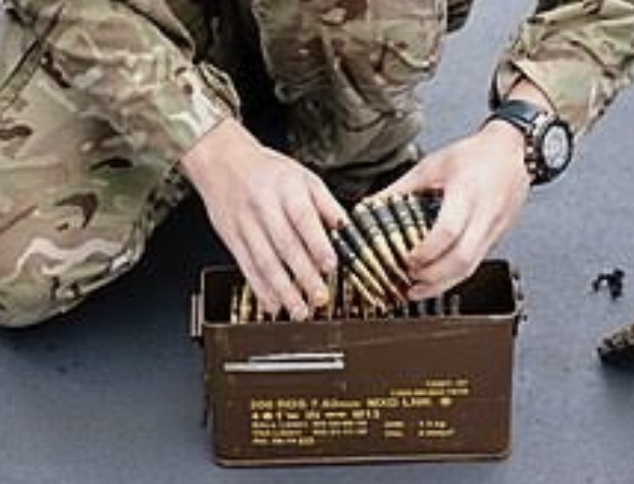
Yet the infantry soldier — the enduring centre of any army’s combat power — still relies on something far simpler. In the pouch on his chest sits the same essential tool that has defined small arms warfare for more than a century: the rifle cartridge.
What has changed, however, is the sophistication of that cartridge. In recent years a quiet but consequential transformation has taken place in infantry ammunition. Advances in materials science, ballistics and manufacturing have reinvigorated a debate that has long occupied military planners — the balance between the light, fast 5.56×45mmcartridge and the heavier, harder-hitting 7.62mm round favoured by British and many other forces for certain roles.
For decades the story of infantry ammunition has largely been framed by these two calibres.
The 5.56×45mm cartridge became the standard NATO infantry round during the Cold War. Lightweight, relatively low in recoil and capable of high-velocity flight, it allowed soldiers to carry far greater quantities of ammunition than previous generations. Rifles chambered in the calibre could be controlled easily in automatic or rapid fire, an important factor in the close engagements expected on the battlefields of Europe during the latter half of the 20th century.
By contrast, the 7.62mm NATO cartridge — heavier, more powerful and longer-ranged — represented the older tradition of full-power rifle ammunition. It delivered formidable stopping power and excellent penetration, particularly at longer distances, but at a price. The ammunition was heavier, recoil more pronounced, and soldiers could carry fewer rounds.
For a time the shift to 5.56 appeared decisive. British forces adopted the round with the introduction of the SA80 rifle family, while many NATO partners followed similar paths. The logic was straightforward: in modern infantry engagements, volume of fire and mobility were thought to outweigh sheer ballistic energy.
Yet warfare has a habit of challenging neat theories.
Operations in Afghanistan and Iraq, particularly in rugged terrain and sprawling urban environments, exposed the limitations of lighter rounds. Engagements sometimes occurred at distances that stretched the effective performance of the 5.56 cartridge. Adversaries armed with heavier calibres — often variants of the venerable AK-47 or rifles chambered in larger Soviet calibres — were able to engage from beyond the comfortable reach of many Western infantry weapons.
British forces responded in part by expanding the use of rifles chambered in 7.62mm, such as the L129A1 Sharpshooter Rifle, a designated marksman weapon designed to extend the reach of infantry sections. The rifle proved enormously popular among troops, offering greater accuracy and punch at longer ranges without the bulk of a traditional sniper system.
What followed was not a rejection of the 5.56 cartridge but a more nuanced appreciation of the strengths and weaknesses of each calibre.
The lighter round retains enormous advantages. A soldier equipped with 5.56 ammunition can carry significantly more rounds than one armed with 7.62. In prolonged engagements, that difference matters. Reduced recoil also allows for faster follow-up shots and better control during rapid fire.
But the heavier 7.62 round offers undeniable benefits of its own. Its greater mass and energy translate into improved penetration, especially against barriers or body armour. It also retains energy more effectively over longer distances, making it particularly valuable in open terrain.
Modern developments in ammunition design are now bringing the best of both worlds closer together.
Advances in propellant chemistry have increased muzzle velocities while maintaining manageable chamber pressures. Contemporary projectiles are more aerodynamically refined, with carefully engineered shapes that reduce drag and preserve energy over longer distances.
The result is that today’s 5.56 ammunition performs far better at range than its early Cold War predecessors. Meanwhile, improvements in recoil management and weapon design have made 7.62 rifles more practical for a wider range of infantry roles.
Equally important has been the emergence of new materials. Hybrid and polymer cartridge cases — once experimental curiosities — are now being produced in meaningful quantities. These lighter casings reduce the weight of ammunition loads, particularly significant for larger calibres like 7.62mm.
For soldiers carrying hundreds of rounds across difficult terrain, even small reductions in weight can have dramatic effects on endurance and mobility.
Another important frontier has been armour penetration. As body armour becomes more widespread and sophisticated across the world’s armed forces, ammunition designers have focused on hardened penetrators made from steel or tungsten alloys.
These projectiles can defeat protective plates at distances once considered beyond the reach of standard infantry rifles. In practical terms, this means that both 5.56 and 7.62 rounds can be optimised to maintain battlefield effectiveness even against well-equipped adversaries.
Accuracy has also improved markedly. Modern manufacturing techniques allow ammunition producers to maintain extremely tight tolerances. Combined with better propellants and improved bullet geometry, the result is more consistent ballistic performance.
For soldiers on the ground, that consistency translates directly into higher first-round hit probability — the most valuable metric of all.
Meanwhile, specialised ammunition continues to evolve. “Barrier-blind” rounds are designed to maintain their trajectory after passing through intermediate obstacles such as glass or vehicle panels, an important capability in urban combat. Modern tracer rounds are also far more sophisticated than their predecessors, closely matching the trajectory of standard ammunition while providing clear visual feedback during firefights.
Environmental considerations have also shaped the new generation of cartridges. Lead-free projectiles and cleaner-burning propellants are increasingly common, reducing contamination on firing ranges and improving conditions for soldiers who spend long hours training with their weapons.
These improvements reflect a broader transformation within the defence industry. Advanced computer modelling now allows engineers to simulate ballistic behaviour with remarkable accuracy before a single prototype is fired. Combined with rapid manufacturing techniques, this capability accelerates innovation in ways that would have seemed extraordinary only a decade ago.
Perhaps the most striking outcome of these developments is that the old debate between 5.56 and 7.62 is gradually evolving into something more sophisticated.
Rather than choosing one calibre to dominate the battlefield, modern infantry units increasingly employ a mixture. Standard rifles chambered in 5.56 provide lightweight firepower and mobility, while 7.62 rifles extend range and striking power within the same squad.
This balanced approach reflects the realities of contemporary warfare. Battlefields are rarely uniform. Dense urban streets, open desert plains and mountainous terrain each place different demands on infantry weapons.
By combining the advantages of both calibres — and continuously improving the ammunition that powers them — modern armies are equipping their soldiers with unprecedented flexibility.
In truth, the infantry cartridge will never capture the imagination in quite the same way as a stealth fighter or missile defence system. Yet the steady refinement of these small but essential components represents one of the most meaningful technological advances in modern military capability.
The cartridge carried by the infantry soldier may be small, but its impact on the battlefield remains enormous.
And as engineers continue to refine the balance between weight, velocity and power, the debate that began with 5.56 and 7.62 is not ending — it is entering its most innovative chapter yet.
BEDEX puts Brussels at the centre of Europe’s defence industry


