Diamonds? Certainly.
Gold bullion? Naturally.
Rare whisky? Understandable.
But 200 pallets of military field rations?
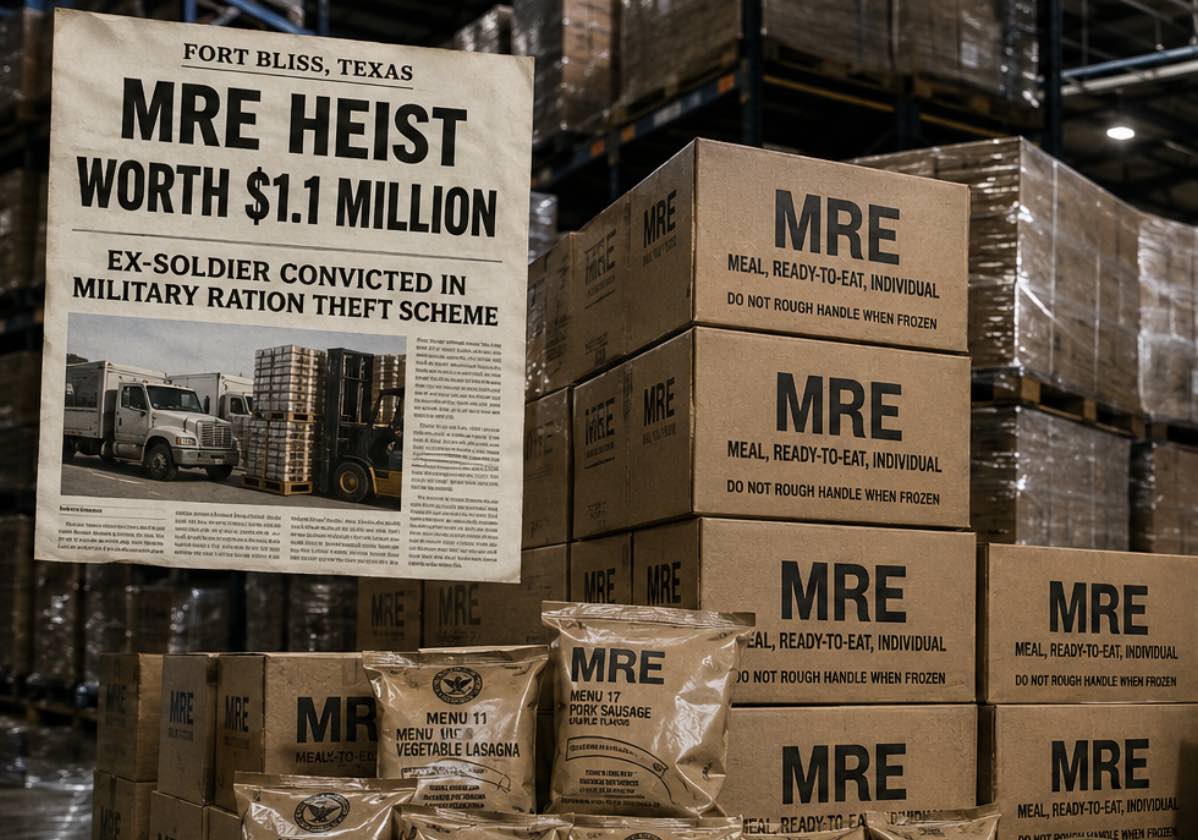
According to Stars and Stripes, Joseph Lavar Davis, 47, a former soldier-turned-contractor, masterminded the removal of more than a million dollars’ worth of MREs from Fort Bliss through fraudulent paperwork before the stock was allegedly sold online. The scheme reportedly ran for months before investigators recovered roughly half the haul from a warehouse in El Paso. It is an impressive logistical exercise if one ignores the small matter of it being entirely illegal. The real puzzle, however, is not how the meals disappeared. It is where on earth they were expected to end up.
Every criminal conspiracy eventually confronts the same question: who is the customer?
Drug cartels have addicts. Art thieves have collectors. Cybercriminals have gullible corporations. Car thieves have eager buyers in distant markets.
Who exactly is sitting at home thinking, “What this family really needs is 57,000 military dinners”?
Military surplus certainly has its devotees. Survivalists buy it. Campers buy it. Emergency planners buy it. The occasional eccentric buys a case “just in case civilisation collapses.”
But civilisation would need to collapse rather comprehensively before demand reached anything approaching 200 pallets.
One begins to picture Amazon warehouses staffed entirely by former infantry sergeants, dispatching vacuum-packed beef stew to suburban America.
There is another complication.
MREs possess perhaps the least enviable culinary reputation of any government procurement programme in existence.
For decades soldiers have invented affectionate reinterpretations of the acronym. “Meals Refusing to Exit.” “Meals Requiring Enemas.” “Meals Rejected by Everyone.”
The version most familiar to British troops—borrowed from their American counterparts—is rather less politically correct: “Meals Rejected by Ethiopians.”
It is an old military joke, certainly, but like most military humour it survives because generations of soldiers have discovered that field catering exists somewhere between nutrition and chemistry.
To be fair, modern MREs are vastly better than their predecessors. Today’s menus include beef taco filling, chicken burrito bowls, maple pork sausage and vegetarian pasta. Nutritionally, they are triumphs of engineering.
Gastronomically, they remain a triumph of optimism.
Military scientists have achieved something genuinely remarkable: food capable of surviving tropical heat, arctic cold, airborne assault and a few decades on a warehouse shelf.
Unfortunately, they have yet to persuade everyone that this represents a desirable dining experience.
Which makes the alleged business model positively fascinating.
Did the organisers envisage an underground network of MRE enthusiasts meeting in discreet locations to swap Menu 11 for Menu 18?
Was there an online community eagerly reviewing production batches?
“Excellent vintage. Notes of preserved tomato. Long finish with powdered coffee.”
Perhaps there exists an annual tasting festival that has somehow escaped public attention.
The logistics themselves deserve admiration of a purely technical variety. Removing 200 pallets from one of America’s largest military installations is hardly the work of an opportunistic thief with a borrowed van. It required paperwork, transport, warehousing and distribution. Strip away the criminal intent and what remains resembles the syllabus for a master’s degree in supply-chain management.
It also says something rather revealing about modern organised crime.
Hollywood still imagines criminals breaking into vaults.
Reality increasingly consists of spreadsheets.
The modern crook does not carry a crowbar.
He carries a barcode scanner.
The serious point, of course, is that military logistics are not a victimless playground. Supplies intended for soldiers exist for obvious reasons, and prosecutors argue that operational readiness suffered as equipment intended for training and emergencies quietly entered the commercial marketplace. That matters. An army marches on its’ stomach, and it functions because quartermasters know exactly what is available and exactly where it is.
If the inventory says 50,000 meals are available when in reality they are sitting in somebody’s rented warehouse, planning has already begun to fail.
Yet one cannot entirely suppress a smile.
Of all the commodities available for criminal enrichment, emergency field rations seem an extraordinary choice.
One imagines the moment the conspirators stood back to admire their success.
“We’ve done it.”
“We’re rich.”
“What have we actually got?”
“Approximately three million crackers, enough instant coffee to fuel a medium-sized nation, and sufficient shelf-stable chilli mac to survive the Apocalypse.”
Silence.
Even the black market has standards.
Perhaps the greatest irony is that MREs are specifically designed for situations in which people have absolutely no alternative.
The alleged thieves appear to have built an entire commercial enterprise around persuading customers to choose them voluntarily.
That may be the boldest leap of faith in the entire affair.
Military planners often speak of “mission creep”. This was surely “menu creep”—the moment someone looked at a pallet of government-issued ravioli and saw not emergency preparedness but entrepreneurial opportunity.
History is full of criminal masterminds.
It is rather shorter on culinary visionaries.
One suspects this particular enterprise belongs firmly in the latter category.