Ukraine’s Security Service has reported strikes on Russian military support vessels and air-defence equipment in occupied Kerch, opening a new phase in Kyiv’s campaign against Russian military infrastructure in Crimea.
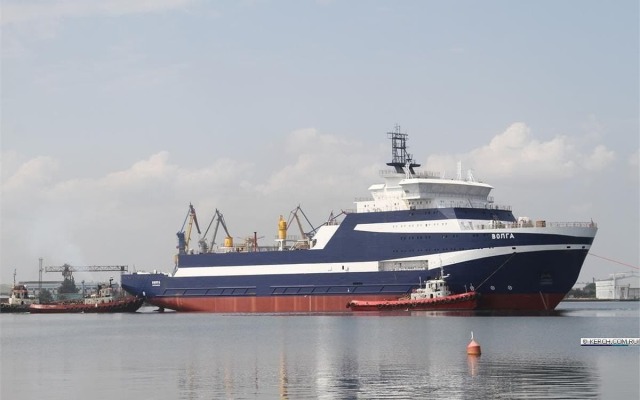
According to a statement attributed to the SBU, drones operated by the Alpha special forces unit struck two Project 15310 cable vessels, Volga and Vyatka, at the Zaliv shipyard. The same operation reportedly hit the cargo-passenger ferry Petropavlovsk, which Ukrainian sources said was 96 per cent complete, as well as components of an S-400 air-defence system protecting the Kerch Strait area.
The operation was presented in Kyiv as part of the 40-day campaign approved by President Volodymyr Zelenskyy to increase pressure on Russia. Zelenskyy has described the purpose of that campaign as forcing Russia towards peace through sustained military and security pressure. The Kerch strike, if confirmed in full, suggests that the campaign is not limited to symbolic targets, but is directed at systems that support Russia’s long-term military posture in and around Crimea.
The choice of targets is central to the operation’s importance. Volga and Vyatka are not standard combat vessels. They are specialised cable-laying ships built under Project 15310, a class designed for laying, lifting and repairing underwater fibre-optic cable lines. Open-source naval references have linked these vessels to Russia’s possible Garmoniya hydroacoustic surveillance network, a system intended to monitor underwater activity across large maritime areas.
That gives the strike a relevance beyond the Black Sea. Western governments have repeatedly warned about the vulnerability of seabed infrastructure, including data cables, energy pipelines and underwater sensors. Russian naval and intelligence vessels have been monitored near sensitive maritime routes, while European states have increased attention to the protection of undersea communications and energy links. The reported damage to Volga and Vyatka therefore intersects with a wider European security concern: Russia’s ability to map, monitor or threaten critical infrastructure below the waterline.
The SBU also said the vessels could be used to lay non-contact sea mines against ships, pipelines, cables and other critical infrastructure. That claim has not been independently verified, but it is consistent with the broader military value of specialised naval support ships. Such vessels are expensive, difficult to replace and require specific equipment and crews. Their loss or prolonged repair would be more than a local shipyard problem for Russia.
Petropavlovsk is a different type of target, but no less relevant to the Crimea campaign. A cargo-passenger ferry close to completion would have added to Russian transport capacity between the peninsula and other areas under Moscow’s control. Since the full-scale invasion, Ukraine has repeatedly targeted bridges, ferries, depots and transport nodes used to sustain Russian forces in occupied territory. Any reduction in ferry capacity increases the strain on a logistics system already dependent on vulnerable routes.
The Kerch Strait remains one of Russia’s most important transport corridors. It links Russian territory with occupied Crimea and sits beside the Crimean Bridge, which has both military and political value for Moscow. Recent satellite imagery has shown long queues near the bridge, while other visual reporting has documented Russian attempts to protect the area with smoke screens and air-defence deployments.
The reported strike on S-400 components fits that pattern. Ukraine has been trying to weaken Russia’s air-defence shield around Crimea before attacking higher-value logistics and military targets. Radar stations, launchers and command elements are essential to that shield. When they are damaged, Russia must either accept greater exposure or redeploy systems from other areas.
That redeployment is itself part of Kyiv’s calculation. Zelenskyy has previously said that Russia has been moving additional air-defence systems towards Moscow, Valdai and the Kerch Bridge, leaving other areas less protected. Ukraine’s strike campaign is therefore not only destroying individual targets. It is forcing Russia to make choices about what it can defend.
For Moscow, the Zaliv shipyard is an uncomfortable location to be hit. Kerch is close to the bridge and has been used to support Russia’s naval and transport requirements in Crimea. A successful strike there would show that even heavily defended sites near one of Russia’s most politically sensitive assets remain exposed.
There are still important caveats. Wartime claims require independent confirmation, and the full scale of damage to Volga, Vyatka, Petropavlovsk and the S-400 system will depend on further imagery and technical assessment. A fire visible after a strike does not automatically mean that a vessel is beyond repair. Nor does the loss of individual components necessarily mean the complete destruction of an air-defence battery.
Even so, the reported operation points to a consistent Ukrainian method. Kyiv is not only targeting weapons already being used against Ukraine. It is targeting the enabling architecture of Russian power in Crimea: the ships that support underwater surveillance, the ferries that move supplies, the air defences that protect logistics, and the shipyards that sustain future capacity.
If the damage is substantial, the Kerch strike will be seen as another step in Ukraine’s attempt to make Crimea harder for Russia to hold, harder to supply and harder to defend.